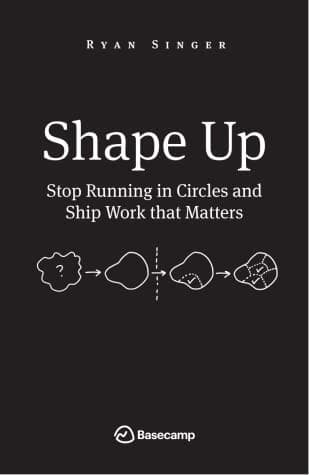
Core Idea
- Shape Up is Basecamp’s method for shipping meaningful software on a fixed rhythm by reducing uncertainty before a team starts building.
- Its central bargain is fixed time, variable scope: decide the appetite first, shape the solution to fit, then let a team build without constant interruptions.
- The method is aimed less at discovering the “perfect” product idea than at preventing stalled, sprawling work and the risk of not shipping on time.
Shaping and Betting
- Work is split into two tracks: shaping happens privately before commitment, while building happens only after a project is bet on.
- A good shaped project is rough enough to leave room for the team, solved enough that the main elements hang together, and bounded enough to make clear what is out of scope.
- Shaping happens at the right level of abstraction: too concrete locks in details too early, while too abstract leaves no usable boundaries.
- The shaping steps are set boundaries, find the elements, address risks and rabbit holes, and write the pitch.
- Appetite is the core boundary-setting tool: it is a time budget, not an estimate, usually either a small batch of 1–2 weeks or a big batch of 6 weeks.
- The book contrasts appetite with estimates: appetite starts with a number and ends with a design, while estimates start with a design and end with a number.
- Raw ideas should get a soft response—“Interesting. Maybe some day.”—rather than being turned into backlogs or immediate commitments.
- The book rejects backlogs as a large pile of stale ideas that creates guilt, review overhead, and false urgency.
- Instead of backlogs, Basecamp uses a small set of shaped pitches as possible bets.
- A pitch has five ingredients: problem, appetite, solution, rabbit holes, and no-gos.
- The pitch must join a specific problem story with a shaped solution so decision-makers can judge whether the bet is worth the appetite.
- No-gos matter because they make the scope finite by stating explicitly what the project will not do.
How Shaping Reduces Risk
- Shaping narrows from a broad request to a specific use case, as in the move from “calendar” to the need to see free spaces to schedule meetings.
- The Dot Grid Calendar example shows the intended level of detail: concrete enough to define behavior, but not so detailed that designers lose room to improve it.
- After sketching the basic elements, the shaper looks for rabbit holes such as technical unknowns, design problems, or hidden interdependencies that could wreck the schedule.
- A shaped project should have a thin-tailed risk profile: it may slip a week, but it should not have a real chance of turning into a multi-cycle disaster.
- If a rabbit hole appears, the shaper can patch it, cut scope, or declare something out of bounds rather than pushing the problem onto the team.
- In To-Do Groups, completed items became a tricky hole, so Basecamp chose a simpler compromise instead of forcing the team to solve a deep problem on the clock.
- Shaping may involve technical experts, but the real question is not whether something is possible in the abstract; it is whether it is possible within the appetite.
- The goal is not perfect prediction but enough reduction in uncertainty to make the project a reasonable bet.
Building, Scopes, and Status
- Once a project is bet on, the team gets full responsibility for the project rather than a list of pre-cut tasks.
- Teams should assign projects, not tasks, because many important tasks only appear when the code and UI are real.
- The first goal is to get one piece done by integrating one meaningful slice end-to-end early.
- The team then discovers scopes, meaning independent, finishable parts of the project, and uses those scopes as the project’s language.
- Scopes are discovered, not preplanned; they should reflect real interdependencies rather than arbitrary buckets or role-based lists.
- Useful shapes include layer cakes when UI and backend are evenly matched, icebergs when one side is much more complex, and a chowder list for loose tasks that do not yet fit anywhere.
- Inside a scope, new or evolving tasks can be marked as nice-to-haves with
~; the scope is only done when the must-haves are complete. - Progress is tracked with the Hill Chart, which separates uphill work, where unknowns are still being resolved, from downhill work, where execution is straightforward.
- The hill chart is meant to show status without nagging; if a scope stays uphill too long, it may actually contain multiple problems and should be split.
- The team should attack the scariest unknowns first and move riskier scopes uphill early, leaving routine work for later.
- The end-of-cycle rule is strict: finish within the appetite or the project does not happen by default, which acts as a circuit breaker against runaway work.
- Bugs are handled without constant interruptions: many wait until cool-down, some compete at the betting table, and rare crises can still stop the line.
- After a cycle, the slate is kept clean so the next bet reflects current priorities rather than accumulated leftovers.
Cycle Structure and Variants
- Basecamp’s standard cadence is a six-week cycle followed by a two-week cool-down.
- Six weeks is long enough to finish something meaningful and short enough that the deadline is visible from the start.
- Cool-down exists because the end of a cycle is a bad time to plan; it creates space for bugs, loose ends, and the next betting discussion.
- The betting table is a short, high-level meeting where a few shaped pitches compete for the next cycle’s time.
- The book insists on planning only one cycle ahead so new ideas and urgent problems can change direction next cycle.
- For new products, Shape Up distinguishes R&D mode, production mode, and cleanup mode: early R&D is exploratory and senior-led, production mode is more formal and scalable, and cleanup mode is a final unstructured push before launch.
- The method is scale-sensitive: tiny teams can improvise more, but as a company grows, separating shaping, betting, and building becomes more necessary.
What To Take Away
- Shape the work before you schedule it, or the team will be forced to shape under deadline pressure and hidden risk.
- Use appetite to force trade-offs and keep projects finite; do not confuse it with an estimate.
- Treat shaped pitches as the unit of decision-making, not backlogs or vague requests.
- Give teams one integrated slice, clear scopes, visible hill-chart status, and permission to cut scope without treating that as a failure.
Generated with GPT-5.4 Mini · prompt 2026-05-11-v6