Core Idea
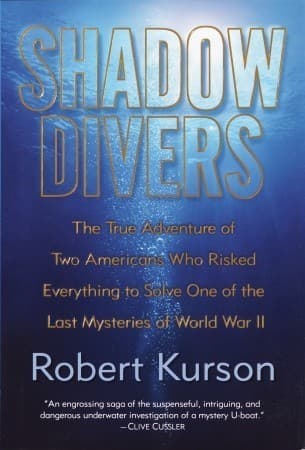
- Shadow Divers is the true story of two New Jersey wreck divers who found a World War II German U-boat off the coast of New Jersey and spent years trying to identify it, because naming the wreck was the only way to “write history” correctly.
- Kurson treats the search as both a technical investigation and a moral quest: the divers are trying to honor the dead, correct the record, and prove that written history can be wrong until tested against wreckage, archives, and eyewitness memory.
- The book’s larger stakes come from what the discovery reveals about late-war U-boat combat, the dangers of deep wreck diving, and the way obsession can become a form of loyalty to the dead.
The Dive That Starts the Mystery
- Bill Nagle, a legendary deep-wreck diver, is pulled back into exploration when a fishing captain, Skeets, gives him coordinates for an unknown deep steel wreck that looks huge, dangerous, and possibly special.
- Nagle and John Chatterton assemble a crew for a 1991 expedition to the numbers, and on the first serious descent Chatterton realizes the wreck is a German U-boat with a crew still aboard.
- The find is immediate proof that the Atlantic holds graves and secrets that official records do not fully explain; the divers decide to keep the discovery secret until they can identify the submarine.
- Rivalry, pride, and reputation matter from the start, especially because captains like Steve Bielenda might steal the find if word leaks.
What Makes Deep-Wreck Diving So Dangerous
- Kurson explains wreck diving as a battle against nitrogen narcosis, decompression sickness, zero visibility, entanglement, current, and equipment failure; many dead divers are found with air still in their tanks.
- Beyond about 66 feet, narcosis can feel like drunkenness, hallucination, panic, and bad judgment; decompression requires a slow ascent or dissolved nitrogen can form bubbles that injure or kill.
- The standard deep wreck rig is heavy and deliberate: twin tanks, dry suit, backup lights, lines, markers, tools, and decompression tables, all built around the anchor line as the diver’s lifeline.
- The book insists that good wreck diving is not bravado but discipline, navigation, self-reliance, and the refusal to panic; a buddy can be more danger than help at depth.
- The wreck interior is especially lethal because collapsed steel, wires, rods, and debris can snag a diver until fear cascades into death, as shown in accidents like Joe Drozd’s on the Andrea Doria.
- Chatterton and other elite divers succeed by planning obsessively, moving calmly, and treating the wreck as a problem to be understood rather than a prize to be taken.
Chatterton, Kohler, and the Long Identification Hunt
- Chatterton’s background as a commercial diver and Vietnam medic makes him unusually suited to the search: he is comfortable in hostile environments, thinks tactically, and refuses to quit once committed.
- Nagle’s friend and rival John Kohler brings similar intensity, and the two gradually turn the mystery into a joint inquiry driven by research, technical diving, and respect for the crewmen below.
- Their first clues come from the wreck itself: the submarine’s shape, torpedo tubes, hatches, damaged hull, and interior layout rule out some candidates and suggest a Type IX rather than a Type VII.
- The Horenburg knife becomes the crucial artifact because it gives them a crew name to trace; from then on, the question is not just “what submarine is this?” but “which crew did this boat belong to?”
- Kurson shows how the investigation depends on a mix of field evidence and archival work: National Archives files, German memorial records, U-boat databases, museum visits, wartime intelligence summaries, and letters from surviving experts.
- A major theme is that official wartime assessments were often wrong or later rewritten, so the divers repeatedly have to check records against original documents and physical evidence.
- Trimix is a turning point in the diving itself: the mixed gas reduces narcosis and gives clearer thinking at 230 feet, making deeper, more careful investigation possible.
- The book’s identification arc moves through discarded theories such as U-550, U-521, U-851, U-158, and U-857, until the evidence finally converges on U-869.
- The most important archival breakthrough comes from ULTRA decrypts showing U-869 was heading for the New York approaches, even though postwar history had placed it elsewhere.
- The wreck’s catastrophic damage fits the theory that U-869 was killed by a circle-runner—its own torpedo turning back and striking the boat—explaining the lack of an external attack record.
The Human Cost and the Meaning of the Search
- The U-boat sections reconstruct life aboard U-869 as a tight, bleak wartime world: young crewmen, severe discipline, cramped quarters, noise, heat, fear, and a growing sense that the war was turning against them.
- Kurson emphasizes that many of the men were not ideological Nazis but ordinary sailors trapped in a collapsing war machine, which makes their deaths more personal and tragic.
- The book repeatedly returns to the idea that these wrecks are mass graves, not treasure sites, and the divers’ ethics harden as they recover bones, artifacts, and names.
- Bill Nagle’s decline and death underline the cost of the obsession: the culture that made the discovery also consumes people through alcoholism, strain, and risk.
- The final identification changes the survivors’ mission from discovery to remembrance, especially for Kohler, who seeks out the families of the dead to give them the truth, artifacts, and a place for memory to attach.
- The epilogue broadens the point: once a wreck is correctly named, history becomes human again, because the dead are no longer an anonymous shadow on the seabed.
What To Take Away
- History is provisional until physical evidence, archives, and witnesses are forced to agree.
- Deep-wreck diving in the book is not adventure for its own sake; it is a test of discipline, humility, and respect for the dead.
- The mystery matters because the divers are not just identifying a submarine, but restoring identity to a crew that wartime records misplaced.
- The book’s deepest claim is that persistence can turn a rumor, a knife, and a set of numbers into a corrected piece of world history.
Generated with GPT-5.4 Mini · prompt 2026-05-11-v6