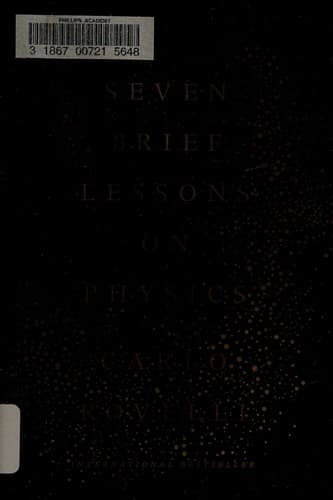
Core Idea
- Physics is a sequence of conceptual revolutions that repeatedly overturn common sense and reveal a reality that is more relational, probabilistic, and beautiful than it first appears.
- Rovelli’s central claim is that space, time, matter, and even probability are not what everyday intuition makes them seem: space is curved and dynamic, time is not fundamental in the way we experience it, matter is made of fields and quanta, and many properties only exist through interaction.
- The book pairs explanation with humility and wonder: modern physics has achieved extraordinary insight, but each success also exposes how much remains unknown.
Relativity, Quantum Theory, and the New Picture of Reality
- General relativity recasts gravity not as a force acting through empty space, but as the curvature of space-time itself in the presence of matter-energy.
- Rovelli treats Einstein’s theory as a deep simplification: it explains the bending of light, time dilation near massive bodies, black holes, the expansion of the universe, the big bang, and gravitational waves.
- The core mathematical idea is Riemannian curvature, and Einstein’s field equation is presented as the statement that space curves where matter-energy is present.
- Quantum mechanics begins with Planck’s quanta and Einstein’s photons and matures into a theory in which systems are described by probabilities of interactions rather than by definite classical trajectories.
- An electron is not a tiny particle following a fixed path; it appears in specific places only through interactions, and between interactions it is represented by an abstract quantum state rather than a classical object “in itself.”
- Rovelli emphasizes that quantum theory is not merely philosophically puzzling: it is astonishingly successful, underpinning chemistry, transistors, and much of modern technology.
- Its strangeness lies in its refusal to describe a world of independently well-defined properties; it describes how systems affect one another.
Cosmos, Particles, and the Incomplete Standard Model
- The book’s cosmological arc moves from Earth-centered skies to Copernicus, then to Earth as one planet among many, the Milky Way as one galaxy among billions, and finally to an expanding universe born from a hot dense beginning.
- Modern particle physics reduces the material world to a small cast of entities: electrons, quarks, photons, gluons, neutrinos, and the Higgs boson.
- These are not miniature solid objects but quanta of fields, and even apparently empty space is not truly empty because it contains fluctuations.
- The Standard Model is extraordinarily accurate but not fully satisfying, because it looks like a patchwork of many fields, symmetries, constants, and interactions whose values are not explained by the theory itself.
- Rovelli notes that key techniques such as renormalization work beautifully but can feel mathematically baroque, and even physicists like Paul Dirac remained dissatisfied with the theory’s completeness.
- The Standard Model is also incomplete empirically: dark matter is inferred from gravity but has no identified Standard Model explanation.
- Elegant extensions such as SU(5) or supersymmetry have been proposed, but they have not yet been confirmed by experiment.
Quantum Gravity, Time, and the Emergence of the Arrow of Time
- Rovelli argues that general relativity and quantum mechanics cannot both be right in their present forms, because one assumes a smooth continuous space-time while the other makes the world discrete and probabilistic.
- Quantum gravity is the attempt to reconcile them, and the book presents loop quantum gravity as one major approach.
- In loop quantum gravity, space is granular, composed of tiny “atoms of space” connected in networks, so space is not a container but a structure built from relations.
- A striking consequence is that fundamental time drops out of the basic equations; change still exists, but there is no universal external clock ordering all events.
- Rovelli extends this picture to black holes and cosmology: a collapsing star may become a Planck star and rebound, and the big bang may be a big bounce from a previous contracting universe.
- The sixth lesson links heat, probability, and time by showing that thermodynamics explains why heat flows from hot to cold as a statistical tendency, not as an absolute mechanical law.
- In thermodynamics, probability reflects our limited access to microscopic details, and the apparent arrow of time emerges from that asymmetry rather than from a fundamental cosmic direction.
- The familiar sense of a flowing present is therefore not basic to physics; it is tied to the coarse-grained way beings like us interact with the world.
- Hawking’s black hole radiation matters because it brings together quantum mechanics, gravity, and thermodynamics in one phenomenon, making black holes a crucial testing ground for deeper theory.
What To Take Away
- Space, time, and matter are not fundamental in the everyday sense; modern physics describes a world of curvature, relations, quanta, and probabilities.
- Relativity and quantum mechanics are both immense successes, yet incomplete together, which is why quantum gravity remains the deepest open problem.
- The arrow of time may be an emergent statistical fact rather than an irreducible law of nature.
- Human beings are part of the same physical world we study: our experience of self, now, and continuity arises within nature, not outside it.
Generated with GPT-5.4 Mini · prompt 2026-05-11-v6