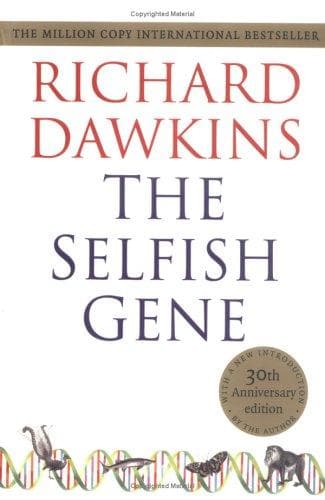
Core Idea
- Dawkins’s central claim is that natural selection is best understood from the gene’s-eye view: organisms are survival machines built by selfish genes, and the apparent “purpose” of bodies and behavior is explained by which genes get copied.
- This is not a moral theory but an explanatory one; Dawkins repeatedly warns against confusing is with ought, while also rejecting the old “good of the species” view as a misleading explanation of altruism.
- His goal is to replace organism- or group-centered intuition with a more exact picture of evolution in which genes are the longest-lived, most stable units of selection.
The Gene as the Unit of Selection
- Dawkins starts from replicators: stable entities that make copies of themselves, vary through copying errors, and compete for limited resources; life begins when a molecule in the primeval soup acquired this property.
- Natural selection is the differential survival of replicators with greater longevity, fecundity, and copying fidelity.
- Modern DNA is the descendant of those early replicators, and all organisms are temporary vehicles that genes build to preserve and spread copies of themselves.
- His definition of gene is deliberately practical and elastic: not an indivisible particle, but any chromosomal segment that can persist long enough, in copies, to act as a unit of selection.
- Sexual reproduction makes this view especially powerful because bodies are temporary mixtures, while gene copies persist across generations by shuffling through meiosis and crossing-over.
- Dawkins uses this to explain why genes are “immortal” only as copies, why bodies are transient, and why the real competition is among alleles occupying the same slot in future chromosomes.
- He also uses this framework to reinterpret ageing and sex: late-acting harmful genes can accumulate because selection removes them less efficiently, and sex preserves gene “liquidity” even though it appears wasteful at the level of the individual.
Behavior, Conflict, and Cooperation
- Once bodies are treated as gene-built machines, behavior becomes a field of design and conflict: genes shape brains to promote survival, but they cannot micromanage each choice in a changing world.
- Dawkins explains apparently purposive behavior through feedback, programming, learning, and simulation rather than consciousness or foresight.
- Communication is often cooperation in appearance but competition in function: signals can be useful, but they are also vulnerable to deception, from false alarm calls to mimicry, angler fish lures, and orchid deception.
- Aggression is modeled with game theory, especially Maynard Smith’s evolutionarily stable strategy (ESS): a strategy that cannot be invaded once common.
- The classic hawk-dove model shows why pure aggression or pure pacifism is unstable; the stable outcome is often a mixed equilibrium.
- Many animal fights are therefore ritualized and constrained, producing the “gloved fist” character of real combat rather than endless lethal violence.
- Territoriality, dominance, and many forms of restraint are treated as ESS outcomes rather than group-serving adaptations.
- Dawkins extends this logic to kin altruism: a gene can “want” help to flow toward relatives because relatives share copies of the same gene.
- Hamilton’s rule and relatedness calculations explain why aiding siblings, parents, cousins, or offspring can be favored when the genetic payoff outweighs the cost.
- Recognition of kin is approximate, so animals use cues like resemblance or group membership, which can misfire into adoption, prejudice-like errors, or exploitation by brood parasites.
- Parent-offspring conflict follows from the fact that parents and children value the same resources differently; weaning, begging, and sibling rivalry are all arenas of bargaining and manipulation.
- Dawkins treats brood parasitism, cuckoos, and related cases as extreme forms of this conflict, where the parasite exploits parental rules more than kinship obligations.
- Social insects provide a dramatic case of apparent altruism, but Dawkins explains worker sterility and colony organization through inclusive fitness, haplodiploidy, and conflicts over sex ratio rather than species-level self-sacrifice.
Sex, Reciprocal Altruism, Memes, and the Body Beyond the Body
- Sexual selection and mating are interpreted as strategic conflict: males are generally pushed toward promiscuity because sperm are cheap, while females are typically choosier because eggs and parental investment are costly.
- This yields two broad female strategies: domestic bliss, where males are induced to invest, and he-man choice, where females favor evidence of quality or “good genes.”
- Dawkins is skeptical of simple moralized stories about romance or pair bonds; instead he models courtship as mutual mistrust, deception, and counter-deception shaped by investment asymmetries.
- He uses the same logic to discuss sex ratios: Fisher’s argument predicts the familiar 1:1 ratio because genes for deviation are eventually selected against.
- Reciprocal altruism is explored through the Prisoner’s Dilemma and Tit for Tat: cooperation can evolve when interactions are repeated, cheating can be punished, and future contact matters.
- Axelrod’s tournaments show that nice, forgiving strategies can outperform more aggressive ones, but only when the “shadow of the future” is long enough and the population structure allows cooperation to cluster.
- This leads to Dawkins’s larger distinction between replicators and vehicles: genes are the replicators, while bodies are vehicles; the same logic also explains extended phenotype effects such as beaver dams, bird nests, and parasite-manipulated behavior.
- A gene’s phenotype can extend beyond the skin if its effects on the world are heritable consequences of its replication; this is why Dawkins says genes can influence artifacts, host behavior, and other organisms.
- The book ends by widening the replicator idea to culture with memes: tunes, ideas, catchphrases, religions, and fashions replicate by imitation, compete for attention, and can persist or mutate independently of gene fitness.
- Memes may conflict with genes, as in celibacy or ideological commitment, and Dawkins suggests humans are unusual in being able to reflect on both gene and meme interests rather than simply obey them.
What To Take Away
- The book’s most distinctive move is to treat evolution as competition among genes as replicators, with organisms as temporary tools rather than ultimate units.
- Many behaviors that look altruistic, moral, or group-serving are reinterpreted as strategies that promote the spread of the underlying genes.
- Game theory, kin selection, reciprocal altruism, and extended phenotype are the key explanatory tools that make the gene-centered framework work across aggression, sex, cooperation, and parasitism.
- Dawkins’s closing implication is not that humans should be selfish, but that we can understand our impulses clearly enough to choose, deliberately, when to support altruism against the pull of selfish replicators.
Generated with GPT-5.4 Mini · prompt 2026-05-11-v6