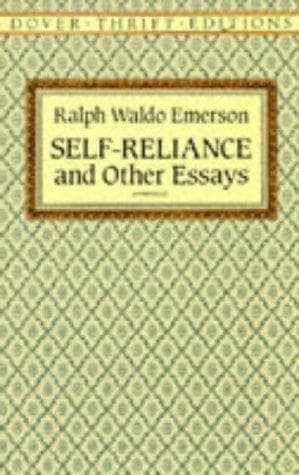
Core Idea
- Emerson’s central claim is that mind is universal: history, nature, art, and religion all express one common soul that each person can access directly.
- He therefore opposes passive dependence on authority, tradition, and surface facts, and repeatedly argues for self-reliance, inward perception, and spiritual independence.
- The essays move from this metaphysical premise to a social ethic: nonconformity, compensation, friendship, prudence, heroism, the Over-Soul, intellect, circles, and art are all different ways the same inward law appears in life.
History, Self-Reliance, and Compensation
- In “History,” Emerson says there is no mere external history: events are intelligible only when read as expressions of the same mind that lives in the reader.
- He insists that thought precedes fact, so the past should be approached through biography, identification, and sympathy, not detached chronology.
- Great public events mirror private ones, and every era is partly a stage each person passes through, as with his account of the Greek age as a phase of bodily vigor, simplicity, and unconscious greatness.
- Myths, monuments, and fables are not dead absurdities but compressed moral truths: Prometheus, Orpheus, the Sphinx, cathedrals, and ancient ruins all encode recurring laws of soul and nature.
- In “Self-Reliance,” Emerson’s keynote is that one must trust one’s own thought, speak it plainly, and refuse conformity even when society punishes independence.
- He treats “a foolish consistency” as a trap for little minds; character is an internal law, not a record of past opinions.
- The self is not static but always becoming, and the wise person lives in the present rather than dragging the “corpse of memory.”
- In “Compensation,” Emerson sets out a law of polarity and balance: every force has its counterforce, and excess, defect, reward, and penalty are secretly paired.
- Wrongdoing carries its own penalty, while virtue is not a bargain but an increase of being; calamity can also become remedial, breaking old forms so growth can enter.
Love, Friendship, Prudence, and Heroism
- In “Love,” Emerson treats passion as a force that expands from private attraction into sympathy with nature, imagination, society, and ultimately God.
- Love lifts the beloved beyond anatomy or utility: the lover sees radiance, summer evenings, rainbow, birdsong, and a beauty that “suggests more than satisfies.”
- He follows a Platonic ascent in which bodily beauty recalls the soul to higher beauty, and true love matures from possession into universal affinity.
- Marriage is described as a long process in which two people gradually become a real union of intellect and heart, though Emerson distrusts purely sensual or commercial domesticity.
- Friendship is sacred but difficult: it requires one-to-one intimacy, truth, tenderness, and mutual independence, not flattery or domestic absorption.
- A true friend should be a “nettle” rather than an echo; friendship needs difference as well as likeness, and should remain reverent, poetic, and unpossessive.
- In “Prudence,” Emerson defines prudence as the virtue of the senses: a practical wisdom about appearances, timing, climate, household facts, and bodily conditions.
- Yet prudence is only lower wisdom unless joined to truth, courage, humility, and frankness; the good man and the wise man should not be divided.
- He repeatedly warns against mistaking mere comfort for wisdom, and insists that higher trust may require risking conventional safety.
- In “Heroism,” the heroic soul acts from self-trust under danger, indifferent to ridicule, poverty, or public disapproval.
- Heroism includes truth-speaking, generosity, hospitality, temperance, and persistence; it is less a doctrine than a readiness to do what one fears.
- Emerson’s heroes are often misunderstood at first, because great action outruns prudent opinion before it is later recognized as just.
The Over-Soul, Circles, and Intellect
- In “The Over-Soul,” Emerson names a Unity in which all persons are contained and through which inspiration, thought, and moral force arrive.
- The soul is not a private possession but the source of our best acts; we are pensioners, not self-made causes.
- From the standpoint of the soul, time and space lose their absolute force, and youth or age becomes a spiritual state rather than merely a calendar fact.
- True revelation is inward and immediate; Jesus is presented as a master of speaking from within, not by external proof or prediction.
- Emerson stresses that the soul communicates through awe, insight, and character, and that society itself becomes a kind of moral test in which people reveal themselves.
- In “Circles,” he uses the circle as the emblem of life: every form, thought, and institution is provisional, and each horizon can be surpassed by a larger one.
- There are no fixtures in nature; old structures are displaced by new arts, inventions, and ideas, from roads and sails to rail and electricity.
- Because thought governs character, a person changes only when a new commanding idea arrives; reform is therefore spiritual before it is mechanical.
- Emerson values valor as the power to stand where one is placed and accept supersession without collapse.
- In “Intellect,” he distinguishes raw intellect from will, method, or usefulness: intellect is a dissolving and unifying force that sees the fact itself, not its social value.
- Thought is largely spontaneous; reflection is useful only when it clears away obstruction so the mind can receive what is already there.
- Genius is constructive intellect—the power to turn inward vision into sentences, designs, poems, and systems.
- Emerson repeatedly says great thinkers are translators of what already lies in us; their function is to publish inner truth in a form others can recognize.
- In “Art,” he argues that art should not imitate surface facts but create a new whole that embodies spirit, character, and the Genius of the Hour.
- Historical art matters because each age stamps its truth into form, but the best art is still simple, domestic, and living, not merely dazzling or technical.
- Fine and useful arts should ultimately converge: the highest art is a way of making life itself more beautiful, practical, and morally radiant.
What To Take Away
- Emerson’s essays are united by the belief that the deepest truth is inward, universal, and immediately available to a receptive mind.
- His major oppositions are consistent: self vs. conformity, spirit vs. surface fact, living insight vs. dead tradition, and growth vs. settled form.
- He treats love, friendship, heroism, intellect, and art as different expressions of one spiritual law: the soul enlarges itself by recognizing its own power in the world.
- The book’s enduring challenge is not to admire Emerson’s abstractions, but to see how relentlessly he makes every domain of life answer to inward law.
Generated with GPT-5.4 Mini · prompt 2026-05-11-v6