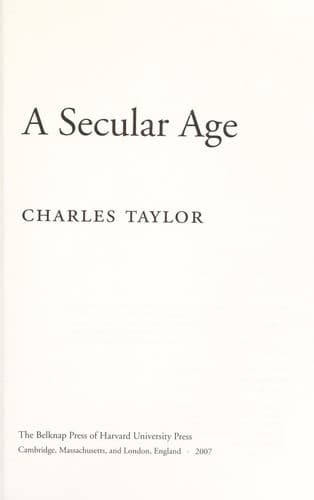
Core Idea
- Taylor’s central claim is that modern secularity is not just less religion, but a new condition of belief in which faith is one option among many, under a background that makes unbelief plausible and often default.
- He rejects a simple subtraction story: modernity did not merely remove illusion, but produced new practices, social imaginaries, and moral forms that made both exclusive humanism and modern unbelief livable.
- The book tracks how the West moved from an enchanted, porous, cosmos-shaped world to a buffered self living in an immanent frame, where transcendence remains possible but no longer socially obvious.
From Enchanted Cosmos to Immanent Frame
- In 1500, belief was embedded in a world of higher times, sacred society, and an enchanted cosmos where spirits, relics, rites, and cosmic order seemed immediately real.
- The earlier porous self was vulnerable to spiritual forces and collective sacred power; modernity creates a buffered self with a hard inner boundary, distance from spirits, and stronger self-control.
- Taylor argues that disenchantment matters, but not because science simply disproved religion; rather, science, discipline, and new social habits together made a free-standing nature and a law-governed universe thinkable.
- Modern time becomes homogeneous and empty, replacing liturgical and origin-filled “higher times” with measured secular time, while the world shifts from cosmos to universe.
- This transformation also changes the social order: sacred bonds once grounded common life, but modernity makes society seem constructible by human agency in secular time.
- The Great Disembedding names the long process by which older complementarities disappear—between renunciation and ordinary life, Carnival and order, sacred and temporal power, and communal religion and individual belief.
Reform, Civility, and the Modern Moral Order
- Taylor treats late medieval and Reformation Reform as a major engine of modernity: a drive to narrow gaps between religious elites and ordinary life, delegitimate lower practices, and remake society to match Christian demands.
- Reform intensified inward devotion, Christocentric piety, fear of sin and death, Purgatory, and individualized judgment, while also attacking “white magic” and sacramental uses of holy objects.
- The same reforming impulse fed civility and state-building: discipline, manners, education, labor, and suppression of Carnival helped create a rationalized order and a police state logic.
- Out of this emerged the modern moral order of mutual benefit: society is imagined as horizontal, made by individuals for peace, prosperity, and reciprocity rather than by a sacred hierarchy.
- Taylor links this to exclusive humanism, where human flourishing becomes the highest goal and God, if retained, is reduced to a providential designer of a law-governed order.
- Deism is a half-way house here: it preserves God as architect of nature and mutual benefit while stripping away intervention, grace, mystery, and transformation, thereby easing the route to atheism.
- The modern order is stabilized by the public sphere, a secular meta-topical space of discussion and judgment, and by democratic ideas of the sovereign people, especially in the American and French revolutions.
Cross-Pressures, Crises, and New Spiritual Paths
- Taylor’s recurring theme is cross-pressure: modern people are pulled between closed, materialist or humanist readings and persistent intuitions of fullness, transcendence, and meaning.
- He identifies three modern malaise forms within immanence: fragility of meaning, flatness in rituals of passage, and emptiness in everyday life.
- Against this, modernity also produces a nova of positions: Romanticism, Kantian moral autonomy, aestheticism, tragic pessimism, neo-Nietzschean heroism, and religious revivals all answer the same background crisis differently.
- The nineteenth century brings deeper unbelief because it is rooted in the lifeworld itself, not just explicit arguments; the shift from cosmos to universe, deep time, and evolutionary history makes older frameworks harder to inhabit.
- Yet Taylor insists the modern story is not one of simple loss: Burnet, Vico, Schiller, and absolute music show how ruins, the sublime, beauty, and expressive art open new ways of sensing depth without fixed ontology.
- He also reads modern history through new religious itineraries: Péguy emphasizes memory, fidelity, mystique versus politique, and gathered time; Hopkins uses poetic language, inscape, and sacramental particularity to resist excarnation.
- These “itineraries” show that modern faith need not simply restore old Christendom; it can become newly personal, embodied, and ecumenical, while still rejecting the flattening tendencies of reform, moralism, and pure instrumental reason.
What To Take Away
- Secularity is best understood as a historical transformation in the conditions of belief, not as a clean victory of reason over religion.
- Modern unbelief depends on new background imaginaries: buffered selfhood, immanent order, secular time, horizontal society, and the moral authority of mutual benefit.
- Taylor’s deepest claim is that modern life remains haunted by fullness: even within the immanent frame, people keep searching for transcendence, meaning, beauty, and reconciliation.
- The book explains why modernity can produce both disenchantment and renewed spiritual creativity, often in the same person, culture, or historical moment.
Generated with GPT-5.4 Mini · prompt 2026-05-11-v6