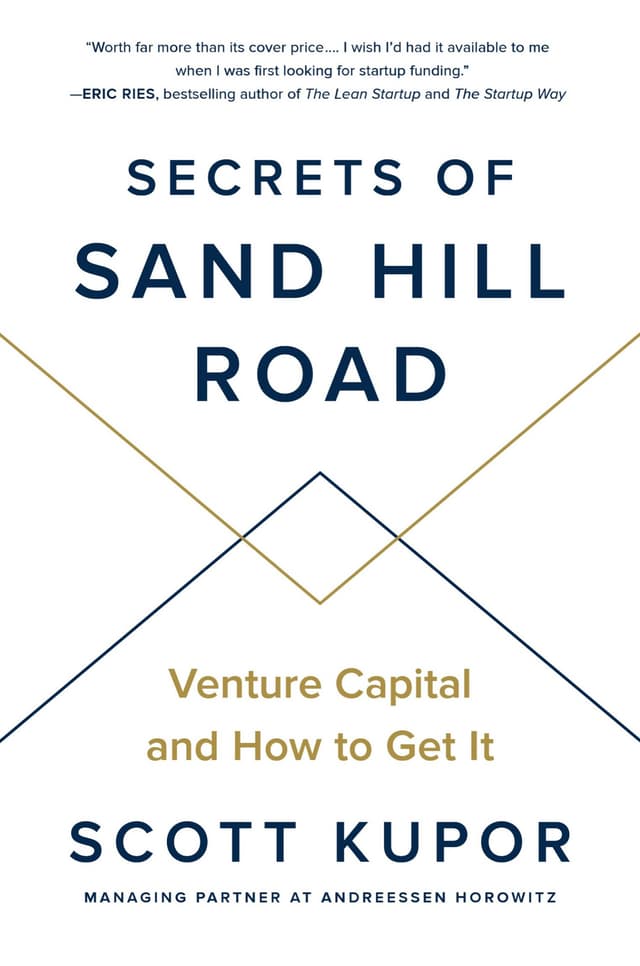
Core Idea
- The book’s purpose is to demystify venture capital so founders can understand VC incentives, ask better questions, and enter the relationship with clearer eyes.
- Kupor’s central warning is: know your partner before you get married; VC is a long-term partnership shaped by economics, governance, and fund-level incentives.
- The core tension is that VCs provide capital and support, but entrepreneurs build the company and must live with the terms long after the money is wired.
How Venture Capital Works
- VC is equity financing for risky, illiquid, long-duration companies that are poor fits for bank lending; unlike debt, equity does not need repayment and is meant for uncertain upside.
- The asset class is tiny and highly skewed: returns follow a power law, not a normal distribution, so a few huge winners matter far more than batting average.
- A fund can have many losers and still be excellent if it produces enough 10x–100x home runs; the canonical example is Facebook, whose early investment became roughly a 1,000x outcome.
- VC is effectively zero-sum at the deal level because each startup usually takes only a small number of early investors, and the first financing round is often the one-time chance to invest.
- The industry’s persistence comes from signaling and access: top firms keep winning because good returns attract better entrepreneurs and talent in the next cycle.
- The book uses the dot-com bust, LoudCloud, and Opsware to show how startups are buffeted by capital markets; when capital dries up, “it’s not about the money. It’s about the F-ing money.”
- VC’s real influence is outsized relative to its size because venture-backed firms account for a disproportionate share of IPOs, market cap, employment, and R&D.
- LPs fund VC firms to seek alpha over public markets, and the major LPs are endowments, foundations, pensions, family offices, sovereign wealth funds, and similar institutions with long horizons.
What VCs Look For and How Fund Terms Shape Behavior
- Early-stage VC judgment relies heavily on heuristics around people, product, and market because there is little hard data.
- Founder-market fit matters: VCs ask why this team should win, not just whether the idea sounds good.
- The author contrasts product-first companies, which begin with a real problem, with company-first companies, which begin with a desire to start a company and then search for an idea.
- VCs also look for unusually durable leadership: founders must recruit, sell, raise the next round, and persist through setbacks with what Marc Andreessen and Ben Horowitz once described as borderline egomaniacal self-belief.
- Product evaluation is about an idea maze rather than a polished mockup; good founders hold strong opinions, but weakly enough to pivot when evidence demands it.
- New products usually need to be 10x better or cheaper than the status quo, and Ben Horowitz’s “aspirin versus vitamin” distinction captures the preference for painful problems over nice-to-haves.
- Market size is the biggest gating factor: the opportunity must plausibly support a large, profitable, high-growth business over 7–10 years.
- The book repeatedly stresses that the worst mistake is being right about the company but wrong about the market; even a great team can stall in a small market.
- LPs care about fund timing because VC funds are usually 10-year vehicles with pressure to return cash through exits, and later-vintage funds may be pushed harder to realize value.
- The LPA governs the fund’s economics and controls: management fees, carry, key-man provisions, investment scope, and no-fault divorce rights all shape what the GP will do.
- The standard 2% fee / 20% carry model is only the starting point; the real story is how fees, recycling, clawbacks, preferred returns, and vesting align or misalign incentives.
- Because VC returns are so back-ended, the J-curve is normal: early cash flows are negative, and weak companies tend to reveal themselves early, deepening the valley.
- The author’s recurring point for founders is that fund-level incentives matter: a GP under pressure to raise the next fund or avoid clawback may push for an exit sooner than the founder prefers.
The Startup Structure and the Term Sheet
- Most startups should form as C corporations, not pass-through entities, because they want to reinvest profits, issue multiple classes of stock, and avoid tax problems for tax-exempt LPs.
- Founders should treat cofounder arrangements like a prenup: use vesting, removal rules, and transfer restrictions before conflict appears.
- The standard pattern is four-year vesting with a one-year cliff, though the book notes that private-company timelines now often exceed the old IPO assumptions behind that norm.
- IP should be cleaned up early with invention assignment and a clean-room mindset; later downloads from a prior employer can become serious claims, as in the Uber/Waymo/Levandowski dispute.
- Employee equity is usually an option pool, commonly around 15% at the outset, with separate mechanics for ISOs and NQOs and the tax tradeoffs that follow.
- The book emphasizes that term sheets are not just about headline valuation; founders must understand economics and governance together.
- Key economic terms include the option pool, liquidation preference, participating preferred, conversion rights, antidilution protection, and occasionally preferred returns or hurdles.
- A crucial technical point is that post-money valuation usually includes both convertible notes and the option pool, so founders cannot assume those dilutions are “free.”
- Governance terms include board seats, protective provisions, pro rata rights, registration rights, ROFR/co-sale, drag-along, and no-shop provisions.
- The book repeatedly warns that what looks like a simple fundraising instrument can quietly shift a lot of control or dilution through follow-on rounds, note caps, conversion mechanics, and board composition.
Boards, Control, and Exit Events
- Once funded, the board becomes a real operating force: it should hire and fire the CEO, approve major actions, and provide strategic counsel without running the company.
- Private-company boards are more complex than public boards because multiple preferred series may have separate votes and because VC directors are dual fiduciaries: they owe duties to the company while also representing fund economics.
- The law matters: duty of care, loyalty, confidentiality, and candor are central, while the Business Judgment Rule protects well-informed, good-faith decisions.
- If directors are conflicted, courts can apply entire fairness scrutiny, and the book’s key example is Trados, where preference stacks and a management incentive plan made the board’s process suspect even though common ultimately had little residual value.
- The book treats recapitalizations and down rounds as reset events: companies may need to reduce preferences, rebuild option pools, or use a management incentive plan (MIP), but these tools can create sharp conflicts.
- Acquisitions are the dominant exit path for VC-backed companies, so founders should build relationships with likely acquirers early and understand deal terms beyond price, including escrow, stock consideration, and employee-option treatment.
- IPOs have become less about access to capital and more about liquidity, credibility, and M&A currency; the JOBS Act and emerging-growth-company rules lowered the friction, but public-market timing still matters.
What To Take Away
- VC is best understood as a system of incentives, fund structures, and power-sharing, not just money.
- Founders should judge term sheets and boards by their future consequences, especially around dilution, control, and exit pressure.
- The right VC relationship is one where both sides understand the other’s constraints and can still work toward the same long-term outcome.
- The book’s bottom line is that capital is commoditized, but judgment, networks, coaching, and governance are not.
Generated with GPT-5.4 Mini · prompt 2026-05-11-v6