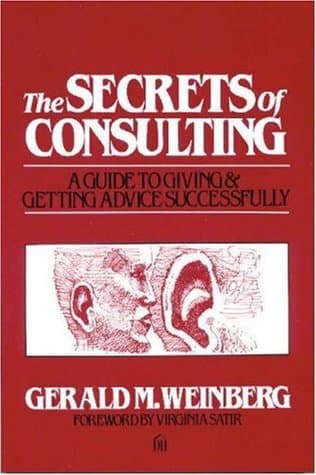
Core Idea
- Consulting is “the art of influencing people at their request”; unsolicited help, authority, and selling are not consulting.
- Weinberg treats consulting as a paradoxical human activity: clients ask for help inside irrational systems, so the consultant must be rational about irrationality and work with people, not just problems.
- The book’s central claim is that effective consulting usually means changing how clients see, feel, and act just enough to unstick a system, not delivering a perfect solution.
How Consulting Really Works
- Sherbie’s Laws frame the job: there is always a problem, it is always a people problem, and clients pay by the hour rather than by the solution.
- The Ten Percent Promise warns against overpromising; modest improvement is more believable than transformation.
- Marvin’s Law says advise something different from what the client is already doing, because people close to a problem tend to repeat failed patterns.
- The Credit Rule says nothing gets done if you care who gets the credit; often clients want an alibi more than a fix.
- The Fourth Law of Consulting says if they did not hire you, do not solve their problem; outside intervention without request usually backfires.
- The Law of Raspberry Jam says influence thins as it spreads wider, so consultants cannot expect force to scale.
- The Law of Twins says most of the time nothing significant happens; consultants are hired to work in the rare moments when change is possible.
- The Hard Law, Harder Law, and Hardest Law insist that failure, unfinished problems, and one’s own mess are normal parts of consulting.
- Weinberg repeatedly warns: do not be rational; be reasonable—meaning attend to tradeoffs, timing, and human limits rather than optimizing abstractly.
- Optimitis is the disease of asking for the best, fastest, cheapest, or minimum-cost result without naming what must be sacrificed.
Seeing, Triggering, and Unsticking Systems
- A consultant often acts as a jiggler: an outside disturbance that gets a stuck system moving without directly “fixing” it.
- The point is often prevention and self-correction, not just solving the current complaint; the best jiggler helps the system learn to jiggle itself.
- The book’s recurring lesson is less is more: small changes in perception, timing, or organization can matter more than big interventions.
- The elephant fable shows that specialists misread partial evidence by label, while a broad problem-solver can find the right lever.
- Consultants should look for what is missing: missing tools, missing people, missing procedures, missing requests for help, and missing history often reveal the real problem.
- The Five-Minute Rule says clients often state the solution early if you listen well.
- The Rule of Three says if you cannot think of three things that might go wrong, your thinking is already blocked.
- The Why Whammy helps uncover hidden assumptions, but the Label Law warns that people buy labels instead of merchandise, so naming is never enough.
- Misdirection and the Three-Finger Rule show how emotionally charged labels can hide responsibility; consultants should watch where the pointing finger actually points.
- Brown’s Brilliant Bequest is to listen to the music, especially your own internal signals, because intuition can warn of missing elements before language does.
- A recurring theme is that consultants must adjust perception through experience, not explanation alone: tours, mixed meetings, anonymity methods, and carefully designed questions can open eyes.
- Weinberg’s hippopotamus trick and hidden-agenda exercises show how altering attention or revealing intention can expose the gap between what people say and what they are doing.
Change, Resistance, Trust, and the Consultant’s Own Behavior
- Change should be handled with humility and risk control: expect failure, reduce newness one piece at a time, and use backups.
- Pandora’s Pox names the human tendency to believe hopeful new things will work; Weinberg argues that hope often masks repeated mistakes.
- Small preserved differences can accumulate into large change, so “no difference + no difference + no difference” eventually becomes a real difference.
- The book insists that truth is usually kinder than illusion; trying to protect clients from change by preserving a fantasy only makes the eventual break worse.
- Resistance is not an obstacle to resent but useful feedback about the consultant’s ideas, timing, and contracts.
- Weinberg treats his own behavior as a diagnostic tool: repetition, defensive tone, or odd wording can reveal resistance before the client admits it.
- The consultant should not push harder against resistance; instead, name the process, test tradeoffs, and let the client’s own priorities surface.
- Trust is central: deeds matter more than explanations, trust is won slowly and lost quickly, and written contracts support but cannot replace it.
- Honesty is nonnegotiable; the consultant should not distort facts for a client, even when asked, because that creates cheating and weakens the organization.
- A good consultant must also manage their own dependence: the marketing laws warn against becoming captive to any one client, and Lynne’s Law of Life says you must be able to say no in order to say yes to yourself.
- Marketing works best through satisfied clients, referrals, exposure, and generosity of ideas, not hoarding or hard selling.
- Pricing is not just money but a relationship signal; the fee screens for mutual respect, carries psychological costs, and should be set with the principle of least regret.
- Weinberg often uses contingency-style arrangements and even money-back guarantees to make feedback real and to keep both sides honest.
- The consultant’s self is the main instrument, so journaling, lifelong learning, and attention to one’s own blind spots are part of the job.
What To Take Away
- Consulting is less about delivering answers than about changing stuck human systems without forcing them.
- The best consultants are not heroic fixers; they are neutral, observant jiggers who know how to trigger useful change and stay out of the way.
- Success depends on perception, timing, trust, and self-knowledge as much as technical skill.
- The book’s deepest warning is that consultants can become part of the problem unless they constantly test their assumptions, resist overhelping, and keep learning.
Generated with GPT-5.4 Mini · prompt 2026-05-11-v6