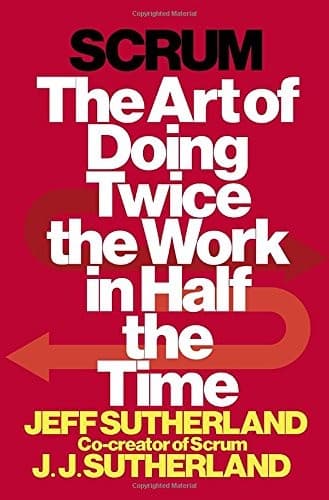
Core Idea
- Scrum delivers 2x output in half the time by breaking work into 1-4 week Sprints with daily feedback loops and ruthless prioritization.
- Small, cross-functional teams (7±2 people) eliminate communication waste and silos; every additional member adds exponential overhead.
- Transparency + continuous improvement (kaizen) beats heroic effort; happiness and sustainable pace drive measurable performance gains.
The Scrum Cycle (What to Do Weekly)
- Daily Stand-up (15 min): What did you do? What's next? What blocks you? Remove obstacles immediately.
- Sprint Review: Demo completed work to stakeholders; capture real feedback, not assumptions.
- Sprint Retrospective: Identify ONE small improvement to implement next Sprint; relentlessly iterate on process.
- Stop mid-Sprint regardless of progress; assess and adjust rather than power through bad direction.
Estimation & Planning
- Use relative sizing (Fibonacci: 1,2,3,5,8,13), not hours—humans estimate absolute time poorly.
- Planning Poker: Anonymous card-based estimation prevents groupthink and halo effects.
- Prioritize by business value, not effort; 80% of value comes from 20% of features.
- Get MVP to market fast for real feedback; reorder Backlog each Sprint based on OODA loop (Observe→Orient→Decide→Act).
Team & Culture
- Remove titles; measure team output, not individual performance.
- Cross-functional teams (all skills needed end-to-end) outperform siloed specialists by orders of magnitude.
- Work sustainable hours (<40/week peak productivity); overwork causes errors and decision fatigue.
- Measure happiness (1-5 scale) end-of-Sprint—morale drops signal problems before velocity does.
- Purpose + Autonomy + Mastery = intrinsic motivation; remove obstacles, not people.
Waste Elimination
- Multitasking destroys productivity (75% waste juggling 5 projects); single-task instead.
- Fix bugs in 24 hours, not weeks—vastly cheaper to fix immediately.
- Measure velocity (points per Sprint) to forecast delivery and identify bottlenecks.
Enterprise Scale
- Start with one reference team before rolling out enterprise-wide.
- Executive Metascrum: Weekly cross-functional Product Owner group to align priorities and resolve conflicts.
- Stable, dedicated teams—don't shuffle rosters between projects; route new work via centralized Backlog.
- Everything into the Backlog; no hidden "business as usual" work—all requests prioritized centrally or they don't happen.
- Expect 9-16 months for organizational mindset shift; reinforce messaging repeatedly.
- Shift project→product mindset: Replace temporary problem-solving teams with permanent value-delivery teams.
Action Plan
- Pick a Product Owner with real decision authority; create prioritized Backlog with clear value metrics.
- Form small cross-functional team (7±2); define Scrum Master as coach, not manager.
- Run 2-week Sprints: Daily Stand-up, transparent board (To Do/Doing/Done), weekly Demo, Retrospective.
- Measure velocity and happiness end-of-Sprint; iterate on process based on one kaizen per cycle.
- Scale thoughtfully: Prove the model with one team first; establish Executive Metascrum before enterprise rollout.
Generated with Claude Sonnet 4.6 · prompt legacy-pre-v6 · model inferred from repository history