Core Idea
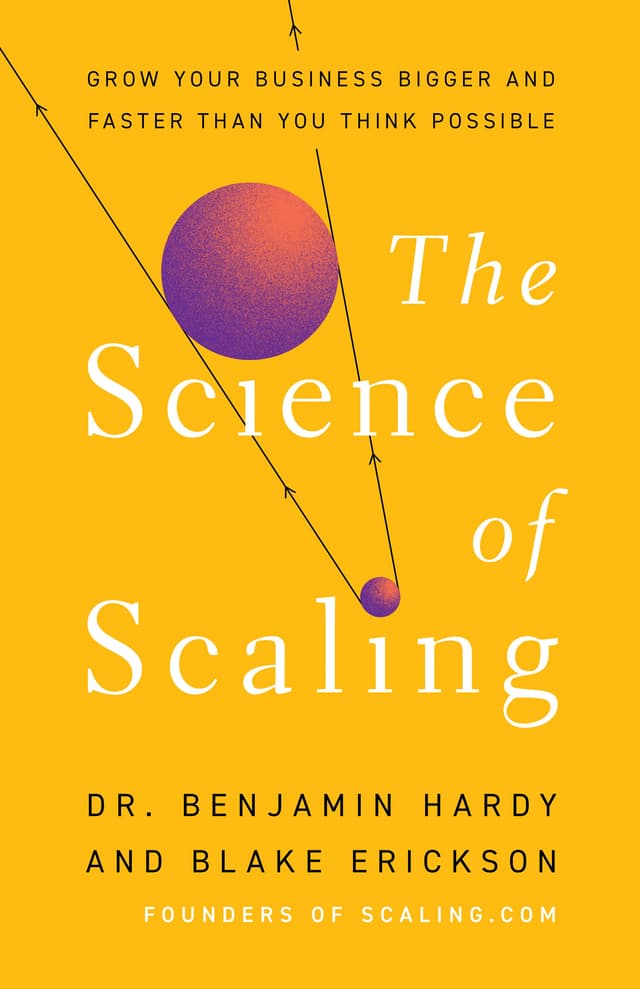
- The book’s central claim is that scaling starts with an impossible goal and an impossible deadline, because those two forces filter what matters and expose the most direct path to growth.
- Hardy argues that ordinary, attainable goals keep businesses complex, diluted, and self-deceiving, while impossible goals force honesty about what should be cut, ignored, or replaced.
- The recurring frame is the Scaling Framework: Frame what you see, Floor what you refuse to do, and Focus on the paths and people that can actually reach the goal.
How Impossible Goals Change the System
- Goals are treated not as wishes but as psychological and strategic tools that shape perception, attention, decisions, and systems.
- The book argues that all human action is goal-driven, and that goals drive selective attention and pathways thinking, so changing the goal changes what you can even notice.
- Kennedy’s moon speech is the signature example: the point was not generic ambition, but a single, bold objective—put a man on the moon and return him safely before the end of the decade.
- Hardy’s reinterpretation is that Kennedy’s power came from choosing one impossible destination, not multiple plausible routes.
- He defines impossible goals using stretch-goal research: a goal whose probability of attainment is unknown or seems impossible given current capabilities.
- The author repeatedly warns that multiple competing goals create a complex system that cannot scale, because attention and resources get split across conflicting priorities.
- Donella Meadows is used to reinforce that a system’s purpose/goal directs behavior, so vague or wrong goals produce the wrong results.
- Tony Robbins’ foreword frames the same idea as growth through unreasonable goals, urgent timelines, and emotionally compelling reasons why.
The Three Levers: Frame, Floor, Focus
- Frame is the future you are aiming at; it determines what looks relevant and what looks like noise.
- Floor is the standard of what you will no longer do; raising it means saying no to lower-value offers, habits, clients, and behaviors.
- Focus is the small set of paths, partners, and actions that can plausibly reach the impossible goal.
- The book insists that attainable goals are too weak as filters, so the business keeps optimizing things that should not exist.
- Elon Musk’s line—“The most common mistake of a smart engineer is to optimize a thing that should not exist”—is used as a recurring warning.
- April Graves’ photography business shows the logic of simplification: raising her commission goal to $15,000 forced her to stop offering dozens of lower-end options and led to a same-day commission.
- Jeckyll & Hyde Advertising changed by deciding to “only do one thing,” cutting lower-floor services and refocusing on a $100 million revenue frame.
- Alicia Ault’s original goal of 100 clients in 90 days would have made her busier; shifting to 1,000 credit repair companies in 90 days opened a partnership path reaching 8,000+ companies through software integration.
- The book’s repeated point is that an impossible goal often reveals a far better route than brute-force execution.
Deadlines, Simplification, and Raising the Floor
- Chapter 2 treats time as a tool, not a passive container: the future is something you use to direct the present.
- Shorter deadlines force the organization to identify the crux—the core constraint that must be solved—or the climb fails.
- Richard Bryan’s BHAG shrinking from 11 years to 3, then 1, revealed that his investment portfolio had fallen below the floor and should be sold so he could focus on coaching and writing.
- Parkinson’s law is used to argue that work expands to fill available time, so long timelines justify bad choices and delay hard decisions.
- Xavier Martine’s law firm improved quickly after shifting from a 10-year goal to 3 years, exposing weak staffing, missed calls, and unprofitable case types.
- The book uses NASA as a cautionary example of a successful but overly linear and bureaucratic process that was safe but not maximally direct.
- Chapter 3 argues that raising the floor is about honesty, accountability, and maturity, not perfection.
- Zion Williamson illustrates the difference between ceiling and floor: enormous talent means little if consistency, conditioning, and trustworthiness stay low.
- Culture is defined as the agreed-upon level of transparency and accountability in the system.
- Kim Crawford Goodman’s turnaround of Smarsh shows floor-raising in action: she cut staff, closed offices, removed vendors, enforced expectations, and scaled from under $40M** to over **$300M.
- Tom Wood’s Floor Coverings International example shows that real floor standards sometimes require firing underperformers; once enforced, average franchisee revenue rose from $700K** to **$2M+ and the company outgrew the industry.
- Prouduct’s move to a $25,000 minimum client floor cut small work and shifted the business toward much larger projects, dramatically increasing revenue per client.
Simplify to Scale: Offer, People, and Path
- Chapter 4’s main argument is that scaling requires simplifying the system, not merely optimizing many things at once.
- Steve Jobs’ return to Apple is the classic model: he cut the product line from about 350 products to around 10 connected products.
- Rich Hickey’s “elephant” metaphor explains how past complexity becomes the burden future work must drag around.
- Hardy applies this to his own work by dropping YouTube, coaching, keynotes, and consulting because they were dead-end paths relative to writing better books.
- Chad Willardson simplified his wealth-management business by exiting the lower-AUM segment and focusing on top family-office clients.
- Lewis Howes reduced many revenue streams to focus on the podcast, which then grew from 30 million to 500 million downloads.
- Stephanie’s family business case shows that simplification may require cannibalizing the legacy product line if the services side is the real scalable path.
- The book also argues for Super Whos—top-of-market people who create leverage, slack, and higher standards, but only work in a world-class culture.
- Blake Murray’s Divvy and Ryan Riley’s CellCore are major examples of pathfinding through simplification: Murray found a real-time financial visibility problem and built a business-model innovation around it, while Riley turned a confusing supplement catalog into “The Protocol.”
- Divvy’s free-software, credit-card-revenue model and CellCore’s simplified system both scaled because they made the offer legible, focused, and easy to buy.
What To Take Away
- Impossible goals are useful because they sharpen perception, reveal better pathways, and expose weak commitments.
- Shorter deadlines are not merely stressful; they compress attention and force you to find the crux and remove false requirements.
- Raise the floor by making accountability real, because undefined businesses and low standards cannot scale.
- Simplify to scale: the strongest strategy in the book is choosing what not to do, then aligning frame, floor, and focus around one demanding future.
Generated with GPT-5.4 Mini · prompt 2026-05-11-v6