Core Idea
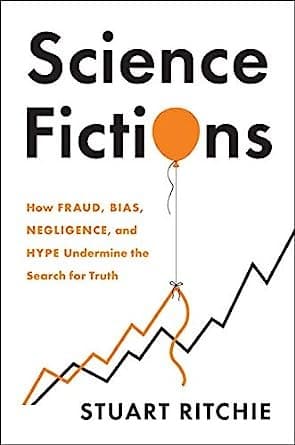
- Science Fictions argues that modern science is undermined by four recurring distortions: fraud, bias, negligence, and perverse incentives/hype.
- The book’s central worry is not that science is useless, but that its social systems—peer review, publication, prestige, and metrics—often reward findings that are dramatic, positive, and clean rather than true.
- Ritchie treats replication, transparency, and careful scrutiny as the main defenses, but shows that these safeguards are often weak, delayed, or bypassed.
How Science Goes Wrong
- The book begins with the Bem and Stapel scandals to show the difference between a non-replicable claim and outright fraud, and to stress that dramatic findings should not be accepted without replication.
- Science is described as a social process governed by the Mertonian norms of universalism, disinterestedness, communality, and organised scepticism, yet human ambition and status-seeking constantly strain those ideals.
- The standard publication pipeline—idea, funding, experiment, analysis, paper, peer review, revision, publication—creates many points where distortion can enter.
- The crisis is broad, not disciplinary: psychology is the clearest case, but economics, neuroscience, biology, chemistry, and medicine all show similar problems.
- Ritchie distinguishes replicability from reproducibility: sometimes another lab cannot get the effect at all, and sometimes the same data cannot reproduce the published result because analysis details were missing or undisclosed.
- Landmark examples such as power posing, classic priming studies, and the Stanford Prison Experiment show how celebrated findings can collapse under closer testing or reveal heavy stage-management.
- Large replication projects in psychology found disturbingly low success rates, and even successful replications often showed that the original effects were exaggerated.
- In medicine, the consequences are especially serious: preclinical findings often fail to translate, important interventions are later reversed, and missing protocols or methodological details make verification impossible.
Bias, Negligence, and the Statistics of Distortion
- Bias is treated as a systematic push away from truth, often unconscious, and often rooted in the desire for clear, exciting, or theory-confirming results.
- The chapter on bias uses Samuel Morton as a classic case of “the tyranny of prior preference,” where expectations may have shaped skull measurements without conscious fraud.
- A major mechanism of bias is publication bias or the file-drawer problem: positive results are much more likely to be written up and published than null results.
- Relatedly, the book emphasizes p-hacking, HARKing (“hypothesising after the results are known”), and outcome switching, all of which can manufacture apparent significance from noisy data.
- The familiar p < 0.05 threshold is presented as a convention, not a law of nature, and the book stresses how multiple testing and analytic flexibility make false positives easy to produce.
- The “garden of forking paths” captures how even one dataset contains many hidden choices, so an apparently single analysis can overfit noise if the path is chosen after seeing the results.
- Examples such as Brian Wansink’s pizza papers, Dana Carney’s repudiation of power posing, and survey evidence from psychologists, economists, and biostatisticians show how common these practices are.
- Bias can also be collective, as in contentious fields such as Alzheimer’s amyloid research, where sincere belief in a theory may still suppress dissent.
- Ritchie also notes that bias is not only political; sex bias in animal research and other default assumptions show how “neutral” science can still be systematically skewed.
- Negligence covers avoidable errors from poor training, inattention, weak design, or carelessness, and the book argues that these are far more common than readers may assume.
- Simple mistakes can have large consequences, as in the Reinhart and Rogoff Excel error, while tools like Statcheck and GRIM reveal how often published numbers are internally inconsistent.
- Data audits by John Carlisle and image-sleuthing work by Elisabeth Bik show that published literature often contains suspicious patterns, impossible means, duplicated images, or implausibly regular data.
- The book stresses that underpowered studies are a major negligence problem: tiny samples encourage exaggerated positives and weak conclusions, especially in animal research and candidate-gene genetics.
- The candidate-gene collapse is an important example of what happens when dramatic claims from small studies are replaced by large, better-powered analyses.
Fraud, Incentives, and Why Bad Science Persists
- Fraud is presented as deliberate fabrication, falsification, or deception, and the book emphasizes that it is not rare enough to dismiss as aberrant.
- Cases such as Paolo Macchiarini, Woo-Suk Hwang, Haruko Obokata, Jan Hendrik Schön, Michael LaCour, and Andrew Wakefield show how fraud can hide inside elite institutions, prestigious journals, and public hero narratives.
- Several fraud cases caused direct harm: patients died or were endangered, coauthors were tarnished, and in extreme cases, the fallout contributed to tragedy and suicide.
- Retractions do not cleanly remove fraud from the record, because retracted papers continue to be cited, often positively and without readers noticing the retraction.
- Ritchie argues that misconduct is encouraged by a system built on publish-or-perish, journal prestige, impact factors, citations, and grant competition.
- He shows how these incentives produce salami-slicing, predatory journals, fake peer review, coercive citation, and self-citation games that inflate apparent productivity.
- The broader warning is that science may select for people who are good at maximizing outputs under distorted metrics, not necessarily those most committed to truth.
- The book’s recurring theme is that bad science is often not produced by a few villains alone, but by institutions that reward novelty, positivity, speed, and quantity over rigor.
What To Take Away
- Replication, transparency, and full methodological detail are not optional extras; they are the main checks against false discovery.
- A positive, clean, or famous result should be treated cautiously if it has not survived independent scrutiny.
- Statistics and peer review are useful but limited, because they can be gamed by unconscious bias, sloppy analysis, or deliberate deception.
- The deepest problem is structural: to improve science, the reward system must value truthfulness, openness, and reproducibility more than prestige, publication count, or headline appeal.
Generated with GPT-5.4 Mini · prompt 2026-05-11-v6