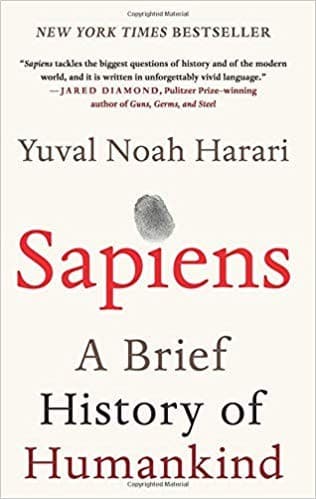
Core Idea
- Sapiens argues that human history is driven less by biology than by shared stories, institutions, and technologies that let large numbers of strangers cooperate.
- Harari’s broad arc runs from the Cognitive Revolution to the Agricultural Revolution, then to the rise of money, empires, religion, science, and finally the possibility of humans redesigning themselves.
- His recurring claim is unsettling: what increases collective power often worsens individual life, and the species that became dominant may now be preparing to outgrow itself.
From Animal to Storytelling Species
- For most of their existence, humans were ordinary animals with limited ecological impact, living among several other human species such as Neanderthals and Denisovans.
- The Cognitive Revolution gave Homo sapiens a decisive advantage not because it improved factual communication, but because language could transmit fiction: gods, nations, laws, corporations, and other imagined realities.
- These shared fictions created flexible cooperation on a scale impossible for other species; Harari contrasts this with the rigid cooperation of ants and bees.
- He treats institutions like Peugeot SA as “real” only because people collectively believe in them, and calls this shared world of law, money, and states a dual reality of objective facts plus imagined orders.
- Biological evolution remained slow, but cultural evolution became fast, allowing new social forms without genetic change.
- Before farming, foragers likely lived in many different ways; Harari rejects the idea of one timeless “natural” human society.
- He also argues that foragers were often better off than early farmers, with more varied diets, less disease, and more leisure, though he refuses to romanticize them.
Agriculture, Inequality, and the Rise of Imagined Orders
- The Agricultural Revolution was, in Harari’s words, history’s biggest fraud: it increased total food and population, but usually made life worse for the average person.
- Farming “domesticated” humans as much as plants and animals; wheat is his emblematic example of a crop that spread by recruiting human labor for its own reproduction.
- Agriculture brought heavier work, monotony, disease, and greater dependence on a few staples, while settled life tied people to small plots, houses, and storage.
- Because farmers produced surpluses, a minority could live as rulers, soldiers, priests, and artists, while history remained mostly the story of peasant labor.
- Large settled societies needed not just food but coordination, so they relied on imagined orders: myths that defined kingship, class, law, and obligation.
- Harari uses the Code of Hammurabi to show how legal systems naturalize hierarchy, and the Declaration of Independence to show how modern political ideals are also built from inter-subjective beliefs.
- These orders are fragile and require constant reinforcement by armies, courts, schools, rituals, and propaganda; bayonets alone cannot sustain them.
- Writing emerged mainly to handle empire-scale administration, beginning with Sumerian accounting and later partial scripts such as the quipu.
- He argues that gender hierarchy is nearly universal in known societies, but no convincing biological explanation has been found; culture, not nature, does most of the work.
- His summary rule is “Biology enables, Culture forbids”: biology opens possibilities, while culture decides which ones become socially permitted.
The Three Great Unifiers: Money, Empires, Religion
- Harari treats money, empires, and religion as the three major forces that unified humankind across local divisions.
- Money is the most universal system of trust because it is an inter-subjective reality accepted by people precisely because others accept it.
- Its power comes from convertibility: money can turn land, labor, violence, sex, and even salvation into comparable value, but it also corrodes “priceless” things like loyalty and honor.
- Empires are political structures that absorb many peoples under one order; Harari emphasizes that they are historically normal, long-lived, and often culturally hybrid rather than purely tyrannical anomalies.
- Empires spread languages, laws, roads, and institutions, but they also relied on conquest, enslavement, deportation, and sometimes genocide.
- Religion is defined as a system of norms and values founded on belief in a superhuman order.
- Harari traces a progression from animism and local spirits to polytheism, then monotheism, dualism, and later natural-law religions such as Buddhism and Stoicism.
- He argues that polytheism was often tolerant because it allowed many partial powers, while monotheism was more universal and more prone to missionary zeal and persecution.
- Buddhism stands out for focusing on suffering and craving rather than divine command; modern ideologies such as liberalism, communism, nationalism, and Nazism are treated as secular religions grounded in human or evolutionary myths.
Modernity, Science, Capitalism, and the Future
- The modern world emerges from the alliance of science, capitalism, and empire: explorers, investors, and states all expanded together.
- Science advanced by admitting ignorance and seeking new knowledge; imperial power supplied the money, ships, and administration to turn knowledge into control.
- Capitalism depends on belief in the future: credit works because people trust that tomorrow will be better and that growth can repay debt.
- Harari emphasizes reinvestment as capitalism’s key logic; profit becomes capital only when it is used to expand production.
- Joint-stock companies and limited liability made large-scale risk-taking possible, helping finance empire and global trade.
- The Industrial Revolution transformed energy, transport, and production, but also intensified exploitation, consumerism, and the pace of life.
- He links modern prosperity to the creation of a consumer culture that must keep people wanting more in order to keep growth going.
- Despite major gains in material power, Harari argues that modernity has not obviously made humans happier, and it has massively increased suffering for nonhuman animals.
- In the final arc, biotechnology, cyborg engineering, and inorganic life may allow humans to redesign themselves beyond natural selection.
- Genetic engineering, brain-computer interfaces, and digital minds could produce beings no longer recognizable as Homo sapiens.
- Harari’s deepest warning is that the next historical question is no longer only what humans can do, but what they should want to become.
What To Take Away
- Human dominance rests on the unique ability to create and believe in shared fictions that coordinate millions of strangers.
- Agriculture, empire, religion, and capitalism all expanded collective power, but each also created new forms of hierarchy, dependence, and suffering.
- The modern age is not the end of this process: science and technology may soon let humans redesign their bodies, minds, and desires.
- Harari’s final question is moral as much as historical: if we can become something greater than human, what kind of being should we choose to become?
Generated with GPT-5.4 Mini · prompt 2026-05-11-v6