Core Idea
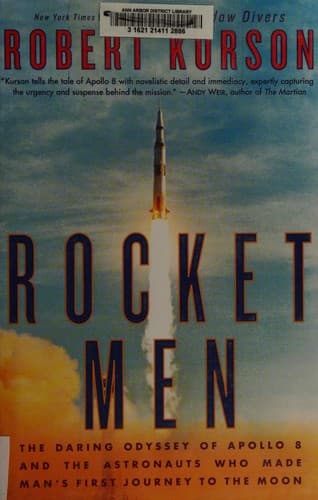
- Rocket Men tells the story of Apollo 8 as a reckless, compressed gamble that became America’s first journey to the Moon and a decisive emotional turning point in 1968.
- The mission’s stakes were not just technical but civilizational: NASA was trying to beat the Soviets, honor Kennedy’s deadline, and give a shattered nation something to believe in.
- Kurson frames Apollo 8 as a triumph of calculated audacity, where a series of near-impossible decisions, intense preparation, and disciplined crew work turned a near-catastrophe into historic success.
How Apollo 8 Became Possible
- Apollo 8 began as a routine Earth-orbit mission, then became a lunar-orbit mission after George Low and Chris Kraft realized NASA could skip the troubled lunar module and still make the Moon before 1968 ended.
- The plan was frighteningly thin: the Saturn V had flown only a few times, Apollo 1 had just exposed deadly design flaws, and if the service propulsion system failed near the Moon, the crew had no lunar-module “lifeboat.”
- Deke Slayton and Frank Borman drove the decision forward, while Wernher von Braun concluded the rocket could be “pushed” to the Moon if NASA was willing to try.
- NASA’s key safety logic was the free-return trajectory, which meant lunar gravity could sling Apollo 8 home even if major systems failed.
- The final mission design was a tightly packed six-day loop with about ten lunar orbits, TV broadcasts, navigation sightings, photography, and a high-risk return through a razor-thin reentry corridor.
- Apollo 7 mattered enormously because its technical success cleared the last major prerequisite, even though the crew itself was abrasive and uncooperative.
- Soviet Zond 5 and Zond 6 made the Moon race feel urgent, since from outside it looked as if the USSR might reach lunar flight first, even though their missions hid dangerous failures.
- Public opposition was real, with some arguing NASA should do things “right” rather than first, but Apollo 8 moved ahead anyway.
- The mission was launched under intense secrecy, compressed training, and constant fear that any unresolved “showstopper” could doom the crew.
The Three Men and the Human Cost
- Frank Borman is the mission’s hard-edged commander: disciplined, blunt, anti-bullshit, and deeply shaped by duty, West Point, Apollo 1, and his belief that America was worth defending.
- Jim Lovell is the warm, exploratory optimist, a natural aviator whose steadiness under pressure had already been proven in Gemini and who saw Apollo 8 as the adventure of a lifetime.
- Bill Anders is the brilliant technician and natural flier, shaped by a Navy family, wartime memory, engineering training, and a desire to be where the action is.
- The book makes much of how each man fit the mission: Borman’s command, Lovell’s calm adaptability, and Anders’s precision and systems thinking.
- Their earlier flight together on Gemini 7 mattered because it proved they could endure confinement, fatigue, and long-duration spaceflight as a team.
- Anders’s backstory, especially the Panay attack and his father’s wartime heroism, helps explain his lifelong mix of realism, patriotism, and emotional reserve.
- Borman’s family burden is central, especially Susan’s fear that he was “leaving the world,” while Lovell and Anders also carry families who understand the danger but cannot control it.
- Training at NASA is shown as almost brutal in its realism, with the SimSup job being to “kill” astronauts in simulation so they can survive the real thing.
What Apollo 8 Revealed
- The launch itself is portrayed as violent and overwhelming, far beyond simulation, and Apollo 8 becomes the first crewed flight of the Saturn V.
- A major early crisis comes when Borman becomes violently ill, raising fears of radiation, virus, or some unknown effect of spaceflight; NASA ultimately treats it as a sickness episode and keeps the mission going.
- Apollo 8’s live broadcasts become part technical demonstration and part cultural event, even when the first Earth view is awkwardly transmitted.
- The crew’s second broadcast and later lunar-orbit views make the Moon feel barren, gray, and ancient, while Earth appears fragile, small, and almost shockingly alive.
- Earthrise is the book’s most iconic moment: Anders’s photograph turns Earth into a blue-and-white marble over a black horizon and becomes one of the most influential images ever made.
- Kurson treats Earthrise as more than a beautiful photo; it becomes a symbol of planetary unity, environmental consciousness, and human smallness.
- The Christmas Eve reading from Genesis is presented as the mission’s emotional climax, with the crew’s final line to “the good Earth” moving listeners around the world.
- The return leg is no less dangerous than the outward journey, with TEI and reentry presented as life-or-death burns that could strand the crew forever if they failed.
- The final splashdown and recovery close the mission with relief rather than triumph alone, because the crew has simply made it home from an almost unimaginable place.
What To Take Away
- Apollo 8 succeeded because NASA chose speed, risk, and ingenuity over caution, and then executed with extraordinary discipline.
- The mission’s importance was not only that America got to the Moon first, but that it proved humans could travel into deep space and come back alive.
- Earthrise and the Genesis broadcast gave the mission a cultural meaning far larger than engineering, reshaping how many people saw Earth, space, and each other.
- Kurson closes by showing that the Apollo 8 astronauts’ later lives remained marked by the mission, but that the deepest victory may have been personal: the people they loved were the real home they returned to.
Generated with GPT-5.4 Mini · prompt 2026-05-11-v6