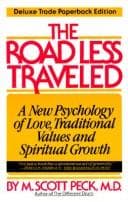
Core Idea
- Peck’s central claim is that mental growth and spiritual growth are the same process, and both require disciplined willingness to face pain, reality, and responsibility.
- His book treats love, maturity, and grace as hard-won forms of growth, not feelings or comforts, and argues that avoidance of suffering is the main source of psychological illness.
- The “road less traveled” is the lifelong path of self-discipline, truth, and renunciation, which is also the path toward greater consciousness and, ultimately, God.
Discipline, Suffering, and Reality
- Peck begins from the blunt premise that life is difficult, and says accepting that fact reduces suffering by ending futile resistance.
- He defines discipline through four techniques: delaying gratification, accepting responsibility, dedication to truth, and balancing.
- Delaying gratification means scheduling pain before pleasure; he ties failure here to impulsiveness, truancy, addiction, and later life breakdowns.
- Peck argues that children can learn self-discipline only when parents model self-restraint, spend real time with them, and are willing to suffer with them rather than merely punish them.
- He stresses that love matters more than punishment: orderly homes can still produce damaged children if they are loveless, while imperfect homes can produce disciplined children if they are genuinely loved.
- Accepting responsibility means owning one’s choices instead of blaming spouses, children, schools, society, or “the system”; neurosis over-assumes responsibility, while character disorder under-assumes it.
- Dedication to truth requires revising one’s “maps” of reality; clinging to outdated assumptions produces misery, and psychotherapy is valuable because it invites challenge and scrutiny.
- Peck’s notion of transference extends beyond therapy: childhood maps can be unconsciously imposed on marriages, organizations, and even whole nations.
- Balancing is the discipline of flexibility, especially in deciding when to speak, when to withhold, when to act, and when to give up something smaller for something greater.
- He uses anger, chess with his daughter, and a schizophrenic woman’s boundary training to show that judgment, not impulse, must govern expression.
- Growth always involves giving up old selves, fantasies, and identities; depression can be healthy when it accompanies necessary renunciation.
- He treats bracketing as a temporary self-suspension that lets new truth enter, and says the pain of growth is the pain of the death of the old self.
- Peck repeatedly insists there are no shortcuts: discipline is not a quick route to sainthood, but the ordinary basis of spiritual evolution.
Love, Dependency, and Misconceptions
- Peck defines love as “the will to extend one’s self for the purpose of nurturing one’s own or another’s spiritual growth.”
- Love is therefore teleological: its purpose is growth, not comfort, merger, or gratification.
- “Falling in love” is not real love in his account; it is a temporary collapse of ego boundaries that feels ecstatic but is instinctual and brief.
- The myth of the “meant-for-you” soulmate is, for Peck, a dangerous lie that confuses chemistry with commitment and causes people to misread marriages.
- Mature love begins when the ecstasy fades and one continues to act lovingly by choice; he says spouses often need psychological distance before mature marriage can form.
- Real love grows by cathexis: investing the beloved into the self over time, which can create a stable “plateau experience” of union unlike the fleeting peak of infatuation or orgasm.
- Peck warns that mystical language about oneness can become a justification for regression if used to evade adult responsibility.
- His second major falsehood is dependency-as-love: needing another person for survival is parasitism, not love, because it removes freedom and choice.
- Passive dependent personality is marked by emptiness, fear of loneliness, weak identity, shallow attachments, and an inability to function without others’ active care.
- He links dependency to childhood inconsistency and lack of love, and says such people often cannot delay gratification, tell the truth, or leave destructive relationships.
- Peck connects dependency with addiction by arguing that people are often “addicted to people” first, and drugs become substitutes for human attachment.
- He broadens the concept further to cathexis without love: money, power, golf, or pets may be loved in a loose sense, but are not love unless they serve spiritual growth.
- By his strict definition, one can truly love only human beings, because only humans possess a spirit capable of substantial growth.
- Love is not mere giving; it includes judicious giving and withholding—praise, criticism, leadership, and confrontation all require judgment.
- Peck’s “self-sacrifice” discussion argues that much apparent sacrifice secretly serves the giver’s identity, self-image, or need for control.
- He also stresses that love is not a feeling: one can feel loving and behave badly, or act lovingly toward someone one does not feel affection for.
Grace, Evil, and Spiritual Evolution
- In the later chapters Peck turns to religion, arguing that science and faith are often both distorted by dogmatism, and that mature inquiry must remain open to paradox.
- He treats grace as a force outside ordinary consciousness that nurtures life, appears in dreams and synchronicities, and helps people heal or grow.
- Serendipity, synchronicity, and dreams are framed as ordinary but meaningful channels through which grace becomes visible.
- He reads the unconscious as allied with truth and growth, not simply pathology; slips, dreams, and symbolic images can disclose what consciousness resists.
- Peck uses evolution as a model: life pushes upward against entropy, and spiritual growth does the same through consciousness, discipline, and love.
- He proposes that God is the source and destination of this process, and that humans are being called toward godhood in the sense of greater consciousness and responsibility.
- The main obstacle to growth is laziness, which Peck treats as the practical form of entropy and, in extreme form, the root of evil.
- He reinterprets original sin as laziness: the refusal to do the work of self-criticism, debate, and honest effort.
- Evil is not just weakness but active resistance to growth, including the use of power or coercion to avoid spiritual extension.
- Mental illness, in his account, is a disturbance of consciousness that often improves only when symptoms force the person to see reality and assume responsibility.
- Therapy succeeds not merely through technique but through the patient’s will to grow, which Peck treats as essentially the same as love.
- He closes by emphasizing that grace is both given and welcomed: people must discipline themselves to become receptive, but grace itself cannot be mechanically earned.
What To Take Away
- Peck’s book is a sustained argument that truth, discipline, and love are inseparable from psychological health and spiritual maturity.
- He repeatedly rejects easy substitutes for love: infatuation, dependency, self-sacrifice, and projection all fail because they do not foster growth.
- The deepest moral danger in the book is avoidance—of pain, responsibility, and reality—because it blocks both healing and grace.
- His vision is demanding but unified: to grow up fully is to become more truthful, more responsible, more loving, and more open to God.
Generated with GPT-5.4 Mini · prompt 2026-05-11-v6