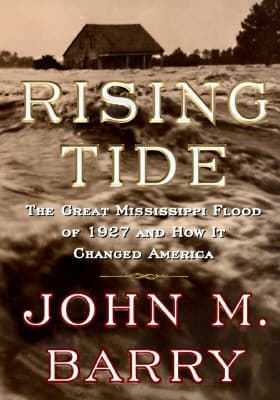
Core Idea
- Rising Tide uses the 1927 Mississippi Flood to show how engineering, race, class, and political power became inseparable in modern America.
- Barry’s central claim is that the flood was not just a natural disaster: it exposed the consequences of a century of levee-only river control, and it reshaped national ideas about government responsibility, relief, and black citizenship.
- The book follows two linked stories: the long struggle to control the Mississippi River, and the human catastrophe that followed when that control failed.
The River, the Engineers, and the Wrong Theory
- Nineteenth-century river policy turned on a fierce debate between levees-only and broader systems that included outlets, reservoirs, cutoffs, and jetties.
- James B. Eads and Andrew A. Humphreys embody the conflict: Eads is the intuitive, innovative civilian engineer; Humphreys is the data-rich but status-conscious Army officer whose conclusions were bent by rivalry and ambition.
- Barry argues that Humphreys’ data often supported outlets and rejected levees-only doctrine, but he rewrote his own recommendations into the opposite position and later used his authority to enforce that view.
- The Mississippi River Commission, created in 1879, institutionalized the wrong compromise: it discarded the wider system of river management and embraced ever-higher levees.
- The result was a self-reinforcing trap: confine the river more, and flood stages rise, so levees must rise again, while natural outlets are closed.
- Barry treats the levee system as a vast, unintended experiment whose risks were visible long before 1927 but politically irresistible because it promised protection for valuable land.
The Delta Order: Wealth, Labor, and Racial Power
- The Yazoo-Mississippi Delta is presented as both extraordinarily fertile and violently remade by capital, drainage, levees, railroads, and labor coercion.
- Planters like the Percys treated the Delta as an empire project: land value depended on flood control, transport, and control of labor.
- LeRoy Percy emerges as a central Delta aristocrat who combined plantation ownership, law, banking influence, railroad ties, and political authority.
- Percy’s ideal was a highly ordered agricultural “factory,” but one that still depended on black labor and therefore required a managed racial hierarchy.
- Sharecropping, limited black participation in local politics, and selective restraint on overt violence helped make the Delta workable for white elites.
- Barry stresses that the Delta’s “progress” was built on exclusion, intimidation, and the constant need to keep labor from escaping or rebelling.
Flood, Relief, and the Political Meaning of 1927
- The flood season of 1927 was extraordinary even before the breaks: basin-wide storms, saturated ground, record river stages, and multiple flood crests made the whole lower Mississippi system unstable.
- The key engineering fact is that flood danger depended not just on water volume but on crest height, speed, duration, and channel cross-section; high water dammed later crests and made subsequent flooding worse.
- When the river finally broke, Mounds Landing produced the largest single Mississippi crevasse ever described in the book, and later breaks pushed water deep into Louisiana.
- Flood fighting was quasi-military and intensely racialized: black labor did the heaviest work, often under coercion, while white elites controlled money, transport, and command.
- In Greenville, Percy and others mobilized banks, railroads, guards, and labor to defend the city, but the protection levee eventually failed and the town was flooded and stratified by class and race.
- Barry presents Greenville’s flood response as revealing the Delta’s social order in miniature: black residents were first to be conscripted, confined, and abused, even as their labor made survival possible.
New Orleans, Caernarvon, and the Limits of “Protection”
- In New Orleans, elite bankers and civic leaders effectively took over flood policy through private committees, trying to protect the city’s credit, reputation, and commerce as much as its physical safety.
- The decision to dynamite the Caernarvon levee was a moral and political sacrifice of St. Bernard and Plaquemines parishes, justified as necessary to save New Orleans.
- Barry underscores the violence of that choice: victims were excluded from the decision, then faced a compensation process controlled by the city that paid only a fraction of what was claimed.
- The episode shows how flood control had become a system for distributing loss downward while preserving the core of urban and financial power.
Hoover, Coolidge, and a New Federal Politics
- Calvin Coolidge is depicted as passive and remote, while Herbert Hoover uses the flood to build a national reputation through organization, publicity, and decisive action.
- Hoover’s worldview fused Quaker duty, engineering culture, and a belief in associationalism: society should be coordinated by expert leadership rather than left to markets or mass politics.
- In the flood, Hoover created a centralized relief machine, but he also managed the press, shaped the narrative, and repeatedly overstated success.
- His relief and reconstruction efforts exposed a larger shift in American politics: the public increasingly expected the federal government to act in disasters, even when officials still preached private voluntarism.
- Hoover’s black rehabilitation plans, including the idea of small-farm resettlement, were ambitious but ultimately abandoned.
Race, Scandal, and Aftermath
- The flood camps in Greenville became infamous for forced black labor, restricted rations, violence, theft, and sexual abuse, turning relief into what black newspapers called a form of legal bondage.
- Barry treats the Moton Commission as both a serious investigation and a political containment strategy: it documented abuse while helping Hoover manage black criticism and preserve his presidential prospects.
- The scandal mattered nationally because black support was still important in Republican politics, and Hoover needed to contain the damage without surrendering elite control.
- Will Percy is portrayed as noble, tortured, and overmatched: he wanted order and fairness, but could not control the county’s power structure, the labor system, or the abuses unleashed in the camps.
- By the end, the flood has changed more than a landscape: it accelerates black migration, intensifies debate over federal duty, strengthens Hoover, and confirms that engineering choices can reorganize politics and race relations for decades.
What To Take Away
- The 1927 flood was the payoff of a long engineering and political choice, not a freak event detached from history.
- Levee-only thinking made the Mississippi more dangerous by narrowing the river, raising stages, and closing escape routes.
- The flood showed that control of nature in the Mississippi Valley was also control of labor, race, finance, and public authority.
- Barry’s broader argument is that modern America was remade when a river, a disaster, and competing elites forced the nation to confront what “protection” really cost.
Generated with GPT-5.4 Mini · prompt 2026-05-11-v6