Core Idea
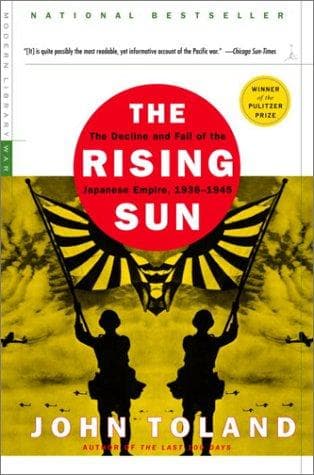
- Toland argues that Japan’s road to war was driven less by a single plan than by a long drift of militarism, imperial anxiety, economic pressure, and repeated civilian control failures inside a system that rewarded bold insubordination.
- He presents the Pacific War as a collision shaped by mutual fear, racism, misreading, and incompatible aims: Japan sought empire, security, and status; the United States insisted on principles Japan read as humiliation and encirclement.
- The book’s core narrative is that Japan’s early brilliance and ferocity produced stunning victories, but strategic overreach, industrial inferiority, and internal fragmentation made defeat increasingly certain.
How Japan Slid into War
- Toland roots the 1930s crisis in social strain: postwar democracy, socialism, corruption scandals, Diet brawling, poverty, overpopulation, and the appeal of nationalist reformers like Ikki Kita.
- The key military concept is gekokujo—“insubordination” justified as loyalty to a higher cause—which Toland uses to explain assassinations, coups, and the Army’s habit of ignoring Tokyo.
- Young officers and radicals saw Manchuria as the answer to poverty, raw-material scarcity, and Soviet threat; Ishihara and Itagaki turned reformist zeal into action, culminating in the Mukden incident and the seizure of Manchuria.
- The 1936 2/26 Incident becomes the book’s emblem of the era: rebels claimed emperor-centered purity, murdered officials, and collapsed only when Hirohito finally broke precedent and ordered suppression.
- Toland stresses that the Emperor was not a simple dictator; Hirohito was constrained by custom, while the real political mechanism was a system in which ministers and Army factions could force or block policy.
- After 2/26, civilian attempts to restrain the Army often backfired, weakening civilian control further and empowering hardliners who could withhold war ministers and steer policy.
From China to Pearl Harbor
- Toland treats the China war as a crucial turn: the Marco Polo Bridge crisis escalated through confusion and field autonomy, but Tokyo still chose expansion, and the result was a widening war that Japan could not quickly end.
- The Nanking atrocities are presented as especially savage and not fully explainable as ordinary battlefield collapse; Toland implies radical officers wanted to terrorize China into submission.
- Konoye repeatedly sought peace or settlement, but his diplomacy was undone by military independence, ideological rigidity, and Tokyo’s tendency to promise more than the field would obey.
- Japan’s turn south after Nomonhan and the Soviet pact reflected fear, not confidence; the Tripartite Pact and Indochina moves were meant to deter the U.S. and Britain but instead tightened the oil squeeze.
- Roosevelt’s oil freeze is the decisive pressure point: Japan saw it as ABCD encirclement, while Washington saw it as a response to aggression; both sides then interpreted delay as bad faith.
- The Walsh-Drought, Nomura, and Hull channel produced a near-settlement, but Toland emphasizes the fatal role of misunderstanding and translation errors: Hull thought he was giving cautious principles, while Tokyo thought Washington was accepting a basis for agreement.
- Hull’s insistence on immediate withdrawal from China, without a face-saving formula, is one of Toland’s central diplomatic criticisms; he thinks it made war more likely.
- The last-moment talks were further muddled by Hull’s alternating rigidity and Roosevelt’s occasional modus vivendi openness, leaving Tokyo unsure whether diplomacy was real.
- Japanese leaders meanwhile set deadlines, armed themselves for war, and sent Kido Butai to Pearl Harbor under Operation Z, after a carefully built intelligence and torpedo-development campaign.
The War’s Arc: Early Triumph, Strategic Collapse
- Pearl Harbor is shown as a brilliant tactical strike enabled by secrecy, imperfect U.S. readiness, and Japanese confidence in surprise, but Toland stresses that it failed to destroy the U.S. carrier force and therefore did not win the war.
- Japan’s early victories—Singapore, Hong Kong, the Philippines, Java, Malaya—were real and devastating, yet they also exposed a widening gap between tactical brilliance and long-term logistics.
- Toland repeatedly contrasts Japanese courage with American industrial depth: the Japanese could win battles, but the U.S. could replace losses, build carriers, and sustain a global war.
- The Guadalcanal campaign marks the turning point from conquest to attrition; Japanese night fighting and fanaticism meet growing U.S. coordination, while supply failure, disease, and command confusion steadily wear Japan down.
- The book treats Midway as the great naval reversal, where intelligence, timing, and Japanese overconfidence combine to destroy four carriers and much of Japan’s elite naval air arm.
- Toland presents the Doolittle Raid, Bismarck Sea, Leyte, and especially Saipan as evidence that Japan’s perimeter could be pierced and its shipping, airpower, and morale progressively crushed.
- Saipan becomes symbolically and strategically decisive: civilian suicides, collapsing defense, and the erosion of Tojo’s authority show that the homeland itself is no longer secure.
- Toland’s portrait of Japanese command is one of chronic factionalism: Army vs. Navy, front vs. Tokyo, hardliners vs. mediators, with every decisive crisis producing last-minute compromise rather than coherent strategy.
Home Front, Endgame, and Toland’s Larger Judgment
- The American bombing campaign moves from precision dreams to firebombing, and Toland treats the Tokyo firestorm, then Nagasaki and Hiroshima, as the final stage of a war in which civilian industry and morale became targets.
- He is explicit that the atomic bomb and Soviet entry together broke Japan’s last hope, but he also shows the collapse of Japanese diplomacy before then: repeated mediation efforts, secret channels, and cabinet turmoil never produced a stable exit.
- The decisive political act is the Emperor’s intervention: Hirohito finally concludes the nation must “bear the unbearable and endure the unendurable,” forcing acceptance of surrender over military resistance.
- The final coup attempt by hardliners shows the depth of militarist commitment, but also its exhaustion; the emperor’s recorded surrender and the Eastern District Army’s intervention end the rebellion.
- Toland closes by arguing that the postwar world did not simply settle old conflicts; Asia’s nationalist revolutions, anti-colonial movements, and resentments against Western double standards continued the war’s political legacy.
- He presents Japan as both aggressor and product of its era, and America as both liberator and imperial power, insisting that the Pacific War cannot be reduced to a simple morality play.
What To Take Away
- Gekokujo and weak civilian institutions helped turn Japanese militarism into a self-accelerating system.
- Japan’s leaders repeatedly sought a face-saving settlement, but they could not align diplomacy, the Army, and strategic reality.
- The war was won less by one dramatic event than by the cumulative force of American industry, codebreaking, logistics, and sustained pressure.
- Toland’s deepest claim is that the Pacific War was both a military conflict and a reckoning over empire, race, and Asian political future.
Generated with GPT-5.4 Mini · prompt 2026-05-11-v6