Core Idea
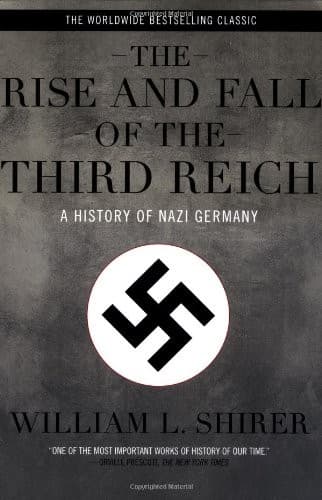
- Shirer argues that the Third Reich can be understood through unusually rich documentary evidence—captured files, diaries, interrogations, and Nuremberg records—and that this evidence shows Nazi rule as a system of ideology, coercion, propaganda, and war.
- His central historical claim is that Hitler was indispensable: a uniquely ruthless, tactically gifted leader who turned older German and Austrian prejudices into a regime of terror, conquest, and genocide.
- The book’s warning is that Nazi dictatorship was made possible not by one coup, but by the collapse of democratic safeguards, elite collaboration, institutional cowardice, and Western hesitation.
How Hitler and Nazism Took Power
- Shirer traces Hitler from his formation in Austria and Vienna, where resentment, racial nationalism, mass politics, and anti-Semitism hardened into a worldview centered on racial hierarchy, anti-Marxism, Führerprinzip, and Lebensraum.
- Mein Kampf is treated as the key statement of this program, especially its demand that Parliament, majority rule, and ordinary morality be subordinated to the will of the leader and the racial purpose of the nation.
- Shirer links Nazi ideas to older German thought and culture, citing figures such as Fichte, Hegel, Treitschke, Nietzsche, Wagner, Gobineau, and Houston Stewart Chamberlain as part of the intellectual background that legitimized authoritarianism, war, and anti-Semitism.
- The Weimar Republic was structurally weak: the Army never fully republicanized, and the judiciary, bureaucracy, business, universities, and Junkers largely retained old loyalties.
- Versailles humiliation, hyperinflation, unemployment, and the Great Depression helped destroy confidence in democracy, while conservative elites repeatedly believed they could use Hitler and control him.
- Hitler learned from the failed Beer Hall Putsch that power had to be won legally first, then used to destroy legality from within.
- The Nazi Party became a disciplined parallel state, using Gaue, local cells, youth groups, women’s organizations, the SA, SS, propaganda, and party courts to combine organization, spectacle, and street violence.
- Hitler’s rise depended on the convergence of mass appeal and elite miscalculation: he won votes from the discontented while reassuring conservatives, industrialists, bankers, and Army men that he would restore order.
Dictatorship, Coordination, and War
- Hitler became Chancellor on January 30, 1933, and used the Reichstag fire, the emergency decree, arrests, censorship, and police violence to crush opposition.
- The Enabling Act made dictatorship constitutional in form, while the Potsdam ceremony staged a symbolic merger of Nazism with Prussian-monarchical tradition to reassure the old order.
- Gleichschaltung brought parties, unions, states, churches, schools, culture, and labor under Nazi control; by July 1933 the Nazi Party was the only legal party.
- The trade unions were smashed by deception and force, and Jews were pushed out of public life through boycotts, exclusions, and escalating legal discrimination.
- Shirer emphasizes that Nazi rule was political before it was economic: Hitler wanted order, Army support, and business confidence, not a social revolution that threatened power.
- The Night of the Long Knives eliminated Röhm and the SA leadership, but also conservative and military rivals; the Army’s approval made it complicit in Hitler’s rise to absolute authority.
- After Hindenburg’s death, Hitler fused the offices of President and Chancellor and required personal loyalty from the Army, while the Gestapo, SS, SD, and concentration camps created a police state above ordinary law.
- The churches, universities, education system, and culture were subordinated through pressure, purges, propaganda, and pseudo-science, while labor was regimented through the Labor Front, labor conscription, and Strength Through Joy.
- Economic recovery depended on rearmament, with Schacht’s financial devices and later the Four-Year Plan mobilizing resources for war while tightening state control.
- Foreign policy followed a pattern of peace talk abroad and war planning at home: Germany withdrew from disarmament, remilitarized, exploited appeasement, absorbed Austria, and destroyed Czechoslovakia through coercion and staged legality.
- Shirer treats Kristallnacht as a state-directed pogrom, not a spontaneous riot, showing the regime’s move from persecution to open racial violence.
War, Occupation, and the Nazi System of Killing
- Munich did not preserve peace; it saved Hitler from crisis and encouraged the next round of expansion by giving him the Sudetenland and destroying Czechoslovakia’s strategic position.
- The Nazi-Soviet Pact was a cynical partition agreement that removed the danger of a two-front war and cleared the way for the attack on Poland.
- Hitler’s invasion of Poland used staged incidents like Gleiwitz as an alibi, and the campaign introduced the modern shock tactics of blitzkrieg.
- Once war began, Nazi policy in occupied Europe fused military rule with terror, plunder, and administrative murder; occupied Poland quickly became a laboratory for brutal racial policy.
- Shirer treats the Nazi occupation system as a planned New Order of German domination, extraction of food, labor, gold, art, and industrial capacity, and the reduction of Slavs to slave labor.
- The Final Solution is presented as the regime’s defining crime: mass shootings by the Einsatzgruppen, then gas vans and industrial killing in camps such as Auschwitz, Treblinka, Belzec, Sobibor, and Chelmno.
- The Wannsee Conference coordinated the bureaucratic murder of European Jewry, while Auschwitz shows the convergence of deception, industrial engineering, and extermination.
- Shirer also stresses complicity beyond the SS: ministries, industry, the Reichsbank, doctors, and firms such as I.G. Farben were entangled in slave labor, plunder, and camp systems.
- Resistance existed—especially the White Rose and the conspirators around Beck, Goerdeler, Canaris, Tresckow, Stauffenberg, and Olbricht—but it was fragmented, late, and repeatedly blocked by hesitation and institutional dependence on the state.
Collapse of the Reich
- Germany’s military strength rested on surprise, daring, and enemy paralysis, but Hitler’s strategic overreach—especially Barbarossa—turned initial success into disaster.
- His refusal to prioritize Moscow, his fixation on Ukraine, Leningrad, and the Caucasus, and his insistence on stand-fast orders helped produce the catastrophe of Stalingrad.
- Stalingrad is the key turning point: after the Sixth Army surrendered, Germany never regained the strategic initiative, while El Alamein, Tunisia, Sicily, and Italy marked the wider collapse of Axis power.
- Britain’s survival after the Battle of Britain was decisive, because Sea Lion never became a viable invasion and Hitler failed to force a settlement.
- The July 20 plot and Operation Valkyrie failed through chance, delay, and structural weakness; Hitler survived, then answered with mass arrests, the People’s Court, executions, and reprisals.
- The last section of the book ends in the bunker: Hitler’s suicide, Goebbels’s suicide, Berlin’s fall, Dönitz’s powerless succession, and Germany’s surrender at Reims and on May 8–9, 1945.
What To Take Away
- Shirer’s deepest claim is that Nazism was not an accident of one man alone, but a regime where ideology, bureaucracy, and war reinforced one another.
- The book shows how a modern state can be destroyed legally, then turned into a machine for conquest, forced labor, and extermination.
- The Third Reich fell because its victories were built on deception, speed, and the weakness of others, not on a sustainable strategic foundation.
- Shirer’s final warning is political as much as historical: when resentment, militarism, and anti-Semitism are normalized, and elites choose convenience over resistance, catastrophe can be made to look lawful.
Generated with GPT-5.4 Mini · prompt 2026-05-11-v6