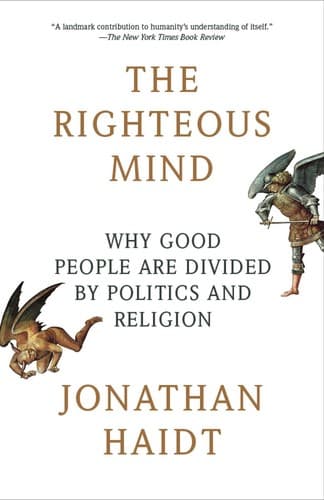
Core Idea
- Haidt’s central claim is that morality is not built mainly by cold reasoning about harm and fairness; intuitions come first, strategic reasoning second.
- Moral judgment is broader than Western liberal accounts admit: people moralize loyalty, authority, sanctity, and liberty as well as care and fairness.
- Politics and religion are downstream of moral psychology: they bind groups together, but they also make people morally confident, tribal, and blind to other values.
How Moral Judgment Works
- The mind is best understood as a rider on an elephant: conscious reasoning is small, but the intuitive, emotional, automatic side drives most judgments.
- Haidt’s term “morally dumbfounded” names the experience of knowing something is wrong without being able to explain why.
- His taboo stories, especially harmless violations involving disgust and disrespect, showed that many people condemn acts even when no clear victim exists.
- In one recurring finding, subjects often invented harms after the fact; reasoning then functioned more like a press secretary than a truth-seeker.
- The social intuitionist model says moral reasoning is usually for persuasion, reputation, and alliance-building, not private discovery.
- Evidence for this comes from fast affective reactions, priming, bodily effects like disgust and cleanliness, psychopaths’ intact reasoning with missing emotion, infant social preferences, and neuroscience on moral emotion.
- Haidt argues that Hume was closer to the truth than rationalists like Plato or moral system-builders: reason serves the passions more than it rules them.
- He does not say reasoning is useless; rather, it works best in conversation, when it can trigger new intuitions or be supported by institutions that check bias.
Moral Foundations and Cultural Pluralism
- Haidt’s major corrective to modern moral psychology is Moral Foundations Theory: humans have several prepared “taste receptors” for morality, not just one.
- The original foundations are Care/harm, Fairness/cheating, Loyalty/betrayal, Authority/subversion, and Sanctity/degradation, later joined by Liberty/oppression.
- Care evolved around protecting vulnerable children; Fairness around reciprocal altruism and punishment of cheaters.
- Loyalty comes from coalition psychology, Authority from hierarchy and legitimate rank, and Sanctity from disgust, purity, and the behavioral immune system.
- Liberty tracks resistance to domination and “don’t tread on me” anger, and Haidt treats fairness more as proportionality than equality.
- The theory was shaped by anthropology, especially Shweder’s work in Orissa, which showed that many cultures moralize community and divinity where Americans see mere convention.
- Haidt’s WEIRD studies found that educated Westerners are unusually committed to the harm principle and unusually narrow in what they count as moral.
- His India and Brazil work convinced him that morality is not one universal code but a set of moral matrices that vary by culture and class.
- The Hebrew Bible, purity taboos, and many non-Western practices made clear to him that disgust, purity, and sacredness are central moral forces, not leftovers.
Morality, Groups, and Politics
- Haidt’s larger claim is that morality binds and blinds: it makes cooperative groups possible, but it narrows vision and intensifies conflict with outsiders.
- He describes humans as “90 percent chimp and 10 percent bee”: mostly individualistic, but capable of genuine groupishness and hive-like sacrifice.
- This groupishness is explained through multilevel selection, gene-culture coevolution, and self-domestication rather than pure individual self-interest.
- Shared intentionality, synchronized ritual, and collective effervescence help create the human hive switch, allowing people to lose themselves in a group.
- Religion fits this picture as a team sport: its power lies less in belief alone than in ritual, belonging, sacredness, and costly commitment.
- Religious communities and moralistic gods help suppress cheating and strengthen parochial altruism; Haidt uses commune survival studies to argue that religion can improve group cohesion.
- He defines morality functionally as an interlocking system of values, virtues, norms, practices, identities, institutions, technologies, and evolved mechanisms that suppress selfishness to enable cooperation.
- Politics maps onto moral foundations: liberals center on Care, Liberty, and Fairness, while conservatives use a broader mix that includes Loyalty, Authority, and Sanctity.
- This helps explain partisan misunderstanding: liberals often mistake conservative moral concerns for prejudice, while conservatives more readily recognize liberal concerns.
- Haidt also argues that institutions matter because they store moral capital: the traditions, norms, and structures that make large-scale cooperation possible.
- He is sympathetic to conservatives on the need to protect moral capital, while also warning that high moral capital can support cults, fascism, and harm to out-groups.
What To Take Away
- The book’s most important reversal is that moral reasoning is mostly post hoc; the intuitive side of the mind does the choosing.
- Haidt’s second major claim is that morality is plural, not reducible to harm and fairness, and different cultures weight the foundations differently.
- A third claim is that moral systems are social technologies: they bind communities, but they also create blind spots, tribalism, and political polarization.
- His practical advice is not to abandon judgment, but to “talk to the elephant first” and to understand the sacred values that animate people on the other side.
Generated with GPT-5.4 Mini · prompt 2026-05-11-v6