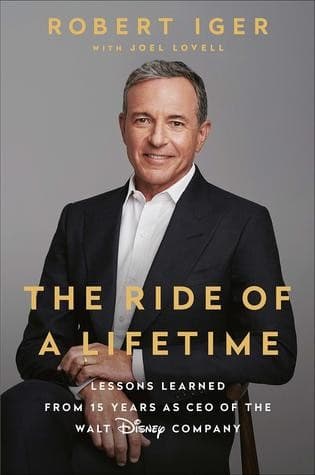
Core Idea
- Robert Iger’s central claim is that Disney’s success came from pairing optimism, courage, curiosity, and integrity with relentless attention to execution, culture, and timing.
- The book is both a memoir of crisis and strategy and a case for leadership that stays decisive under pressure, respectful to creative people, and clear about priorities.
- Iger argues that a CEO’s job is not to protect the status quo, but to anticipate disruption, make hard bets on content and technology, and preserve trust with people whose talent actually creates value.
Leadership, Formation, and Management Style
- Iger traces his leadership habits to childhood in Oceanside, Long Island: his father’s emphasis on books, politics, fairness, productivity, and doing things the right way.
- His father’s instability and manic depression made Iger feel responsible for being the steady center of the family, which shaped his seriousness and time discipline.
- Early jobs, including school janitor work and night shifts making pizza, reinforced his habit of hard work and his belief that effort matters more than status.
- At ABC he learned television from the ground up as a studio supervisor, handling 4:30 A.M. calls, crews, unions, and production logistics, and he kept the habit of rising around 4:15 A.M. to think and prepare.
- Roone Arledge became a formative mentor: perfectionist, innovative, and intolerant of mediocrity, he taught Iger to never accept “no” as final and to “find another way.”
- Iger also learned that excellence can turn toxic if it produces fear, so he stresses fairness, empathy, and second chances for honest mistakes.
- His management rule in unfamiliar jobs was simple: don’t fake knowledge, ask questions, learn quickly, and stay humble without becoming passive.
- He repeatedly insists that good leadership means owning mistakes publicly, giving direct feedback without ego, and not hiding behind corporate insulation in moments of tragedy.
Disney’s Culture, Deals, and Creative Engine
- Under Capital Cities and later Disney, Iger came to value decentralization, cost discipline, and authentic managers who knew what they did not know.
- He contrasts Cap Cities’ plainspoken restraint with Disney’s more centralized strategic culture, which he often found too heavy and too suspicious of entrepreneurial instincts.
- At ABC and later Disney, he learned that the best executives set a few priorities and then let talented people execute, rather than pretending to know every detail.
- He argues that micromanaging is underrated when details determine success, but the real mistake is a CEO taking personal credit for every lamp or decision.
- His best creative work at ABC came from balancing business pressure with respect for talent: he backed shows like Family Matters, Life Goes On, Doogie Howser, M.D., Twin Peaks, and NYPD Blue.
- The lesson from Twin Peaks and Cop Rock was that leadership must permit bold failure if innovation is the goal, but also own the failure rather than distancing oneself from it.
- For creative teams, he says executives should not start with petty notes; they must understand the big picture and protect the creative process while still serving the business.
- He learned that the most powerful businesses are often underleveraged assets: Disney’s parks, hotels, and library could grow through pricing, expansion, and smarter use of existing IP.
- He frames Disney’s “creative and technical heart” as Imagineering, where artists, engineers, architects, and technologists merge story and system.
Succession, Acquisitions, and the Shift to Streaming
- Iger’s rise to Disney CEO came through a long internal succession struggle shaped by Michael Eisner’s ambivalence, board politics, and the need to prove he could lead through ambiguity.
- He distills his CEO agenda into three priorities: high-quality branded content, full embrace of technology, and becoming truly global, especially in China and India.
- The Pixar deal showed his core acquisition philosophy: buy people and culture, not just assets, and preserve what makes the target company work.
- The Pixar negotiations succeeded because Steve Jobs, John Lasseter, and Ed Catmull were treated with authenticity and respect, and Pixar’s identity was protected through a “social compact” of rituals, email, branding, and autonomy.
- Iger says the same principle applied to Marvel and Lucasfilm: deals only worked because he built trust with controlling founders like Ike Perlmutter and George Lucas instead of using “Hollywood slickness.”
- He views the Marvel acquisition as a bet on the depth of characters and long-term franchise potential, and he emphasizes that Black Panther and Captain Marvel proved diverse heroes could be global hits.
- In Lucasfilm, the hardest issue was creative control; Iger refused to buy Star Wars while surrendering authority, even when that meant deals nearly collapsed twice.
- He treats the Jobs, Pixar, Marvel, and Lucasfilm relationships as examples of leadership by trust: the deal was always more than the term sheet, and mishandling dignity could destroy value.
- After the “big three” acquisitions, Iger shifted from building Disney as a content company to defending it against digital disruption with a direct-to-consumer platform.
- He rejected Twitter as a platform acquisition because of brand and societal risks, then chose BAMTech to power ESPN+ and Disney+.
- Disney’s streaming pivot required reorganizing the company around content, technology, and physical goods, even though it meant sacrificing near-term profits and licensing revenue to Netflix.
- Iger describes the move as a deliberate act of reinvention: Disney would still support theatrical and TV businesses, but it would no longer rely on them as its future.
What To Take Away
- Leadership is a balance of optimism and realism: Iger repeatedly treats crises as solvable problems while refusing to ignore danger.
- Culture is a core asset: the Pixar, Marvel, and Lucasfilm deals work in his telling because he preserved identity, respected creators, and avoided forcing Disney’s habits onto them.
- A CEO must choose a few strategic bets and repeat them relentlessly: for Iger, those bets were content quality, technology, and global scale.
- Long-tenured power can distort judgment, so he warns that executives need people around them who will challenge them before overconfidence hardens into blindness.
Generated with GPT-5.4 Mini · prompt 2026-05-11-v6