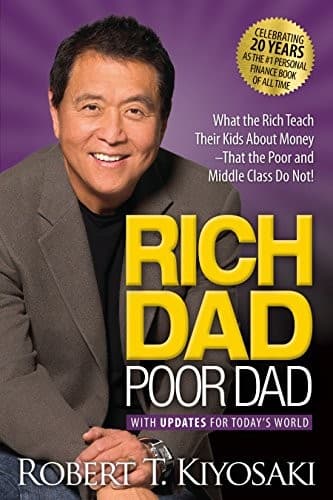
Core Idea
- Kiyosaki argues that school prepares people to become employees, but not to understand money, assets, taxes, or investing.
- The book’s central contrast is between a poor dad who valued job security and a rich dad who taught owning assets, using corporations, and making money work for you.
- Financial freedom, in Kiyosaki’s view, comes from financial literacy plus the courage to act despite fear, cynicism, and social pressure.
The Main Financial Lesson
- The first lesson is that poor and middle-class people work for money, while the rich have money work for them.
- Kiyosaki says fear of not having money and desire to spend it keep most people trapped in the Rat Race of wages, debt, taxes, and rising expenses.
- The key distinction is asset vs. liability: an asset puts money in your pocket; a liability takes money out.
- He argues that many people mistake houses, cars, and consumer purchases for assets when they often function as liabilities because they create ongoing costs.
- Real wealth is not net worth on paper but the amount of cash flow available after monthly expenses.
- The rich buy income-producing assets such as businesses, real estate, stocks, bonds, notes, royalties, and other holdings that do not require their constant presence.
- His preferred rule is to keep a job if needed, but mind your own business by building an asset column before buying luxuries.
- The book repeatedly contrasts two financial orders: employees earn, pay taxes, then spend; the rich earn, spend, then pay taxes.
How the Rich Play by Different Rules
- Kiyosaki says the rich use corporations to reduce taxes, protect assets, and separate business risk from personal wealth.
- He presents corporations as legal entities that can pay expenses before taxes and shield owners from lawsuits.
- He argues that tax laws and structures are not for the fearful; they reward those who learn the rules and use attorneys, accountants, and legal tools wisely.
- His broader point is that the middle class often works hardest for the owner, the government, and the bank, while the wealthy use the system to preserve and grow capital.
- He treats financial intelligence as four linked skills: accounting, investing, market understanding, and the law.
- Accounting means reading statements and seeing what is really happening; investing is the science of making money produce more money.
- Market understanding means knowing supply and demand, both emotionally and fundamentally; law matters because structure shapes tax and risk outcomes.
- He warns that schools teach scholastic and professional skills, but not the skills that make financial independence possible.
Work to Learn, Not Work for Money
- One of the book’s strongest recurring themes is “Work to Learn — Don’t Work for Money.”
- Kiyosaki says the point of early jobs should be skill-building, especially in sales, marketing, communication, leadership, and negotiation.
- He repeatedly argues that people are often one skill away from great wealth, but cling to specialization and job security.
- He uses his own path—leaving secure jobs, learning sales at Xerox, taking risky moves, and forming companies—to show that broad experience matters more than comfort.
- Rich dad had him rotate through many roles and sit in on banker, lawyer, accountant, and broker meetings so he could learn the whole business.
- He praises corporations for grooming leaders broadly, while schools reward narrow specialization.
- The most valuable practical skills, in his view, are sales and marketing, because even talented people fail if they cannot sell their work or themselves.
The Obstacles and the Steps
- After financial literacy, Kiyosaki says people face five major obstacles: fear, cynicism, laziness, bad habits, and arrogance.
- Fear keeps people from investing; he says starting early matters because compound growth is powerful over time.
- Cynicism makes people dismiss opportunities by listening to frightened non-investors instead of analyzing deals themselves.
- Laziness is often disguised as being “busy,” and he says the cure is desire and the question “How can I afford it?” instead of “I can’t afford it.”
- Bad habits include paying bills first; rich dad’s rule was to pay yourself first, then let pressure force creativity and discipline.
- Arrogance is “ego plus ignorance”; he insists that admitting what you do not know is the first step to learning.
- To get started, he says you need a reason greater than reality, then choices, education, mentors, formulas, self-discipline, good brokers, and the habit of buying assets before luxuries.
- He stresses that action beats inaction: make offers, look for change, learn from real practitioners, and keep testing ideas.
- His final teaching is that teach and you shall receive: giving knowledge, help, and value creates reciprocity and deepens your own understanding.
What To Take Away
- The book’s core claim is not simply “get rich,” but learn the rules of money so you can buy freedom.
- Kiyosaki believes most financial pain comes from ignorance: people confuse income with wealth, possessions with assets, and security with safety.
- He treats financial education as a practical discipline built from small decisions, repeated learning, and willingness to look different from the crowd.
- His lasting message is that money is an idea: start small, study the game, build assets, and teach the lesson forward.
Generated with GPT-5.4 Mini · prompt 2026-05-11-v6