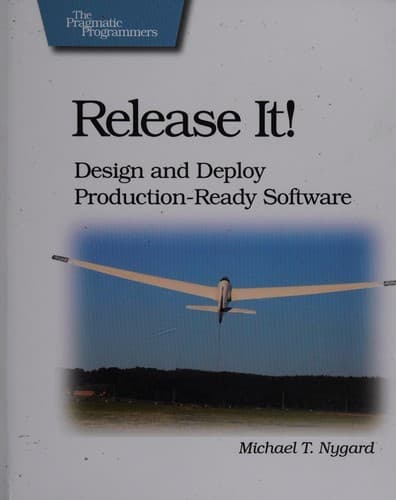
Core Idea
- The book’s central argument is that software must be designed for production reality, not just for passing QA, because systems in the wild must survive crashes, hangs, slowdowns, outages, bad inputs, hostile users, and integration failures.
- Stability is treated as a prerequisite for everything else: if a system falls over daily, teams spend all their time firefighting and never get to the “real” product work.
- Architectural decisions are also economic decisions, since a cheap shortcut in development can become a large recurring operational cost over the system’s life.
Production Failure Is Usually About Propagation
- Nygard distinguishes fault (bad internal state), error (visible incorrect behavior), and failure (the system becomes unresponsive), and focuses on how failures spread through “cracks in the system.”
- The airline outage case shows the pattern: an uncaught
SQLException, connection leaks after failover, and no timeouts in EJB/RMI calls let one failure cascade until kiosks, IVR, and passenger check-in all hung. - Integration points are the book’s main danger zone: sockets, RPC, HTTP, vendor APIs, and callbacks can hang slowly, violate protocols, or block in hidden ways.
- Slow failures are often worse than fast ones, because they consume threads, sockets, pools, and memory while making upstream systems wait and retry.
- The book repeatedly returns to blocked threads as the proximate cause of many outages: systems look alive, but every request thread is stuck waiting on something else.
- Horizontal scaling does not eliminate risk; it can create chain reactions when one node fails, the survivors take extra load, and they begin failing too.
- User behavior can also trigger cascades, especially through expensive transactions, memory-heavy sessions, scrapers, DDoS-like traffic, or “self-denial attacks” from marketing events and partner crawlers.
- The remedies are repeated across examples: timeouts, Circuit Breaker, Decoupling Middleware, and external monitoring with synthetic transactions.
Core Stability Patterns and Their Mechanics
- Circuit Breaker is modeled on electrical breakers: count failures, open the circuit, fail fast for a while, then try half-open probes before closing again.
- Breakers should be per-process, observable, trended, and manually resettable; the book prefers fallback behavior such as cached values or secondary services over repeated hopeful retries.
- Bulkheads partition capacity so one failure cannot sink the whole ship, using separate thread pools, farms, servers, or other isolated resources.
- Fail Fast means refusing to do useless work when the system already knows it cannot succeed, such as validating inputs or dependencies before reserving expensive resources.
- Let It Crash applies to bounded components: crash the instance, restart it quickly, supervise the restart, and reintegrate it through load balancers or breakers.
- Handshaking is cooperative demand control, but the book notes that many application protocols are poor at it; a load balancer with health checks is often the practical substitute.
- Load Shedding is the service-side answer to overload: refuse work early, preferably at the edge with a quick 503, rather than letting queues and timeouts spread the pain.
- Back Pressure works by bounding queues and slowing producers, but across system boundaries it can backfire, so the book often prefers explicit refusal or asynchronous decoupling.
- Governor patterns slow dangerous automated actions, especially shutdowns, deletions, or other control-plane commands that can amplify a small mistake into a large outage.
- The general principle is to create safe failure modes that contain damage instead of letting one subsystem’s problem become everyone’s problem.
Design, Deployment, and Operations as One System
- The book treats steady state as a design goal: production systems should run through release cycles without constant human fiddling.
- Anything that accumulates resources—logs, caches, database rows, sessions—needs a corresponding purge, rotation, invalidation, or size limit.
- Unbounded result sets are dangerous because a query that seems small in QA can become millions of rows in production and crash the app or exhaust memory.
- Sessions are called an Achilles’ heel of web apps, since cookie-less or bogus traffic can create huge numbers of sessions and overwhelm databases or threads.
- Caches are valuable but dangerous if unbounded; they need finite key spaces, monitoring, invalidation, and often time-based flushing.
- Service discovery, configuration, placement, autoscaling, and deployment tools are part of the control plane, and the book warns that control planes themselves can cause outages when they act too fast or too broadly.
- Automation is a force multiplier, but the book’s cautionary examples show that autoscalers, health checks, and orchestration can dogpile databases or delete capacity faster than humans can react.
- Good deployment practice includes artifact repositories, canaries, blue/green or wave releases, health checks, and admin controls that are scriptable from the command line rather than trapped in GUIs.
- The deployment and operations stack should expose meaningful metrics, especially real-user monitoring, business-flow metrics, resource pool health, and dependency health, not just instance uptime.
Learning From Production and Stressing the Whole System
- Load testing must model real user behavior, not just concurrent-user counts, because grazers, buyers, search bots, scrapers, and odd edge cases create very different load shapes.
- The book’s load-testing story shows how months of iterative testing improved capacity by about 10x, but also how production still differed because of “noise” from bots, search engines, and strange traffic patterns.
- Temporary mitigations often become long-lived production fixtures, and the real cost of poor design includes hardware, licenses, labor, delayed features, and lost revenue.
- Chaos engineering is presented as empirical stress testing of whole systems: inject failures, latency, and partial outages to see whether the system still preserves its user-facing invariants.
- Netflix-style tools like Chaos Monkey are examples of the approach, but the book stresses blast-radius limits, tracing, health metrics, and a recovery plan before you begin.
- Effective chaos testing is not random vandalism; it is targeted, measurable, and meant to reveal weaknesses in fallback paths, timeouts, hidden coupling, and human runbooks.
- The book also extends resilience thinking to the organization itself: platform teams, CI/CD, configuration services, and operational processes should be designed so developers can ship frequently without creating brittle handoffs.
What To Take Away
- The book’s deepest message is that production failures are usually systemic, not isolated: they arise from timing, coupling, queues, resource limits, and missing boundaries.
- The most valuable defensive tools are timeouts, circuit breakers, bulkheads, load shedding, and bounded resources, because they stop local faults from becoming global outages.
- Good production design requires thinking about control planes, automation, and operational cost as first-class architecture concerns, not afterthoughts.
- Resilience is not only about surviving failure, but about building systems that can learn, adapt, and recover without turning every incident into a company-wide emergency.
Generated with GPT-5.4 Mini · prompt 2026-05-11-v6