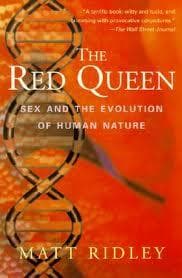
Core Idea
- Sex, not culture alone, is the key to human nature: Ridley argues that our universals, differences, and individuality all make sense when viewed as products of evolution shaped by reproduction.
- The book’s governing metaphor is the Red Queen: in sex, species, and social life, organisms must keep adapting just to stay in place because rivals, mates, parasites, and even genes are also evolving.
- He rejects both “all in our genes” determinism and purely cultural explanations, treating human behavior as the output of evolved psychology interacting with historical conditions.
Why Sex Exists, and Why It Is Costly
- Sex is costly because it halves direct reproductive output, so it needs explanation; Ridley surveys and weighs the main candidates rather than treating sex as self-evident.
- He rejects simple progress stories and group-selection thinking, emphasizing instead individual selection and the gene-centered view of evolution.
- The strongest explanation he endorses is the Red Queen / parasite hypothesis: sex reshuffles genes fast enough to help hosts stay ahead of coevolving parasites.
- Parasites are ideal Red Queen enemies because they are numerous, fast-generating, and constantly adapting; sex creates heterozygosity and polymorphism that act like a library of temporary defenses.
- He uses examples such as HLA histocompatibility variation, mate choice for genetic dissimilarity in mice, Hamilton’s models, New Zealand snails, and topminnows to argue that disease pressure often favors sex over cloning.
- The chapter’s larger point is that sex is not mainly about “improvement” in some abstract sense, but about surviving an arms race in changing environments.
Conflict Inside Genomes and Between Sexes
- Ridley extends the Red Queen logic inward with the tragedy of the commons: genes inside a body can be in conflict, producing free-rider genes, outlaw genes, and other selfish elements.
- He uses transposons, plasmids, Medea, B chromosomes, and meiotic drive in fruit flies to show that genes can bias their own transmission even when damaging the organism.
- Crossing over and recombination can function as a kind of genetic policing by breaking up the link between a selfish driver and its protective mask.
- Sex chromosomes are especially unstable because the Y recombines poorly; this makes sex ratios and sex determination vulnerable to genetic conflict.
- Ridley argues that two sexes emerged partly from conflict over cytoplasmic inheritance: paternal organelles would compete with maternal organelles, so one lineage became the “killer” or provider and the other the “victim.”
- He treats sex-ratio distorters, male-killing microbes, and feminizing agents as evidence that cytoplasmic genes can favor systems that undermine males or bias reproduction toward one sex.
Sexual Selection, Mating Systems, and Human Mating
- Sexual selection is central: males and females often face different reproductive incentives, so men pounce and women choose in many species, including humans.
- Human society is portrayed as mostly monogamous but riddled with adultery, with formal pair bonds coexisting with opportunism, jealousy, and strategic infidelity.
- Ridley explains mating systems through game theory and ecology, but insists that history matters as much as habitat; similar environments can yield different systems because of inherited pathways.
- He links human polygyny to wealth, rank, and power, arguing that agriculture and pastoralism made it easier for elite men to convert resources into wives.
- Historical cases of harems, concubines, and despotic rulers are used to show that polygyny becomes common where power is concentrated and inherited.
- At the same time, he argues monogamy reduced some male-male violence by limiting the reproductive payoff of conquest.
- A major theme is that women often have incentive to pursue a double strategy: retain a helpful husband while seeking extra-good genes elsewhere, which helps explain adultery and sperm competition.
- Concealed ovulation, frequent sex, mate guarding, jealousy, and legal concern over adultery are all presented as adaptations around paternity uncertainty.
- He treats human homosexuality and differences in female vs male sexual psychology as part of the same reproductive asymmetry, though some claims are more speculative than others.
Sexing the Mind, Beauty, and Intelligence
- Ridley argues that men and women evolved somewhat different minds because they faced different ancestral pressures, while stressing that overlap between the sexes remains large.
- He uses vole comparisons, hormone experiments, and developmental cases such as Turner’s syndrome, congenital adrenal hyperplasia, and 5-alpha-reductase deficiency to argue that prenatal hormones matter deeply.
- His preferred picture is that genes shape development through hormones, with testosterone strongly influencing aggression, spatial ability, and male-typed interests.
- He presents many sex differences as broadly universal: women tending more toward verbal, relational, and social sensitivity; men toward aggression, spatial skills, dominance, and competitive risk-taking.
- Mate preference is framed as evolutionarily asymmetric: men prioritize youth and health, women prioritize wealth, status, dominance, and prospects.
- He treats waist-to-hip ratio, facial symmetry, youthfulness, and status displays as important cues in female beauty, and he links male display to honest signaling, Fisherian runaway, and the handicap principle.
- On intelligence, Ridley surveys the Machiavellian intelligence view and Geoffrey Miller’s idea that the neocortex is a courtship device, selected to impress and outwit other minds.
- He treats human intelligence as deeply social: gossip, deception detection, and reasoning about cheating reveal a mind built for navigating other people, not just tools or hunting.
What To Take Away
- Human nature is evolutionary history made visible, and sex is one of its main engines.
- The book’s most distinctive contribution is the Red Queen lens: arms races with parasites, mates, and rival genes help explain sex, attraction, and variation.
- Ridley’s account is strongest when it ties a trait to a clear reproductive conflict, and more tentative when it reaches into intelligence, beauty, or the details of sex differences.
- The unifying claim is that competition and cooperation are inseparable: bodies, minds, marriages, and even genes are shaped by constant negotiation under selection.
Generated with GPT-5.4 Mini · prompt 2026-05-11-v6