Core Idea
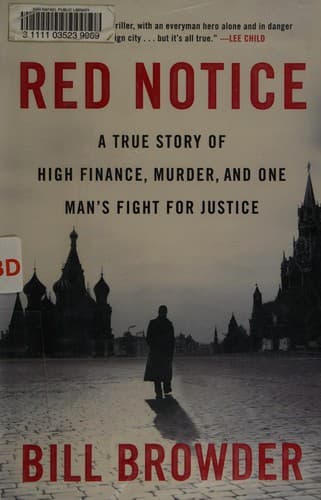
- Red Notice is Bill Browder’s account of turning from a highly successful emerging-markets investor into the most persistent Western critic of Russian corruption and state abuse after Russia tried to steal his firm’s assets and then destroyed the life of his lawyer, Sergei Magnitsky.
- The book’s central claim is that in post-Soviet Russia, property rights, courts, police, tax authorities, and the FSB could be fused into a system for looting companies, intimidating opponents, and covering crimes with official lies.
- Browder argues that the response to that system had to be international: media exposure, legislative sanctions, visa bans, asset freezes, and public naming were the only tools that reliably created consequences.
From Capitalist Opportunist to Russia Specialist
- Browder grew up in a left-wing, intellectual family and deliberately chose capitalism partly as a rebellion against it.
- After training at Bain, Stanford, and BCG, he moved toward Eastern Europe because the opening of the Soviet bloc seemed to offer the biggest opportunity for high-impact investing.
- His first successes came from identifying absurdly cheap post-communist assets, first in Polish privatizations and then in Russia’s voucher system.
- The Russian voucher market convinced him that assets were priced as if almost nobody understood them; he bought with his own money, watched prices surge, and then built a business around the opportunity.
- The early Hermitage model was simple: find undervalued stocks, buy large positions, and use deep local research to understand hidden value that Western investors ignored.
- He raised money from Edmond Safra, who gave him not just capital but operational support, credibility, and a real platform for investing at scale.
- Browder’s personal life ran alongside the investing story: he married Sabrina, later divorced her, and eventually formed a relationship with Elena, who became central to the later part of the book.
How Russian Business Actually Worked
- Browder’s early Russian work showed him that privatization was not a clean transition but a scramble of corruption, misinformation, and opportunism.
- He discovered that many Russian companies had preferred shares that paid dividends but had no voting rights, and these often traded at massive discounts simply because nobody had analyzed them.
- The same pattern appeared in Sidanco: obscure data, evasive managers, and a huge price gap that turned out to be a real mispricing, not a market accident.
- When Sidanco tried to dilute minority shareholders, Browder fought back by combining private pressure, public exposure, and a formal regulator complaint, and he won.
- His campaign against Sidanco revealed the logic of Russian corporate power: when confronted, oligarchs often escalated first, because weakness was dangerous and reputation mattered like it did in a prison yard.
- Browder’s greatest early triumph was Gazprom, where a detailed “stealing analysis” showed management had sold major gas fields to insiders for absurdly little.
- By exposing the theft through Western media and forcing internal Russian reaction, he helped trigger a management shakeup; Gazprom’s stock then soared, validating his method as both research and political intervention.
- He later applied the same anti-corruption pressure to other firms like UES and Sberbank, initially believing Putin’s government was aligning with him against oligarchs rather than using him for its own purposes.
- Browder’s strategic mistake was to think Putin’s anti-oligarch actions were about national reform, when they were often really about reconsolidating state power and disciplining rival elites.
The Break with Russia and Sergei Magnitsky
- The turning point came in 2005 when Browder was suddenly banned from Russia, which he first thought was a mistake but quickly realized was deliberate.
- After he was pushed out, Russian authorities raided Hermitage-related offices, seized corporate seals and documents, and used them to rereregister stolen companies in a classic raider attack.
- Browder and his team, especially Sergei Magnitsky, uncovered that corrupt police and tax officials had fabricated a case, created fake debts and judgments, and then used those documents to claim a massive tax refund.
- The numbers mattered: the bogus judgments matched the companies’ real profits, and the refund equaled the exact taxes Hermitage had paid, proving a state-enabled theft.
- Magnitsky refused to recant, was arrested, abused in detention, and died in 2009 after severe mistreatment and medical neglect.
- Browder treats Magnitsky’s death as the moral and strategic center of the book: the state did not just steal money, it killed the witness who could prove the theft.
- Russian authorities then produced a catastrophic cover-up: false statements, contradictory timelines, denial of abuse, and a refusal to allow a clean independent accounting.
- Browder concludes that justice inside Russia was impossible because the same institutions that committed the crime were responsible for investigating it.
Building the Magnitsky Campaign
- Browder responded by moving the fight abroad, targeting the people involved with US visa bans and sanctions rather than relying on Russian courts.
- With allies such as Kyle Parker, Senator Ben Cardin, John McCain, and others, he pushed the Magnitsky Act, which named and punished officials linked to the case.
- He also used YouTube videos, leaked documents, offshore records, and visual evidence of officials’ wealth to make a technical corruption case legible to the public.
- The campaign expanded beyond Russia to cover wider gross human rights abusers, turning a private revenge story into a broader sanctions framework.
- The politics were difficult: the State Department often preferred caution and “reset” diplomacy, while the Senate and human-rights advocates pushed for confrontation.
- The law passed only after years of pressure, procedural fights, and a link to Jackson-Vanik repeal, which forced Congress to act.
- Browder portrays the Magnitsky Act as a real blow to the Putin system because it attacked one of its sensitive points: the ability of corrupt officials to enjoy stolen money and travel freely.
What To Take Away
- Browder’s investing success in Russia depended on a rare combination of local detail, willingness to investigate theft, and readiness to confront power directly.
- The book’s darkest lesson is that in a system like Putin’s Russia, law can be repurposed into a weapon of theft, and official denial can be as important as the original crime.
- The Magnitsky campaign shows that when domestic justice fails, international sanctions and public exposure can still create consequences.
- Browder presents Sergei Magnitsky not just as a victim, but as the person whose death made a new kind of transnational accountability possible.
- The ending’s emotional point is that Browder values the fight for justice more than wealth: winning a sanction vote for Magnitsky mattered more to him than another financial triumph.
Generated with GPT-5.4 Mini · prompt 2026-05-11-v6