Core Idea
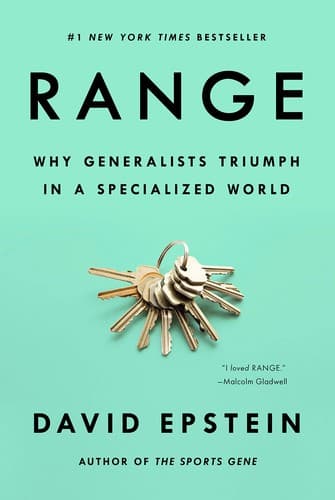
- Epstein’s central claim is that breadth beats premature specialization in many modern domains, especially when problems are wicked rather than kind.
- A “kind” environment has repeating patterns and fast feedback; a “wicked” environment has ambiguous rules, delayed feedback, and weak repeatability, so narrow expertise can mislead.
- The book argues that the world increasingly rewards people who can sample broadly, switch intelligently, and transfer knowledge across domains.
How Range Works
- In sports, music, science, and careers, Epstein repeatedly contrasts early narrow training with a sampling period: broad play, later focus, and repeated exposure before commitment.
- His “Tiger vs. Roger” contrast frames the point: Tiger Woods symbolizes early specialization, while Roger Federer exemplifies broad sampling before elite focus.
- Elite performers in many fields often look less like child prodigies than like late bloomers who tried many things and then converged on a better fit.
- In music, the Venetian figlie del coro and later improvisers show how learning multiple instruments and styles can produce creativity, transfer, and adaptability.
- In math and school learning, Epstein emphasizes desirable difficulties: spacing, interleaving, testing, and generation feel slower in the moment but improve retention and transfer.
- He warns that classrooms often reward performance during practice instead of durable learning, creating a false sense of mastery.
- The same logic extends to work: people often confuse “I can do this now” with “I can do this in a new setting later.”
Deep Thinking, Analogy, and Expertise
- Epstein treats analogy as a core engine of discovery, especially in uncertain fields where there is no direct, reliable rulebook.
- Kepler is his model case: lacking a settled theory of the cosmos, he reasoned by analogies to light, magnetism, whirlpools, and boats in a current until he arrived at a force-based view of the heavens.
- Dedre Gentner’s work shows that deep analogies depend on shared structure, not surface similarity, and are especially useful for solving wicked problems.
- The radiation problem illustrates this: one analogy can triple success, and multiple analogies improve it further because they reveal the underlying structure.
- Epstein also emphasizes the outside view over the inside view: compare a case to similar cases rather than getting trapped in the specifics of your own.
- This matters because experts can become overconfident in their first successful method, a form of cognitive entrenchment that narrows future judgment.
- The book’s warning is not that expertise is useless, but that expertise without range can make people blind to better solutions, especially when the environment changes.
Match Quality, Career Switching, and Identity
- A major theme is match quality: many people do better when they explore, switch, and find the right fit than when they cling to an early plan.
- Epstein uses research on job changes, teacher transfers, military attrition, and educational systems to argue that switching is often a sign of better self-knowledge, not failure.
- He draws on the multi-armed bandit idea: young people should test several promising paths to learn quickly what suits them.
- Grit matters, but Epstein treats it as context-dependent; the right question is not whether someone is gritty in general, but when and where they persist.
- Dan Gilbert’s end of history illusion and Brent Roberts’s personality research support the idea that people change more than they expect, especially in young adulthood.
- Herminia Ibarra sharpens this into “first act and then think”: people discover identity by experimenting with roles, not by freezing themselves in a fixed narrative.
- Epstein repeatedly stresses that many successful people had winding paths, multiple careers, or long detours before finding the work that fit.
Innovation Needs Breadth
- In technology and industry, breadth matters most when problems are uncertain, interfaces matter, or new combinations are needed.
- Nintendo’s Gunpei Yokoi embodies this: he used lateral thinking with withered technology, repurposing old, cheap, well-understood components in novel ways.
- The Ultra Hand, Game & Watch, and Game Boy all show that simpler, older technology can win when it delivers a better user experience.
- Yokoi’s failures, especially the Virtual Boy, underline the risk of abandoning one’s own strengths and chasing novelty for its own sake.
- At 3M, in comic books, and in patent research, Epstein finds that polymaths and broadly experienced people often outperform narrow specialists when uncertainty is high.
- He does not argue against depth; rather, he argues for T-shaped or polymathic profiles: enough depth to contribute, enough breadth to recombine ideas.
- InInnoCentive, oil-spill recovery, and medical cases, outsiders sometimes solved specialist problems precisely because they were not trapped inside the field’s standard assumptions.
- Don Swanson’s work on undiscovered public knowledge shows how linking distant literatures can create new scientific insight; Jill Viles’s patient-driven detective work is a vivid example.
What To Take Away
- Specialization is strongest in kind environments; range is more valuable when the world is complex, changing, or feedback is noisy.
- Breadth creates better analogies, better fit, and better transfer, which is why late focus can beat early narrowing.
- Success often comes from exploration, switching, and repurposing old knowledge rather than from a single linear plan.
- The book’s deepest claim is that modern life rewards people who can learn across boundaries and think structurally, not just procedurally.
Generated with GPT-5.4 Mini · prompt 2026-05-11-v6