Core Idea
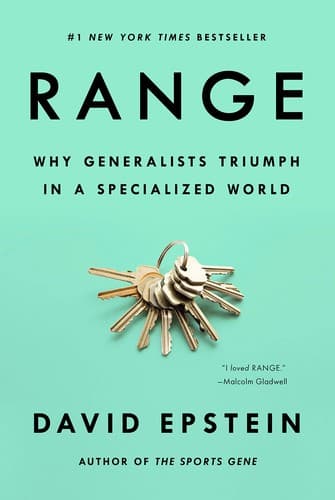
- Epstein argues that in complex, fast-changing wicked environments, people often need range—breadth, sampling, and delayed specialization—more than early narrow expertise.
- The book’s central contrast is between kind domains, where rules repeat and feedback is clear, and wicked domains, where patterns shift, feedback is noisy, and experience can mislead.
Why Breadth Beats Early Specialization
- The Tiger Woods story is not a universal model: Epstein uses Tiger development to show the appeal of early deliberate practice, but contrasts it with Roger development, where broad sampling comes first.
- Many eventual elites, especially in sports, spent their youth in a sampling period across multiple activities, gaining self-knowledge, physical versatility, and a better later fit.
- Epstein extends this beyond sports: early specialists may earn sooner, but later specializers often catch up because they discover work that better matches their abilities and interests.
- Overspecialization can also hurt institutions, as when siloed bankers or doctors optimize a small piece of a problem while missing the larger system and its consequences.
- In wicked domains, experience can produce cognitive entrenchment: experts become overconfident in familiar solutions and less able to adapt when conditions change.
- By contrast, kind domains such as chess or golf reward chunking, repetition, and deliberate practice because structure is stable and feedback is reliable.
- Epstein’s broader point is that many real-world settings are not kind, so school and work should not overgeneralize from domains where intense specialization works best.
Thinking Across Domains
- A major tool for range is analogical thinking: Kepler advanced astronomy by borrowing ideas from smells, heat, light, magnetism, whirlpools, and other domains to reason about unseen forces.
- Epstein uses Kepler to show that discovery often starts by mapping a problem’s deep structure, not by relying on surface similarity or inherited models.
- Dedre Gentner’s work supports this: people solve problems better when they recognize relational structure, not just category labels.
- Studies like the radiation problem show that analogies can sharply improve insight, but people often do not use them spontaneously unless prompted.
- The inside view keeps people stuck in case-specific details, while the outside view uses a reference class of similar cases to make more realistic judgments.
- Epstein repeatedly favors the outside view for prediction, showing that one vivid analogy is weaker than a broader comparison set.
- He also emphasizes match quality: the best outcome is often not staying the course, but finding the role, school, team, or career where your traits fit best.
- Examples from education and work, including Ofer Malamud’s comparison of early and late specialization, suggest that exploration can pay off because it improves match quality even when it delays initial skill accumulation.
- The book treats quitting with nuance: leaving a poor fit can be wise, and “quitters never win” can be bad advice if persistence is preserving a mismatch.
- Career development is therefore modeled as a kind of bandit problem, where early exploration helps identify promising paths before committing.
- Epstein’s examples of Hesselbein, Darwin, Van Gogh, and other circuitous careers all illustrate the same theme: identity and talent are often discovered through experiments, not chosen once in advance.
How Range Gets Built
- The book repeatedly shows that broad experience and deep skill are not opposites; the strongest people often become T-shaped or polymathic, with one area of depth and many adjacent domains.
- Nintendo’s Gunpei Yokoi exemplifies lateral thinking with withered technology: he repeatedly reused old, cheap, familiar technology in novel ways rather than chasing the newest hardware.
- Yokoi’s successes—Ultra Hand, Game & Watch, the D-pad, and the Game Boy—came from combining simple technology with playful design and low barriers to entry.
- His failures, especially the Virtual Boy, show that the doctrine matters: abandoning lateral reuse for novelty can backfire.
- Similar dynamics appear at 3M, where broad inventors, especially polymaths, often produced the highest-impact innovations by connecting distant fields.
- The book also treats creativity as a social and cognitive process: broad teams and broad individuals are more likely to generate useful analogies when encountering surprises.
- For forecasting, Epstein follows Philip Tetlock in distinguishing hedgehogs from foxes: hedgehogs know one big thing, while foxes assemble many small, conflicting pieces of evidence.
- The best forecasters were not the most credentialed specialists, but the most curious, open-minded, and willing to revise beliefs.
- Active open-mindedness matters: foxes seek disconfirming evidence, compare cases, and update when outcomes surprise them.
- Epstein links this to learning science as well: durable learning often requires desirable difficulties like spacing, testing, generation, and interleaving rather than easy short-term performance.
What To Take Away
- The book’s key distinction is not generalist versus specialist, but which environment you are in: stable, repetitive domains reward narrow practice; complex shifting domains reward range.
- Exploration is not indecision; it is often the best way to discover deep structure, improve match quality, and avoid premature lock-in.
- Good judgment comes from comparing across cases, not from treating each situation as uniquely special.
- The deepest practical message is to build a life that keeps options open long enough to learn who you are, then commit where your range gives you the best fit.
Generated with GPT-5.4 Mini · prompt 2026-05-11-v6