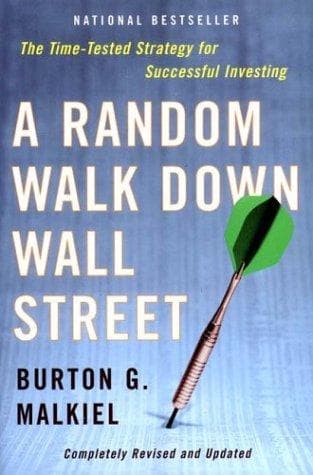
Core Idea
- Malkiel’s central claim is that buy-and-hold indexing in broad, low-cost stock funds beats the costly chase to outsmart the market.
- He argues that markets are usually efficient enough that neither technical charting nor most fundamental stock picking reliably outperforms after fees, taxes, and trading costs.
- The book’s stakes are practical: investors who surrender to hype, overconfidence, and market timing usually end up worse off than disciplined index investors.
How Markets Fool Investors
- Malkiel contrasts firm-foundation theory (buy assets below intrinsic value based on discounted future cash flows) with castle-in-the-air theory (buy what you think someone else will pay more for).
- He traces recurring bubbles to the castle-in-the-air logic, from tulips, the South Sea Bubble, and the 1929 crash to the Nifty Fifty, Japanese land and stocks, the Internet bubble, and the housing boom.
- The pattern is the same: prices rise on stories, momentum, leverage, and “greater fool” thinking, then collapse when reality catches up.
- He treats even famous manias as reminders that institutional investors are not immune; professionals often join the crowd instead of restraining it.
- A key warning is that bubbles are especially dangerous when paired with credit expansion and leverage, because the upward feedback loop reverses violently.
- He does not take bubbles as proof that markets are always irrational; rather, he says mispricing can persist for long periods and still eventually correct.
Why Trading Systems and Analysts Usually Fail
- Technical analysis is attacked as chart-reading based on past prices and volume, but Malkiel argues that past patterns do not reliably predict the next move after costs.
- His “wallpaper principle” is that technicians see significance in patterns the way people see meaning in random wallpaper or coin-toss streaks.
- He tests and dismisses familiar rules and signals such as filter rules, Dow theory, relative strength, price-volume systems, moving averages, and many popular market indicators.
- He also notes that market timing is especially dangerous because a small number of huge up days drive long-run returns.
- Fundamental analysis is no better in his view: analyst earnings forecasts are generally poor, often no better than naive extrapolation, and sometimes worse.
- He points to five sources of forecasting failure: random shocks, creative accounting, analyst error, the loss of top analysts to better-paid jobs, and conflicts with investment banking.
- Behavioral and institutional distortions make things worse, because analysts and managers often prefer to “fail conventionally” rather than be right against the crowd.
- Even mutual-fund managers, pension funds, and advisers as groups fail to beat broad indexes consistently once costs are counted.
Behavioral Finance, Risk, and How to Invest
- Malkiel incorporates behavioral finance but still ends up at passive investing: people are prone to overconfidence, representativeness, herd behavior, and loss aversion.
- Overconfidence leads to excessive trading; Barber and Odean’s evidence shows that the more individuals trade, the worse they do, with men trading more and underperforming more than women.
- Loss aversion explains why investors sell winners too early, hold losers too long, and resist saving more for retirement; inertia and procrastination are also powerful.
- He uses these insights to explain why hot sectors, hot IPOs, and fashionable funds attract buyers near peaks and disappoint afterward.
- His practical remedy is not to outsmart emotion but to design portfolios that reduce the damage: automatic saving, simple rules, and less trading.
- The book’s core portfolio logic is risk and return are linked, but risk can be reduced through diversification.
- Modern portfolio theory shows that combining assets with imperfectly correlated returns lowers portfolio risk; about 50 well-chosen stocks already capture much of the benefit.
- He strongly favors international diversification and notes that bonds can be useful diversifiers too, especially when they are not highly correlated with stocks.
- He also emphasizes rebalancing, which forces investors to sell high and buy low, and dollar-cost averaging for regular savers.
- Retirement guidance centers on matching assets to time horizon and need: younger investors can hold more equities, while older investors should move gradually toward safer income-producing assets.
What To Take Away
- Indexing is the default winner: broad, low-cost funds capture market returns more reliably than active stock picking or market timing.
- Fees, taxes, turnover, and human error are the main enemies of long-term performance, so low-cost and low-trading portfolios have a structural edge.
- Stories matter, but usually as warnings: when an investment becomes a crowd obsession, Malkiel thinks it is often closer to a castle in the air than a firm foundation.
- The lasting lesson is not that markets are perfect, but that humility, diversification, discipline, and patience beat the repeated attempt to forecast every twist of the market.
Generated with GPT-5.4 Mini · prompt 2026-05-11-v6