Core Idea
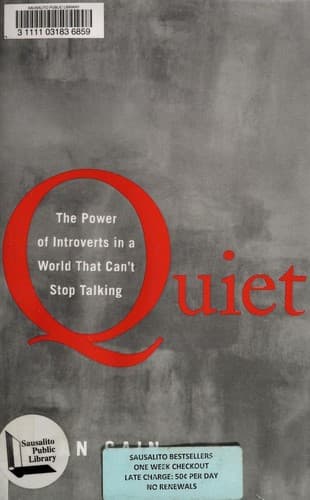
- Quiet argues that modern life is skewed toward the Extrovert Ideal: the belief that the best self is gregarious, high-energy, outspoken, and comfortable performing in public.
- Cain’s counterclaim is that introversion is not a defect but a temperament with real strengths—depth, concentration, persistence, caution, sensitivity, and the ability to notice what louder people miss.
- The book’s deeper stakes are social and moral: when institutions reward visibility over substance, they misread talent, distort leadership, and silence people who may be best equipped to create, judge risk, or act with conscience.
The Extrovert Ideal and Why It Misleads
- Cain traces how America moved from a Culture of Character to a Culture of Personality, where charm, magnetism, and self-promotion replaced private virtue as the main measure of worth.
- Industrialization, urbanization, mass media, and self-help culture helped make social performance feel like survival, so quiet people were pushed to “come out of their shell” and treat themselves as inadequate.
- She uses examples like Dale Carnegie, Toastmasters, Tony Robbins, Harvard Business School, and evangelical “high-energy” worship to show how many arenas equate loudness with competence or godliness.
- Research in the book shows that talkative, fast-speaking people are often judged as smarter, more interesting, and more leader-like, even when that judgment is badly biased.
- Cain insists that introversion is not the same as shyness or misanthropy: shyness is fear of negative judgment, while introversion is a preference for lower stimulation and more inwardly directed attention.
How Quiet People Work Best: Solitude, Depth, and Temperament
- A major theme is that some kinds of work are better done alone, and that solitude often catalyzes creativity by reducing distraction and letting attention deepen.
- Cain uses Stephen Wozniak, Einstein, and creativity research at Berkeley to argue that many innovators are independent, self-directed, and often socially unconventional.
- She criticizes the New Groupthink, the assumption that collaboration is always superior, and shows that open-plan offices, constant meetings, and forced group work often reduce productivity and increase stress.
- Her critique of brainstorming is central: despite its popularity, groups usually generate fewer and worse ideas than individuals because of social loafing, production blocking, and evaluation apprehension.
- She does not reject collaboration outright; instead, she favors intentional collaboration with privacy, flexible workspaces, and room for retreat, since the best results often come from mixing teamwork with quiet concentration.
- Cain also argues that introverts often excel through deliberate practice, persistence, and single-task focus rather than speed, multitasking, or verbal dominance.
Biology, Sensitivity, Leadership, and Risk
- The book grounds temperament in biology through Jerome Kagan’s work on high-reactive infants, who often become cautious, careful, and introverted later in life.
- Cain links this to amygdala sensitivity and Hans Eysenck’s arousal theory: introverts tend to be more easily overstimulated and need lower levels of external input to work well.
- She emphasizes a sweet spot model: performance improves when people match stimulation to temperament, so the goal is not to become someone else but to work within a usable arousal range.
- Cain also draws on Elaine Aron’s research on high sensitivity, showing that some people process experience more deeply, notice more, and feel empathy and conscience more intensely.
- Sensitivity can become a moral strength; examples like Eleanor Roosevelt, Rosa Parks, and Gandhi show how quiet, principled people can exercise durable power without theatrical charisma.
- In leadership, Cain argues that extroversion is not automatically superior: introverted leaders can be better with proactive teams because they listen and incorporate ideas, while extroverts may be better only when followers need energy and direction.
- Her risk chapter links extroversion to reward sensitivity and dopamine-driven “buzz,” explaining why extroverts are often more drawn to status, excitement, and financial risk, while introverts are more likely to notice warning signals.
- She uses Wall Street, Enron, and post-crash finance to show how cultures that reward confidence can marginalize the cautious “FUD” voice—fear, doubt, and questions that may prevent disaster.
- At the same time, introverts are not universally better decision-makers; Cain’s point is that risk sensitivity and persistence are valuable counterweights in environments prone to overreach.
Culture, Children, and Quiet Forms of Influence
- Cain pays special attention to Asian and Asian-American contexts, where quieter traits are often culturally validated through study, modesty, and “soft power” rather than self-advertising.
- She contrasts Western praise of assertiveness with Eastern ideals of harmony and restraint, noting that the same behavior can be read as weak in one setting and admirable in another.
- Her soft power examples—especially Gandhi and Asian-American students who thrive through seriousness and discipline—show that influence can work by water rather than fire.
- For children, Cain warns that many schools are built for extroverts, and quiet kids can be mislabeled as troubled when they are simply overstimulated or need more time to warm up.
- She recommends fit over forced transformation: respect a child’s temperament, provide gradual exposure, use small groups and preparation, and let passions outside school help build confidence.
- The book repeatedly returns to the danger of poor person-environment fit: adults often “blossom” once they can choose workplaces, relationships, and rhythms that suit their natural style.
What To Take Away
- Cain’s core correction is that quiet is not second-best; it is a different temperament with its own intelligence, ethics, and power.
- The real mistake is treating one social style as universal, because that distorts education, management, parenting, religion, and leadership.
- The best environments are not all-quiet or all-loud; they are balanced systems that let introverts and extroverts contribute in the modes where each is strongest.
- The book’s final note is almost spiritual: many people need permission not to become louder, but to become more fully themselves.
Generated with GPT-5.4 Mini · prompt 2026-05-11-v6