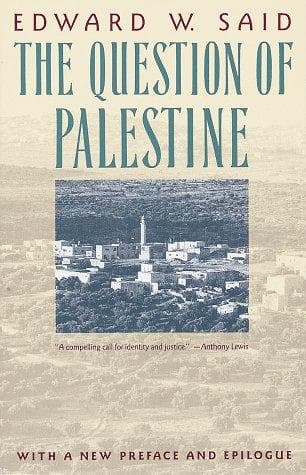
Core Idea
- Said treats “the question of Palestine” as a historical, political, and moral problem about a people, a place, and a contested idea that survives even without sovereign statehood.
- His central claim is that Palestinians have been systematically dispossessed, renamed, ignored, and politically reduced, while Zionism and its Western supporters have worked to make that dispossession appear normal, necessary, or invisible.
Zionism, Colonialism, and the Erasure of Palestinians
- Said argues that Zionism must be read historically as a practical political project, not a pure idea: once enacted, it became a system of land accumulation, demographic control, and displacement.
- He insists criticism of Zionism is not anti-Semitism, and that recognizing Palestinian rights does not mean endorsing reactionary Arab regimes.
- Through George Eliot, Herzl, British Palestine discourse, and colonial comparisons, he shows how Zionism drew power from European habits of imagining the Orient as empty, backward, or administratively available.
- Zionist settlement is presented as a “policy of detail”: land purchase institutions, immigration bodies, the JNF, legal expropriations, and administrative measures all worked together to build a Jewish state while excluding non-Jews.
- Said emphasizes that the 1948 exodus was not simply a voluntary Palestinian departure; it was tied to military strategy, massacres such as Deir Yassin, fear, and prevention of return.
- He follows the post-1948 and post-1967 order as one of military government, land confiscation, censorship, deportation, house demolition, and legal inequality for Arabs inside Israel and in the occupied territories.
- The Koenig Report and similar documents are treated as explicit evidence that demographic management of Arabs was not accidental but a structural concern of the state.
Palestinian Identity, Exile, and Political Formation
- Said argues that Palestinians became self-conscious as a people in response to Zionist immigration from the 1880s onward, and that their identity was rooted in village life, dialect, agriculture, and memory as well as in Arab belonging.
- He stresses that Palestinians were long described only as “Arab refugees,” “extremists,” or “terrorists,” which erased the specific continuity of Palestinian life on the land.
- Exile is the defining Palestinian condition, but it is also the source of literature, institutions, networks, and political resilience.
- He distinguishes between Palestinians in internal exile inside Israel, those under occupation, and those in the diaspora, and argues that these fragmented realities still belong to one national history.
- Palestinian self-assertion appears in testimony, poetry, and fiction: he uses examples like Kanafani, Habibi, and Darwish to show how memory and presence survive dispossession.
- Said sees 1948 as the trauma of expulsion and 1967 as the turning point that made self-help, political organization, and territorial self-determination unavoidable.
- The Palestinian movement evolves from liberation struggle toward a more explicit national independence project, including the demand for a secular democratic state in Palestine for Arabs and Jews.
The PLO, Factional Politics, and the Search for Statehood
- Said treats the PLO as the central expression of modern Palestinian politics because it became a genuine national representative rather than just an Arab League creation.
- He presents the PLO as a coalition of factions—Fateh, the PFLP, the DFLP, and others—united by refusal of disappearance and by the need to represent a dispersed people.
- Karameh (1968) marks the point when Palestinians gained symbolic and political standing through direct confrontation rather than passivity.
- He stresses that the PLO’s importance lies not only in armed struggle but in building schools, welfare networks, unions, women’s groups, diplomatic offices, and research institutions.
- Said also warns of the movement’s tensions: factional rivalry, improvisation, class pressures in exile, and the danger that prosperity or statehood talk could detach leaders from the original dispossessed majority.
- He views the PLO’s growing acceptance of UN Resolutions 242 and 338, and the 1988 Algiers declaration of a secular Palestinian state, as signs of political maturity rather than surrender.
U.S. Power, Western Discourse, and the Problem of “Peace”
- Said identifies the United States as the decisive outside power, shaped by strategic alliance with Israel, domestic politics, and the pro-Zionist consensus in media, academia, and lobbying.
- He gives concrete examples of U.S.-Israeli alignment through AIPAC influence, rising aid, diplomatic shielding, and support during the Lebanon war and Gulf War era.
- He argues that U.S. contacts with the PLO were typically conditional and humiliating, demanding prior renunciations while still denying Palestinian self-determination.
- Western debate is described as heavily policed: sympathetic presentations of Palestinians face censorship, cancellations, denunciation, and exclusion.
- Said attacks the use of “terrorism” as a catchall label that collapses a national movement into a few dramatic acts, while ignoring the far greater scale of Israeli punitive violence.
- He repeatedly returns to the asymmetry that Israeli policies of demolition, torture, deportation, occupation, and settlement have done far more harm to Palestinians than Palestinian attacks have done to Israelis.
- Against Camp David and its aftermath, he argues that the official language of peace often means the reduction or disappearance of the Palestinian question rather than its just resolution.
- His alternative is not sentimental reconciliation but a settlement grounded in Palestinian self-determination, regional recognition, and coexistence of two peoples who are both there to stay.
What To Take Away
- The book’s deepest claim is that Palestine is not a secondary refugee issue but a national history of a real people who were actively made invisible.
- Said’s account links colonial thinking, liberal legitimation, state violence, and media discourse into one system that normalized Palestinian dispossession.
- He shows why Palestinian politics took the shape it did: exile, fragmentation, representation, and statehood-seeking were responses to material conditions, not abstract ideology alone.
- The book ends by insisting that any durable peace must begin with recognition of Palestinian rights and history, not with their administrative absorption or rhetorical erasure.
Generated with GPT-5.4 Mini · prompt 2026-05-11-v6