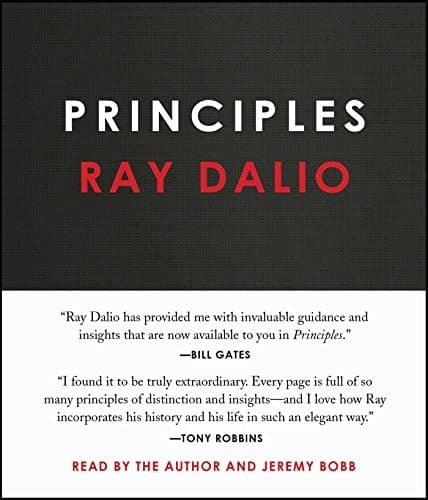
Core Idea
- Dalio’s core claim is that success comes less from what you know than from learning how to deal with what you do not know by thinking for yourself, seeking truth, and repeatedly improving your principles.
- He defines principles as fundamental truths that guide behavior; the point is to turn recurring experience into explicit rules for dealing with “another one of those.”
- The book argues that people and organizations do best when they adopt radical truth, radical transparency, and idea meritocracy, so decisions are made by the most believable reasoning rather than ego, hierarchy, or politeness.
How Dalio Thinks About Life
- Dalio frames life as a repeated cycle of goals → problems → diagnosis → design → execution, and says the key is to do these steps in order rather than blur them together.
- His practical philosophy is to embrace reality and deal with it: accept that pain signals a gap between what is and what should be, then use that pain to learn.
- He argues that the biggest barriers to good decisions are ego and blind spots; the cure is radical open-mindedness, which means genuinely fearing you may be wrong.
- He describes the mind as two competing systems, the logical upper-level self and the emotional lower-level self, and says much bad behavior comes from the lower level hijacking judgment.
- Nature and evolution are his model for reality: what works is rewarded, what does not is penalized, and people, companies, and countries must evolve or die.
- He emphasizes that humans should stop asking how things “should” be and instead ask how they actually are, then align goals and behavior with those realities.
- His notion of good living is not comfort but struggling well: pursuing meaningful goals, learning quickly, and adapting without being knocked out by failure.
Work, Decision Making, and Bridgewater
- Bridgewater was built on the belief that the best decisions come from believability-weighted input, not equal votes or top-down authority.
- Dalio systemized investment decisions by writing criteria down, back-testing them, and turning them into algorithms, arguing that computers can process more information more unemotionally than humans.
- He calls the best portfolio logic the Holy Grail of Investing: combining many uncorrelated return streams can reduce risk without reducing expected return.
- He learned investing through repeated painful mistakes, including being wildly wrong about the 1980s depression call, which forced humility and better timing discipline.
- Bridgewater’s investment edge came from treating markets as logical machines, using explicit cause-effect models, and focusing on changes in the economic environment rather than prediction for its own sake.
- His business examples stress that recurring patterns matter: gold convertibility, inflation, debt cycles, oil shocks, silver mania, and sovereign debt crises all illustrated the same underlying mechanisms.
- He distinguishes beta from alpha and describes Bridgewater’s “alpha overlay” approach as separating passive market exposure from active bets.
- The firm’s tools—Issue Logs, Daily Observations, Baseball Cards, the Dot Collector, and other systems—were meant to make truth visible, surface mistakes, and encode principles into daily behavior.
- He argues management should be systemized like investing: use metrics, process-flow diagrams, role clarity, and repeatable decision rules instead of intuition and charisma.
- Great organizations, in his view, are machines; managers are engineers who diagnose whether failures come from bad design or the wrong people in the wrong roles.
- He warns against collecting people in unsuitable jobs, because preserving comfort or loyalty at the expense of fit undermines the organization and the person.
People, Culture, and Governance
- Dalio’s people philosophy starts from the idea that brains differ materially, so the first task is to understand what people are actually like rather than assume everyone thinks the same way.
- He uses psychometric tools and “Baseball Cards” to map attributes, arguing that self-assessment and interviews are often less reliable than structured evidence.
- He treats many traits as double-edged: creativity can come with contempt for detail, and task-focus can suppress imagination; the goal is role-fit, not perfection.
- He distinguishes shapers—people who turn a unique vision into reality—from ordinary inventors or managers, and says the rarest people can both create and sustain organizations over decades.
- His transition away from running Bridgewater shows his broader theme that leaders need governance and succession, not dependency on one key person.
- He defines governance as the checks-and-balances system that keeps the organization stronger than any leader; without it, even a good culture depends too much on one individual.
- He believes radical transparency is essential but not total: some private, legal, security, or trading-related information should remain limited when the expected value of sharing is lower.
- The culture he wants is tough but caring: people should be far side of fair, say hard truths directly, and hold one another accountable without bad-mouthing or hidden duality.
- He values meaningful work and meaningful relationships together, but says not everyone wants that level of cultural intensity; some people are better suited to a more transactional arrangement.
- His hiring rule is to prioritize values, then abilities, then skills, and to hire only when there is a clear “click” between the person and the role.
- He repeatedly stresses that people should be judged by track record, reasoning, and behavior under pressure, not by status, likability, or claims.
What To Take Away
- Principles are not slogans; they are distilled cause-effect rules for handling recurring reality.
- The deepest habit in the book is to prefer truth over being right, then use disagreement, data, and reflection to improve your model.
- Bridgewater is presented as an attempt to turn that habit into an organization through transparency, believability, and machine-like management.
- Dalio’s final message is that a good life and a good company both come from continuously learning, adapting, and building systems that keep the best ideas in power.
Generated with GPT-5.4 Mini · prompt 2026-05-11-v6