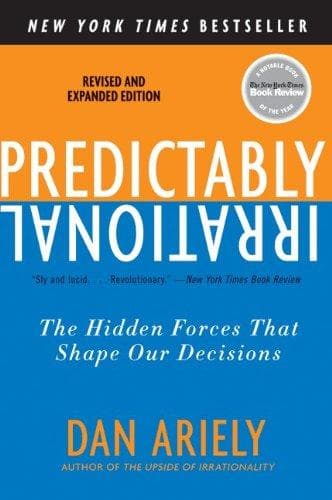
Core Idea
- Ariely’s central claim is that people are not randomly irrational but predictably irrational: we make systematic, repeatable mistakes that can be studied experimentally.
- Behavioral economics, in his account, joins psychology and economics to explain not just outcomes but the decision processes behind them.
- The book’s larger stakes are practical and social: if we understand how context shapes choice, we can make better personal decisions and design better policies, products, and institutions.
How Irrationality Works
- Many choices are driven by relativity, not absolute value: people judge options against nearby alternatives, so a decoy can shift preferences toward the option it resembles and makes look superior.
- Ariely uses examples like The Economist ad, bread machines, and facial attractiveness to show that irrelevant comparison points can move choices in systematic ways.
- Anchoring is another major force: the first number, price, or reference point people encounter can shape willingness to pay and later judgments, even when the anchor is arbitrary.
- He calls this arbitrary coherence: once an anchor is established, later valuations stay consistent with it, whether the anchor came from a price, a social security digit, or an initial recommendation.
- This helps explain why people keep paying in line with past prices, why homebuyers carry over expectations from one city to another, and why first decisions in a sequence matter so much.
- The zero price effect is especially powerful: moving from a small cost to FREE! changes behavior far more than ordinary discounts, often producing emotional overreaction and poor tradeoffs.
- Free offers can increase total demand in some settings, but Ariely shows that at zero the usual demand logic can reverse because people switch from market calculations to social restraint or impulsive grabbing.
- The pain of paying matters: paying nothing feels qualitatively different from paying even one cent, which is why free shipping, free gifts, and zero-cost services can distort choices.
Social Norms, Hot States, and Self-Control
- Ariely repeatedly contrasts social norms with market norms: social exchanges involve friendliness, reciprocity, and patience, while market exchanges are transactional and price-driven.
- Small payments can crowd out social motivation, as in the circle-drawing experiment, the daycare late-fee case, and workplace examples where cash changes the meaning of the relationship.
- He argues that mixing norms can be destructive: mentioning money on a date, charging for a favor, or imposing fines can replace commitment and goodwill with bargaining.
- Money is not always the best motivator; gifts, trust, and noncash recognition can preserve social norms better than explicit pricing.
- The book also emphasizes hot/cold empathy gaps: people in calm states badly predict how they will act when aroused, in pain, or otherwise emotionally “hot.”
- Sexual arousal experiments show that men underpredict how much arousal will change their willingness to take risks, be immoral, or ignore condoms.
- Ariely extends this to safety and health decisions: cold intentions are unreliable unless people precommit, prepare in advance, or build in immediate consequences.
- The same logic appears in procrastination and self-control: fixed deadlines beat self-chosen ones, and precommitment tools help protect long-term goals from short-term temptation.
- He treats email and digital distraction as a variable reward loop, where intermittent payoff keeps people compulsively checking like gamblers.
Ownership, Expectations, Placebos, and Trust
- The endowment effect shows that ownership itself raises value: people demand much more to give up what they own than they would pay to acquire it.
- Effort can create ownership too, as in the Ikea effect, and virtual possession in trials or auctions can make people cling to things before they fully buy them.
- The chapter on expectations argues that what we expect can change what we experience: names, ambience, labels, and prior beliefs shape taste, pain, and even performance.
- Ariely’s beer, coffee, and concert examples show that context can intensify enjoyment, while stereotypes and primes can shift behavior and self-perception.
- Placebo effects are a major theme: sham surgeries, fake pills, and even price cues can produce real relief because belief, conditioning, and prestige affect physiology.
- His medical examples suggest that some costly treatments may work largely through placebo mechanisms, which raises the burden of proof for procedures and drugs.
- Price itself can act like a placebo cue: in his experiments, higher-priced pain relievers and drinks were often reported as more effective than discounted ones, sometimes with objective performance differences.
- The trust section widens the lens: trust is a public good, and when a few actors cheat, they damage the entire market by making everyone more suspicious.
- Ariely connects lies, deceptive advertising, inflated résumés, strategic dating profiles, and source bias to a broader cycle of distrust that spreads beyond the original offense.
- Once trust erodes, even honest actors suffer because people interpret offers through suspicion; rebuilding trust requires transparency, credible sacrifice, and consistent behavior.
What To Take Away
- Human choice is shaped less by stable preferences than by context, comparison, and framing.
- Small changes in price, anchor, or wording can have outsized effects because they alter the norm people think they are in.
- Self-control is easiest when we design for our future, emotionally different selves rather than trusting intention alone.
- Markets depend on more than prices: they also depend on trust, social norms, and believable signals.
Generated with GPT-5.4 Mini · prompt 2026-05-11-v6