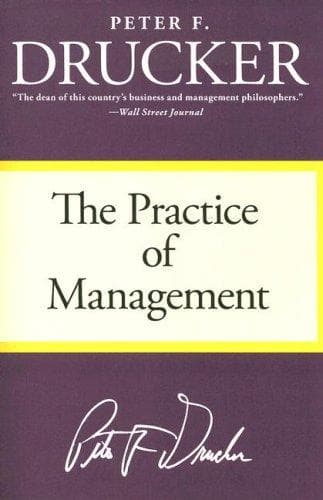
Core Idea
- Drucker treats management as a distinct organ of modern society: neither mere top executives nor simple supervision, but a specific function that makes resources productive through purpose, organization, and responsibility.
- The enterprise must be understood in three dimensions at once: as an economic institution serving customers, as a human organization of managers and workers, and as a social institution with public obligations.
- The central managerial task is to align these dimensions through objectives, self-control, and continuous adaptation to a changing future.
What Management Is For
- A business exists to create a customer, not to maximize profit; profitability is a test and a minimum condition for staying in business, while marketing and innovation are the two entrepreneurial functions.
- Marketing is the business seen from the customer’s point of view, and innovation means offering better or more economic goods, services, or methods across the whole enterprise, not just in R&D.
- Drucker uses Sears to show that a business is not a thing that “makes products” but a system that discovers markets, reshapes distribution, redesigns products, and repeatedly redefines its business.
- The business must be managed in the context of time: decisions always trade off present and future, and long payoff periods make short-term thinking dangerous.
How Management Works
- Management has three inseparable jobs: managing the business, managing managers, and managing workers and work; every major decision affects all three.
- The key tool is management by objectives: each manager’s goals should derive from the needs of the whole business, not from functional convenience or upward pressure alone.
- Self-control requires that managers receive clear, timely information for their own use; Drucker contrasts this with surveillance, “president’s Gestapo” reporting, or crisis-driven “drives.”
- Drucker’s instrument panel of objectives includes eight areas: market standing, innovation, productivity, physical and financial resources, profitability, manager performance and development, worker performance and attitude, and public responsibility.
- Objectives must have a time span and be balanced through judgment, not formula; the budget is the expression of those balance decisions, not a substitute for them.
- The manager’s job is broad and isolating, so Drucker rejects the myth of the one-man chief executive and favors a real chief-executive team with shared deliberation but individual responsibility.
- The Board of Directors should function as review, appraisal, appeal, and final judgment, not as a decorative legal fiction or a day-to-day management body.
The Human and Organizational Side
- Managing managers means treating managers as the scarcest, most expensive, and most perishable resource; Ford’s decline is used to show the cost of running a large enterprise without real managerial authority.
- A healthy organization depends on the spirit of the organization, which Drucker defines through practices: high standards, rewarding jobs, rational promotion, fair appeals for life-and-death decisions, and appointments based on integrity.
- Appraisal should focus on proven performance and strengths, not vague “potential”; compensation should reward achievement tied to job objectives rather than short-term bonuses that distort behavior.
- Manager development is a continuing responsibility to the enterprise, society, and the individual; it is not mere promotion planning, but preparation of the whole management group for tomorrow’s business.
- Drucker argues that personnel work must be rebuilt around actual jobs, not fragmented personnel techniques, and that the worker must be understood as a human being who needs responsibility, information, participation, and a real stake in performance.
- IBM serves as a model for worker/work management: enlarged jobs, planning-with-doing, higher skill, self-control, stable employment, and more responsible shop-floor roles all raise productivity and morale.
- The supervisor should be a true manager with authority over scheduling, training, placement, and performance; the role is often hollowed out by fragmented staff functions.
- Professional employees are a distinct group: they are neither managers nor labor, and they need separate objectives, advancement paths, financial rewards, recognition, and professional jobs rather than forced promotion into administration.
Structure, Production, and Public Responsibility
- Organization must be built from three analyses: activities analysis, decision analysis, and relations analysis; structure exists to improve performance, not as an end in itself.
- Drucker distinguishes federal decentralization from functional decentralization: the first creates autonomous business units with profit-and-loss responsibility, while the second groups major process stages when a separate business unit is not possible.
- Too many levels create friction, delay, and “co-ordinator” layers; growth is not just more of the same, but a change in organizational form that must be diagnosed by looking at activities, decisions, and relations.
- Production strategy matters at top management level: Drucker distinguishes unique-product production, mass production, and process production, and argues that each makes different demands on management, capital, timing, and organization.
- True mass production is based on standardized parts and diversified assembly, not just uniform products; process production fuses process and product and is the most advanced system.
- Production becomes a major path to Automation, which Drucker treats less as gadgetry than as a conceptual rethinking of work; he expects more—not fewer—skilled people, more managerial demands, and stronger needs for decentralization.
- Management’s public responsibility is to make the enterprise serve society without surrendering its autonomy: it must anticipate social pressures, avoid creating future backlash, preserve opportunity, and keep the public good aligned with enterprise self-interest.
- Society grants business enduring power and legitimacy only if management uses that power responsibly, develops future managers, and treats profitability and growth as obligations to the community, not just to owners.
What To Take Away
- Drucker’s core claim is that management is a social institution with its own work, ethics, and methods, not just a style of supervision or a tool for shareholders.
- His lasting framework is the combination of objectives, self-control, decentralized responsibility, and systematic development of managers.
- The book’s most distinctive move is to connect internal management practice to broader issues of production system design, worker responsibility, organizational structure, and public legitimacy.
- The bottom line is that a business survives by creating customers, developing managers, and making the public interest part of its operating logic.
Generated with GPT-5.4 Mini · prompt 2026-05-11-v6