Core Idea
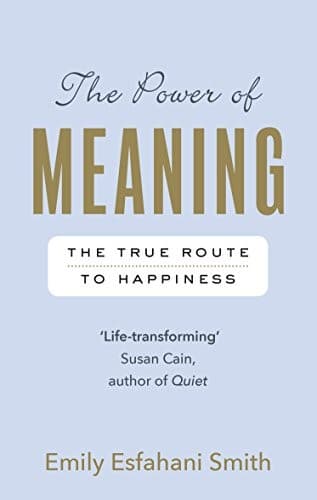
- The book’s central claim is that meaning is not the same as happiness: a good life is not mainly about feeling good, but about feeling that life is significant, coherent, and directed beyond the self.
- Smith argues that meaning rests on four pillars—belonging, purpose, storytelling, and transcendence—and that these can be built in ordinary life, even in secular societies where religion no longer supplies meaning automatically.
What Meaning Is, and Why Happiness Isn’t Enough
- Smith contrasts hedonia (pleasure, comfort, positive feeling) with eudaimonia (flourishing, virtue, contribution, growth), following Aristotle’s idea that the best life is active rather than merely pleasant.
- She uses the experience machine thought experiment to show why constant bliss would still feel empty if it lacked real projects, identity, and earned value.
- Psychological research in the book treats meaning as distinct from happiness: the happy life tends to be easy, low-stress, and self-protective, while the meaningful life often involves more worry, responsibility, and sacrifice.
- In studies cited by Smith, meaning is tied to being a giver, to connection with something larger than the self, and to long-term gains in feeling enriched, inspired, and part of something greater.
- The book frames the modern meaning problem as historical: religion once structured life by default, but in the developed world people increasingly have to build meaning “here on earth.”
The Four Pillars of Meaning
- Belonging means being in relationships where others truly see, value, and care for you, and where you are not socially invisible.
- Smith illustrates belonging with Tangier Island, the SCA “my tribe” community, hospital cleaners recognized by doctors and patients, and brief high-quality connections that leave people feeling human.
- She emphasizes that belonging is not just companionship but mutual obligation; loneliness and social isolation make life feel less meaningful, while even small acts of acknowledgment can restore dignity.
- Purpose is a stable, far-reaching goal that contributes to something beyond the self, not just a hobby or private ambition.
- Ashley Richmond’s work as a zookeeper, Coss Marte’s redirection after prison, and Manjari Sharma’s spiritually informed photography show purpose emerging when talents are put into service.
- Smith treats purpose as especially important in work and youth development: many jobs become meaningful when reframed as service, and adolescents do better when they can connect effort to a larger contribution.
- Storytelling is the process of turning scattered life events into a coherent narrative that explains who we are, where we came from, and what things mean.
- The Moth, Dan McAdams’s narrative identity, and psychotherapy all show that meaning often grows when people rework painful events into stories of growth, agency, or redemption.
- Meaningful lives tend to be narrated as redemptive stories—bad events leading to later insight, closeness, or strength—while contamination stories move from good to bad and are associated with worse well-being.
- Transcendence refers to moments that shrink the self and widen perception through awe, ritual, nature, art, mysticism, or altered states.
- Smith uses Compline, stargazing, wilderness, and psilocybin studies to show that transcendence can dissolve self-focus, expand compassion, and make mortality less frightening.
How Meaning Is Built, Lost, and Rebuilt
- The book argues that modern life often erodes meaning through distraction, overwork, commuting, and consumerism, which weaken time for community, reflection, ritual, and awe.
- Yet Smith also shows that meaning can be intentionally cultivated through institutions and practices that support the four pillars, from StoryCorps and The Future Project to Encore.org and Age-Friendly New York City.
- A recurring caution is that the same pillars can be weaponized: cults, gangs, hate movements, and the Islamic State all offer belonging, purpose, story, and transcendence, but in destructive forms.
- Meaning becomes especially visible in crisis because trauma can shatter assumptions and force people to rebuild their lives around new stories and commitments.
- Smith uses post-traumatic growth research to argue that suffering can produce stronger relationships, new purpose, deeper spirituality, greater appreciation of life, and inner strength.
- She stresses that growth does not make suffering desirable; it means that meaning can emerge if people interpret hardship deliberately and reconstruct some pillar of meaning rather than collapse into nihilism.
- Meaning-centered psychotherapy with dying patients extends this logic to mortality, showing that asking who one is, what mattered, and what legacy remains can reduce hopelessness and death anxiety.
- Viktor Frankl anchors the book’s deepest moral claim: human beings endure by orienting toward a why beyond themselves, especially through love and service.
What To Take Away
- Meaning is broader and more durable than happiness, and the book treats it as the more important target for a life that matters.
- The four pillars—belonging, purpose, storytelling, transcendence—are the book’s main framework for understanding where meaning comes from and how it is repaired.
- Meaning is not reserved for extraordinary lives; it is often created through small acts of care, attention, service, and listening that connect people to one another.
- The book’s deepest warning is that the same human needs that make life meaningful can also be exploited, so the task is not just to seek meaning but to seek it in humane forms.
Generated with GPT-5.4 Mini · prompt 2026-05-11-v6