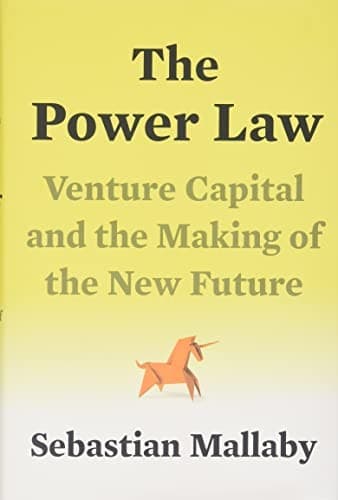
Core Idea
- Venture capital works because returns follow a power law: a tiny fraction of bets produce almost all gains, so VCs must seek a few extraordinary outcomes rather than steady wins.
- Mallaby argues that the industry’s real invention was not just money for startups, but a system for discovering, shaping, and repeatedly restarting talent through equity, networks, and active intervention.
- The book admires VC’s role in building Silicon Valley and later tech giants, but it also warns that the same system can weaken governance, inflate hype, and empower founders or financiers beyond accountability.
How Venture Capital Actually Works
- The modern VC model emerged when equity-only, time-limited limited partnerships replaced clumsy early vehicles like ARD and SBICs, which were too regulated, too small, or too debt-bound to finance risky growth.
- Arthur Rock’s early deals with the Traitorous Eight and Fairchild showed how “liberation capital” let talent defect, own stock, and build companies outside old corporate hierarchies.
- Rock’s 1961 Davis & Rock partnership established the VC template: raise a fund first, keep the investor base limited, concentrate capital in a small set of startups, and aim for 10x returns over about five to seven years.
- Early VC judgment was less about spreadsheets than “Back the Right People”—reading founders’ character, ambition, and resilience when products had no earnings history.
- Don Valentine and Tom Perkins pushed the industry from passive backing to activist capital: they intervened before investing, staged financing to de-risk technical problems, and used board seats to force urgency and managerial upgrades.
- Perkins’s logic at Tandem and Genentech was that if technical risk is removed early, market risk and competition fall too; the model produced huge wins, especially when stock options spread ownership through the firm.
- Mallaby presents VC as a networked institution: deals improve when investors, founders, engineers, and executives circulate through a dense ecosystem of referrals, shared standards, and repeated contact.
Silicon Valley’s Network Advantage
- Silicon Valley’s edge came less from one cause than from the combination of finance, culture, and social structure: irreverent founders, stock ownership, porous labor markets, and VCs who actively connected people.
- AnnaLee Saxenian’s contrast matters throughout the book: Silicon Valley was a web of small, collaborating and competing firms, while Boston and Japan leaned toward more secretive, vertically integrated organizations.
- Weak ties were a feature, not a bug: VCs, engineers, and founders moved between firms, exchanged ideas in places like Walker’s Wagon Wheel, and turned the region into a machine for recombination.
- Apple, Cisco, and later Internet-era firms all depended on this connective tissue; often the decisive investor was not the one who first understood the idea, but the one who could assemble the team and legitimacy around it.
- The book repeatedly shows VCs as relays: they pass companies from founder to manager, from angel to VC, and from one round to the next, often preserving founder energy while upgrading operating capability.
- This same network logic spread globally, especially to China, where U.S.-style VC structures, offshore legal workarounds, and equity incentives helped build a local startup ecosystem that eventually became self-sustaining.
The New Stages of VC, and Its Failures
- In the 1990s and 2000s, angel capital and the internet boom gave founders more leverage; startups like Google could raise money from angels first, then force top VCs to compete on valuation and terms.
- Google’s founders used that leverage to preserve control, culminating in dual-class shares and the idea that founders needed insulation to pursue long-term missions; Mallaby notes this became more controversial as tech power grew.
- Paul Graham and Y Combinator marked a founder-friendly backlash: give hackers small amounts of money, some weekly guidance, and enough structure to launch quickly, but not enough VC intrusion to smother them.
- Peter Thiel pushed the argument further, treating venture returns as maximally skewed, celebrating eccentric founders, rejecting heavy coaching, and building Founders Fund around concentrated, founder-controlled bets.
- As private markets deepened, late-stage capital often came from outsiders—sovereign wealth funds, mutual funds, hedge funds, and SoftBank—who lacked classic VC discipline but chased unicorn momentum.
- That is where the book’s darkest cases appear: Theranos, Zenefits, WeWork, and parts of Uber show how super-voting shares, hype, and endless private funding can leave companies both richly valued and weakly governed.
- Theranos and WeWork especially show the danger of “premature truth” or fake network effects: the language of disruption can mask weak business fundamentals until public scrutiny arrives too late.
- Mallaby does not say classic Sand Hill VCs caused all these blowups; he argues the deeper problem is unicorn governance—private companies staying private too long while control remains concentrated and accountability stays thin.
What To Take Away
- The book’s central claim is that venture capital is a high-skill system for exploiting extreme skew, not a general-purpose funding model.
- VC’s power comes from combining capital, judgment, activism, and networks, not from any one of those alone.
- Silicon Valley’s advantage was built as much by institutional design as by genius: equity, mobility, and connective investors created a regional engine for experimentation.
- The same mechanisms that produce breakthroughs also create fragility when hype outruns oversight, so the biggest lesson is that innovation and governance must be balanced.
Generated with GPT-5.4 Mini · prompt 2026-05-11-v6