Core Idea
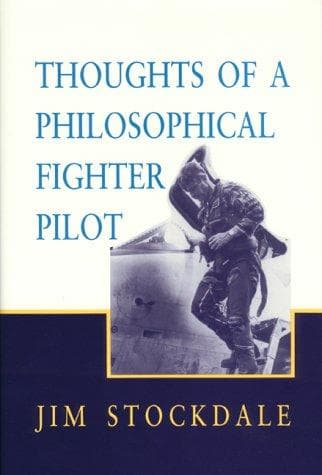
- Stockdale’s book argues that crisis is a crucible: under prison, torture, war, and public failure, people either grow morally or break, and the decisive issue is not comfort but character under pressure.
- His central moral claim is that a person must become “his brother’s keeper”; in captivity and in war, survival depends on loyalty, truthfulness, and mutual obligation rather than private self-protection.
- The book blends memoir, political argument, and philosophy to show that Stoicism, classical virtue, and republican public virtue are not abstractions but practical tools for resisting coercion and preserving self-respect.
Prison, Stoicism, and the Inner Battle
- Stockdale treats Hanoi as a laboratory of the soul where torture, isolation, and shame were the enemy’s real weapons, more dangerous than physical pain.
- He repeatedly turns to Epictetus because the Stoic division between what is up to us and what is not gave him a discipline for captivity: opinions, aims, honor, and judgment remain free even when body and circumstances are not.
- In his reading, pain is tactical but shame is strategic; the interrogator wants to destroy self-respect, guiltlessness, and willingness to stand with fellow prisoners.
- He rejects the idea that prisoners should “lie low” or act as isolated individuals; instead, he insists on prison civilization built through tap code, shared rules, and mutual responsibility.
- His practical maxim is that fear and guilt are chosen vulnerabilities: coercion works by making prisoners accept false guilt, fear exposure, and abandon the group.
- He argues that no one can be morally harmed without some inward assent, so the crucial battle is to guard judgment, reject false guilt, and refuse to betray comrades.
- He also stresses that the good life is not one of emotional numbness; rather, integrity means being integrated, self-consistent, and able to endure ordeal without losing honor.
- Stoic examples matter because they illustrate the same pattern: Socrates, Odysseus, Jesus, Boethius, Cervantes, and Epictetus each embody steadfastness under extreme pressure.
Leadership, War, and Moral Leverage
- Stockdale argues that in war and crisis the essential resource is moral leverage: a clean conscience, courage, and a sense of worthiness that allows people to endure and act.
- He says leaders must be men of the heart, not merely “men of the head,” because technical cleverness, systems-thinking, or game theory without moral commitment produces weakness under pressure.
- He adapts Michael Maccoby’s leader types—Craftsman, Jungle Fighter, Company Man, Gamesman—to argue that none is sufficient for crisis unless joined to a fifth type: the hard-hearted moral leader.
- His ideal crisis leader is a moralist, writer of law, teacher, steward, and philosopher: someone who defines the good, sets standards, cares for followers, explains reality plainly, and does not evade hard truths.
- He treats the Code of Conduct as a real moral guide, not a prohibition on all disclosure; in his account, prisoners are not obliged to give more than name, rank, service number, and date of birth.
- He argues that commanders who feed false hope or evade decisions commit a special cruelty, because people in crisis need honest leadership, not comforting ambiguity.
- His standard model of steadfastness is the biblical reply “But if not” from Shadrach, Meshach, and Abednego: loyalty to principle even when the outcome is the furnace.
Republic, Public Virtue, and the Vietnam Lesson
- Stockdale extends his prison ethics to politics: republics fail when public virtue declines, especially when officials place private interest, cleverness, or convenience above the common good.
- He draws on the Founders’ admiration for Rome, Cato, Polybius, Aristotle, Seneca, and Marcus Aurelius to argue that selfless civic duty is a foundation of republican liberty.
- For him, the Vietnam War reveals what happens when a nation enters war without genuine commitment: the soldier is sent forward, but Congress and the executive reserve the right to revise the cause later.
- He uses the Tonkin Gulf Resolution as a symbol of this problem, arguing that ambiguity, secrecy, and manipulation made it the “engine” of a war that lacked moral leverage from the start.
- His criticism of the “best and the brightest” is that they managed war like a system or game, while the people at risk needed clarity, resolve, and a public national decision.
- He is equally suspicious of media and politics that focus on transient “issues” rather than character; he thinks war-making requires judged conviction, not theatrical message management.
- His ideal of citizenship balances rights and duties, and his larger warning is that a republic cannot survive if it forgets that virtue is not automatic and adversity does not guarantee justice.
What To Take Away
- Character is the decisive resource in prison, war, and politics; Stockdale treats moral endurance as more fundamental than intelligence, technique, or optimism.
- Freedom begins inside judgment: if you cannot control circumstances, you can still control what you assent to, what you fear, and whether you keep faith with others.
- Loyalty matters more than self-preservation when the test is coercion; Stockdale’s prison ethic is built around solidarity, not individual survival.
- Public virtue and private virtue are linked: a republic, like a POW camp, depends on people who can bear truth, accept duty, and refuse to let convenience replace conscience.
Generated with GPT-5.4 Mini · prompt 2026-05-11-v6