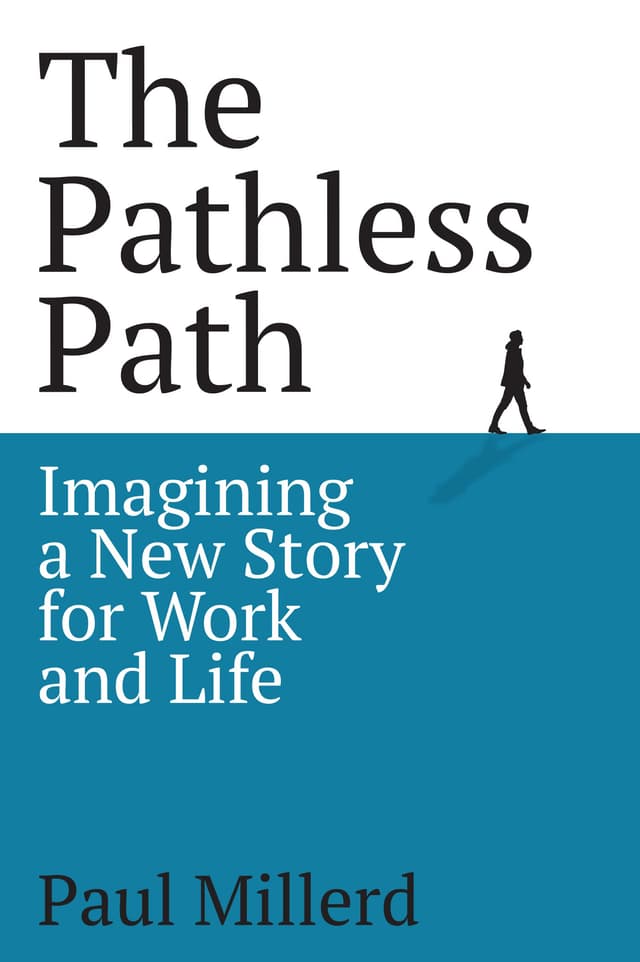
Core Idea
- The Pathless Path argues that the default script of modern success—education, prestige, job, home, family, retirement—no longer fits many lives, and that a better aim is coming alive rather than getting ahead.
- Millerd’s central claim is that leaving the default path is less a heroic leap than a slow, uncertain reorientation toward work, relationships, and a life that feels self-chosen.
- The book treats uncertainty, lostness, and discomfort not as failures to solve but as the normal conditions of building a life outside the script.
The Default Path and Its Traps
- The default path is the culturally shared idea of what a successful adult should do, and in the U.S. it is tied to the American Dream and to life milestones that cluster before age 35.
- Millerd says this script encourages people to internalize “fail conventionally rather than succeed unconventionally,” which makes layoffs, career changes, and nonstandard lives feel shameful.
- His own early life followed this logic: he became a “hoop-jumper,” optimized grades, chased prestige, and used consulting as a fast track into the “inner ring.”
- He frames prestige as dangerous because it rewards what other people already find impressive, so it can warp what you think you want.
- Consulting, GE programs, and McKinsey offered status, social approval, and the feeling of being “smart,” but they also pulled him into work-centric identity and imitation of admired peers.
- The book also questions the assumption that full-time employment is normal or natural, noting that wage-based, full-time work is historically contingent and often treated as the main route to social membership.
- Millerd’s experience at McKinsey and elsewhere shows the mismatch between the appearance of meaning and the lived reality of long hours, busywork, and institutional norms.
What Breaks the Script
- Several existential openings push him away from the old path: his grandfather’s death, his complex Lyme disease, and a growing sense of burnout and cynicism.
- The grandfather’s death reveals how much work had crowded out family, love, and attention; the illness forces him into a different relation to hope, identity, and bodily limits.
- Writing during illness and later through burnout becomes a way to stay oriented; he comes to see that he was not too “smart” to burn out, but simply burned out.
- Burnout is described as a mismatch between personal and institutional values, leading to cynicism, emotional distancing, and grief over a former identity.
- His exit is not a single dramatic moment but a gradual “pebble in my shoe” discomfort that accumulates until he can no longer pretend.
Building a Pathless Life
- Once he leaves, Millerd uses prototyping rather than grand leaps: side projects, coaching, freelance gigs, blogging, and small experiments that reduce risk over time.
- Fear setting helps him name concrete fears, mitigation steps, and the cost of inaction, while also exposing that the deepest fear is often belonging: whether people will still love him if he changes.
- He distinguishes ambition from aspiration: ambition pursues known goals, while aspiration is a journey that changes who you are and often feels vague or defective before it makes sense.
- The pathless path requires finding “the others” — people whose lives make unconventional choices feel possible, from fellow travelers to online communities.
- He argues that many people mistake arrival for happiness, only to find that titles, money, and milestones quickly disappoint and then invite escalation to bigger targets.
- To avoid that treadmill, he proposes defining enough in advance, because otherwise “more” becomes the default response to every insecurity.
- His answer to money anxiety is not maximal accumulation but a more heroic life: one that feels uniquely one’s own rather than merely legible or safe.
- He also emphasizes a gift economy mindset: give without expectation, receive on any timeline, and stay open to being wrong, since generosity builds real ties rather than transactional status.
- The book’s version of success is self-defined: feeling alive, helping people, meeting one’s needs, and creating work that is energizing even when it is not maximally lucrative.
Faith, Leisure, and Non-Doing
- Moving to Taiwan and later building life in places like Taipei, Singapore, Kuala Lumpur, Bali, and Thailand lets him experience wu wei—a non-interfering, non-forced way of moving through life.
- In Taipei he experiences a lighter, more playful rhythm, and meeting Angie reinforces that the pathless path can be shared rather than solitary.
- Faith is defined not as certainty but as the willingness to admit you do not know the outcome and to stay open at the edge of your limits.
- Drawing on Joseph Pieper, he contrasts total work with leisure as a condition of the soul, not merely a break from productivity.
- Money cannot supply the trust required for this life; the deeper requirement is the capacity to sit with uncertainty without immediately converting it into a career plan.
- By the end, the book’s practical advice is less about a specific job model than about questioning the default, experimenting, making friends, creating, giving, and accepting that you can choose your path again every day.
What To Take Away
- The book’s sharpest insight is that many people are not choosing between many real options; they are choosing among versions of the same inherited script.
- Millerd suggests that a meaningful life often begins when prestige, stability, or achievement stop being enough to justify the cost.
- The pathless path is not presented as easy or universally superior, but as a way to trade borrowed certainty for a life with more aliveness, agency, and honesty.
- The deepest challenge is not escaping work, but learning to live well without requiring your life to look conventional before it feels real.
Generated with GPT-5.4 Mini · prompt 2026-05-11-v6