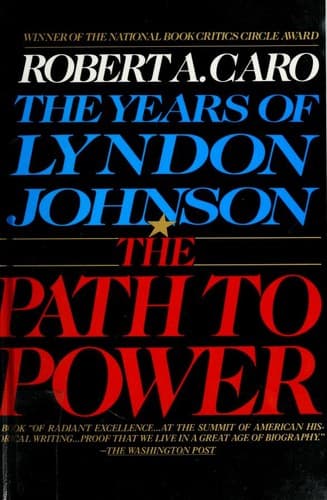
Core Idea
- The Path to Power argues that Lyndon Johnson’s rise can only be understood through the interaction of character, place, and power: a hungry personality, a brutally hard Hill Country environment, and political systems built on money, patronage, and access.
- Caro’s central claim is that Johnson was not driven by ideology so much as by a consuming need for power itself—to dominate people, control institutions, and eventually reach the presidency.
- The book also treats Johnson’s career as a lens on larger American history: the decline of the Hill Country frontier, Populism, New Deal state-building, rural electrification, and the transformation of Congress and the presidency.
Johnson’s Origins: Hill Country, Family Strain, and the Making of Ambition
- Caro roots Johnson in the Texas Hill Country, described as a deceptive “trap” where settlers misread grassland fertility and crossed into a harsh, semiarid world that punished wishful thinking.
- The Johnson and Bunton families embody a tension between dreaming and practicality: the Buntons brought pride, ambition, and heroism, while the Johnsons often lacked the hard realism needed to survive the land.
- Sam Ealy Johnson, Sr. is presented as honest, intelligent, idealistic, and politically gifted, but also financially reckless and ultimately defeated by the economic realities of the frontier.
- Rebekah Baines Johnson came from a more literary and idealistic background, bringing education, discipline, and gentility into a rough farm world that she never fully accepted.
- Lyndon Johnson emerges as a child of intense need: bossy, attention-seeking, competitive, and already hungry to stand out, dominate, and “be somebody.”
- Caro emphasizes that Johnson’s later political style was already visible in youth: secrecy, manipulation, hunger for status, and a willingness to use money or rules instrumentally.
- Sam’s decline matters because Johnson’s attitude toward him changed with it; Caro shows Lyndon worshipping strength and turning rebellious when his father lost authority.
- Johnson’s early life contains both ego and insecurity: he craved adult attention, feared humiliation, and responded to weakness by becoming more forceful.
- His years in San Marcos and Cotulla sharpen these traits, especially through his experiences as a teacher and organizer among poor Mexican-American students.
The Political Method: Money, Patronage, Secrecy, and Total Control
- Caro presents Johnson as a technician of power who learned early that money, favors, and access could substitute for principle.
- His college and campus politics already show recurring patterns: vote-stealing, blackmail, secrecy, selective disclosure, and ruthless coalition-building.
- At San Marcos, Johnson’s rise depended on controlling the White Stars, manipulating elections, and suppressing rivals, a small-scale preview of his later methods in Washington.
- In Cotulla, he became the principal who could finally be “the somebody he had always wanted to be,” using discipline, English-only rules, and relentless exhortation to control poor students and shape their futures.
- Yet even there, Caro shows the emotional motive beneath the command: Johnson needed admiration, deference, and proof that he mattered.
- Johnson’s political genius was not abstract persuasion but personalized domination: remembering names, leaning in physically, buttonholing one voter at a time, and making people feel singled out.
- Caro repeatedly links this style to an organizing principle of Johnson’s career: he built networks through patronage, then converted dependence into loyalty.
- The book argues that Johnson’s secrecy was structural, not incidental: he hid motives, kept separate audiences separate, and tailored his views to whoever could help him.
- This made him appear ideological at times, but Caro insists the underlying constant was not doctrine but advancement.
Washington, New Deal Power, and the Building of a Political Machine
- Johnson’s first Washington years show him learning how Congress and federal agencies actually worked, beginning as a secretary and becoming a ruthless operator of correspondence, casework, and favors.
- He discovered that congressional mail, veteran claims, and bureaucratic pressure could be turned into political capital if handled with extreme speed and precision.
- The Depression and New Deal made his method newly powerful: desperate farmers, unemployed youth, and cash-starved districts needed exactly the kinds of help Johnson could route.
- His work on AAA farm programs, mortgage refinancing, and local crisis meetings shows him as a broker who could translate federal relief into visible local rescue.
- Caro is explicit that Johnson’s effectiveness did not depend on policy idealism; it depended on understanding bureaucracy, flattering officials, and moving people through the system.
- Johnson’s NYA work in Texas becomes a major turning point because it lets him build a statewide organization out of loyal young men, jobs, and favors.
- The NYA also reveals his governing style: relentless work, fast decisions, constant phone calls, total supervision, and a willingness to use the agency as a political training ground.
- His move from district fixer to statewide broker is then amplified by the 1937 Tenth District special election, which he wins through personal campaigning, money, Roosevelt association, and the promise of relief.
- Caro highlights the contrast between Johnson’s public image as a Roosevelt ally and his private conservatism; he supports whatever serves him, while remaining fundamentally pragmatic and self-serving.
What To Take Away
- Johnson’s rise is presented as the product of a rare alignment: a ruthless temperament, a politically primitive but fertile region, and the expanding reach of federal government.
- Caro’s portrait of Johnson is neither simple admiration nor simple condemnation; it is an argument that personality can become historical force when matched to the right institutions.
- The book’s lasting insight is that Johnson learned to convert need into loyalty, access into power, and federal programs into personal political infrastructure.
- By the end of this volume, Johnson is still far from the presidency, but Caro has shown how the habits that would define it—pressure, secrecy, patronage, and ambition without limit—were already fully formed.
Generated with GPT-5.4 Mini · prompt 2026-05-11-v6