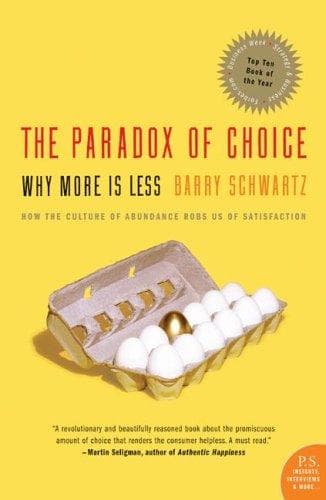
Core Idea
- Schwartz’s central claim is that some choice is essential, but too much choice can become a burden that increases anxiety, decision paralysis, regret, dissatisfaction, and even depression.
- He distinguishes negative liberty (“freedom from” constraint) from positive liberty (“freedom to” live meaningfully), arguing that more options do not automatically make people more free in the sense that matters.
- Modern life turns more and more domains into choice markets—consumer goods, work, health care, retirement, religion, love, and identity—so the problem is not isolated to shopping.
How Choice Becomes a Problem
- Choice overload works because every new option adds opportunity costs: the chosen option is evaluated against what was forgone, not just against a simple standard of adequacy.
- More options also invite people to imagine an ideal hybrid that combines the best features of multiple alternatives, making every real option seem incomplete.
- Schwartz shows that larger assortments often reduce action and satisfaction: in jam and chocolate studies, smaller sets produced more purchases and more contentment than larger sets.
- The same dynamic appears in high-stakes areas like health insurance, retirement plans, and medical care, where complexity raises the cost of mistakes and can overwhelm ordinary consumers.
- Choice is especially taxing because many decisions are socially and psychologically unreal until modern life turns them into explicit decisions, forcing people to constantly act as their own planners and editors.
Why We Choose Poorly
- Wise choosing requires good goals, good information, and good judgment, but people routinely mispredict what will make them happy over time.
- Kahneman’s peak-end rule matters here: remembered experience depends heavily on the worst moment and the ending, not on the full average of the experience.
- Information is unreliable and overwhelming: advertising saturates attention, product branding often substitutes for evidence, and the Internet adds abundance without good filtering.
- Judgment is distorted by availability, anchoring, framing, prospect theory, loss aversion, the endowment effect, and sunk costs.
- These biases make vivid anecdotes, reference points, and prior investments weigh more than statistical reality or detached reasoning.
- Schwartz emphasizes that people become not just choosers but pickers—they select something and hope it works out, rather than calmly optimizing across a stable set of preferences.
Maximizers, Satisficers, and the Emotional Cost of Trade-Offs
- A major distinction in the book is between maximizers, who seek the best possible option, and satisficers, who settle for something good enough once standards are met.
- The Maximization Scale tracks behaviors like comparing constantly, checking alternatives, and never wanting second best.
- Higher maximizing is linked to more comparison, slower decisions, more counterfactual thinking, more regret, less savoring, and less satisfaction with outcomes.
- Schwartz reports that maximizers are less happy, less optimistic, and more depressed; he treats this as correlation rather than proof of causation.
- Trade-offs are the core psychological cost of choice: the more alternatives there are, the more one must think about what is lost, and the less satisfying the final decision feels.
- In experiments, adding attractive options often increased decision avoidance, while a clearly inferior option could make the better choice easier to justify by serving as a comparison point.
- Even trivial decisions can become paralyzing when conflict makes any choice feel hard to defend; the problem is emotional, not just computational.
- Schwartz also argues that reason-giving can backfire: when people are forced to explain choices, they may shift preferences in ways that reduce later satisfaction.
- He is not saying intuition is always right; rather, explicit self-justification can distort choice when options are closely matched and trade-offs are painful.
- Reversible decisions seem attractive, but studies show people are often less satisfied when they can change their minds, because reversibility weakens commitment and amplifies second-guessing.
Regret, Happiness, and the Social Costs of Endless Choice
- More choice means more chances to regret, because more alternatives make it easier to imagine a better outcome and feel personally responsible for not reaching it.
- Schwartz highlights anticipated regret, omission bias, inaction inertia, and the emotional force of near misses as ways regret shapes choice and post-choice evaluation.
- The silver-medal/bronze-medal example shows how comparison standards change emotion: silver medalists compare upward, while bronze medalists compare to missing the podium entirely.
- In the happiness chapters, Schwartz argues that choice has expressive value and supports autonomy, but psychological well-being also depends on control, connection, and commitment.
- He uses learned helplessness to show that lack of control can produce passivity and depression, yet he also argues that too much choice can overwhelm rather than empower.
- Wealth alone does not buy much happiness once basic needs are met; close relationships matter more, even though relationships also impose obligations and limit freedom.
- Modern abundance creates a time problem: managing choices consumes attention that might otherwise go to friends, family, and community.
- Drawing on exit, voice, and loyalty, Schwartz argues that market-style exit is fine for purchases, but social life requires commitment, voice, and constraints rather than perpetual shopping.
- His practical answer is not “choose more,” but use second-order decisions—rules, defaults, standards, and routines—to reduce the number of decisions that must be revisited.
- The book’s final implication is that people often say they want more choice, but once they have it, they may not like the burden that comes with it.
What To Take Away
- More freedom is not always more well-being; the value of choice depends on whether it actually helps people live better, not on the raw number of options.
- Opportunity costs and counterfactuals are what make choice painful, because every option implicitly condemns the road not taken.
- Maximizing is costly in a world of abundance, while satisficing can protect satisfaction by lowering the demand for perfection.
- Schwartz’s deepest warning is that modern life can turn autonomy into anxiety unless people build limits, routines, and commitments that keep choice from becoming a trap.
Generated with GPT-5.4 Mini · prompt 2026-05-11-v6