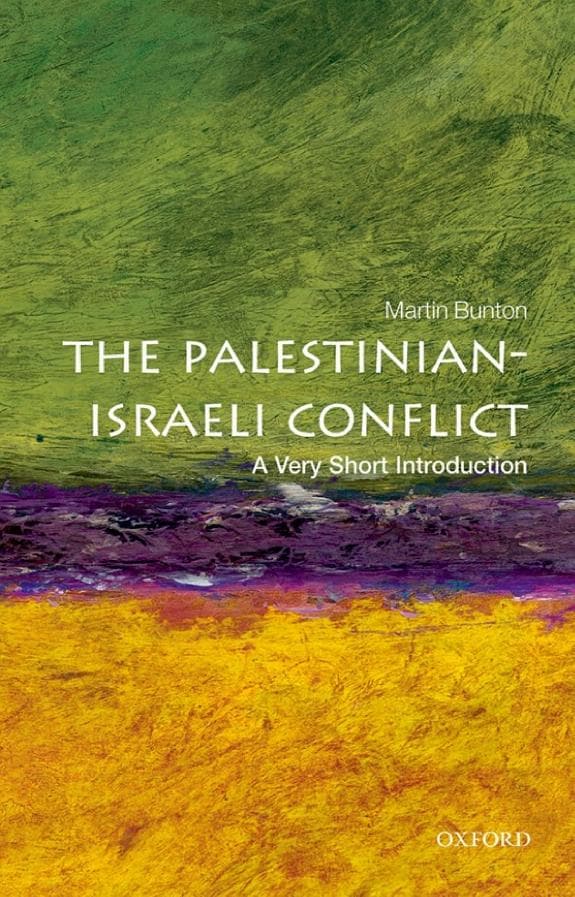
Core Idea
- Bunton presents the conflict as a modern struggle over territory, borders, and sovereignty in “two nations, one land,” not as an ancient religious war.
- His central claim is that every apparent step toward settlement has usually produced a new layer of conflict, progressively “tightening” the territorial knot rather than loosening it.
- The book is organized around decisive turning points—Basel 1897, Balfour 1917, Peel 1937, UN partition 1947, 1967, Oslo, and the intifadas—to show how the conflict was built cumulatively.
How the Conflict Was Made
- Bunton roots the dispute in late Ottoman and British-era changes: Tanzimat land reforms, market pressure, and legal registration helped concentrate land in the hands of notables and made land a political issue.
- He stresses that Palestine was not yet a modern political unit under Ottoman rule; it was a set of districts, while Palestinian national identity emerged later, especially under British rule and in response to Zionist immigration and land purchase.
- Herzl’s Zionism is presented as a modern European nationalist project shaped by anti-Semitism and great-power politics, not chiefly as religious restoration.
- Labor Zionism turned settlement into a social project centered on Jewish labor, separation from Arab labor markets, and institutions such as the kibbutz and the Histadrut.
- The Jewish National Fund (1901) made land purchase and “redemption” central to Zionist institution-building.
- Early Zionist settlement was pragmatic and followed economic opportunity: immigrants favored the coastal plains and valleys, where soil, rainfall, transport links, and citrus potential were better than in the hill country.
- British wartime diplomacy was fundamentally contradictory: McMahon–Husayn, Sykes–Picot, and Balfour pointed in incompatible directions, then were embedded in the mandate system.
- Bunton treats the Balfour Declaration as racially unequal in its assumptions: Jews were recognized as a nation, while the Arab majority appeared only as “non-Jewish communities,” not as Palestinians with political rights.
- The League of Nations mandate uniquely incorporated Balfour and privileged Zionist development, while Britain never created a representative legislature because Arabs feared it would legitimize the mandate’s terms.
From Mandate to War
- The Yishuv built quasi-state institutions—education, health, taxation, Hebrew revival, defense, and labor organization—which deepened separation from the Arab community.
- Jewish immigration surged, especially in the fifth aliyah (1933–36), and Jewish land purchases increasingly shaped the later geography of partition.
- Arab politics remained fragmented, especially through Husayni–Nashashibi rivalry, which Britain exploited through divide-and-rule tactics.
- The 1929 Western Wall riots were a major turning point, showing how quickly communal tensions could become irreversible violence.
- British policy kept shifting: the Passfield White Paper proposed restricting immigration and land purchase, then parts of it were rolled back under Zionist pressure.
- The 1936–39 Arab revolt was a broad anti-colonial and anti-Zionist uprising involving peasants, attacks on railways and police, and a powerful nationalist symbolism, including the keffiyeh.
- Britain crushed the revolt through collective punishment, leaving the Palestinian leadership badly damaged and paving the way for the more restrictive 1939 White Paper.
- During and after World War II, Zionist institutions backed Britain while also strengthening their own military capacity; by the Biltmore Conference (1942), Zionism had moved toward demanding a Jewish state over all of Palestine.
- Postwar militancy by Irgun and Stern Gang accelerated the British exit, while US pressure helped force the Palestine issue into the United Nations.
- UN partition (1947) proposed a Jewish state on about 55 percent of Palestine despite Jews being about a third of the population and owning under 10 percent of the land; the Arab side rejected it.
- Britain’s withdrawal made implementation impossible, and the ensuing 1947–49 war produced the nakba: around 750,000 Palestinians fled or were expelled, Palestinian society was destroyed, and refugee camps and the right of return became enduring political facts.
- Israel’s victory expanded its control to about 78 percent of mandate Palestine, while Jordan took the West Bank and East Jerusalem’s Old City and the internationalization of Jerusalem failed.
- Palestinians who remained inside Israel gained citizenship but lived under military rule and discriminatory land policies until 1966.
Occupation, Uprisings, and the Unfinished Peace Process
- The 1967 war transformed the conflict again by giving Israel the West Bank, Gaza, East Jerusalem, Sinai, and the Golan Heights, creating the core problem of occupation.
- UN Security Council Resolution 242 introduced the “land for peace” formula, but the Khartoum “three noes” showed how far the parties remained apart.
- The PLO, founded in 1964 and later dominated by Fatah under Yasir Arafat, came to represent Palestinian nationalism, though its charter insisted that only armed struggle could liberate all of Palestine.
- The PLO’s legitimacy was repeatedly harmed by militant actions and by its expulsion from Jordan in 1970, after which it relocated to Lebanon and became entangled in regional conflict.
- Israel’s 1982 invasion of Lebanon expelled the PLO from Beirut and helped generate new Shi’ite resistance movements, including Hizbullah.
- The first intifada (1987) marked a major shift because it showed mass Palestinian mobilization from below and forced the PLO toward recognizing Israel and accepting a two-state framework in 1988.
- Oslo (1993) created mutual recognition and a phased Palestinian Authority, but it postponed the hardest issues—borders, refugees, settlements, and Jerusalem.
- Oslo’s interim geography fragmented the West Bank into controlled zones, while settlement expansion and bypass roads kept enlarging Israeli control, especially in Area C.
- Palestinian frustration deepened as Arafat centralized power, while Hamas emerged as a religious and anti-Oslo challenger that treated all of mandate Palestine as an Islamic waqf.
- The peace process collapsed further after Rabin’s assassination, Netanyahu’s election, and the failure of Camp David II and later Clinton parameters to bridge gaps on sovereignty, refugees, and Jerusalem.
- The al-Aqsa/second intifada followed Sharon’s visit to al-Haram al-Sharif/Temple Mount and Israel’s deadly response, producing massive casualties and hardening both sides.
- The second intifada strengthened Hamas, weakened Fatah, led Israel to destroy Palestinian Authority infrastructure, and helped Sharon justify the separation barrier and disengagement from Gaza.
- Bunton sees settlements as the central obstacle today: more than 500,000 settlers, expanding infrastructure, and encircled East Jerusalem make a contiguous Palestinian state increasingly hard to imagine.
- His preferred outcome remains two states based on the 1949 armistice lines, with shared Jerusalem, a negotiated refugee settlement, and limits on Palestinian military forces.
What To Take Away
- The book’s core message is that the conflict is best understood as a historically constructed territorial struggle, not a timeless religious enmity.
- British rule, wartime promises, partition, occupation, and failed diplomacy each added new layers to the same territorial dispute.
- Bunton still treats two states as the clearest framework, but argues the window is narrowing because of settlements, hardliners, division, and weak leadership.
- If two states fail, he sees only two broad alternatives: a binational state with equal rights or an apartheid-like system of fragmented Palestinian enclaves.
Generated with GPT-5.4 Mini · prompt 2026-05-11-v6