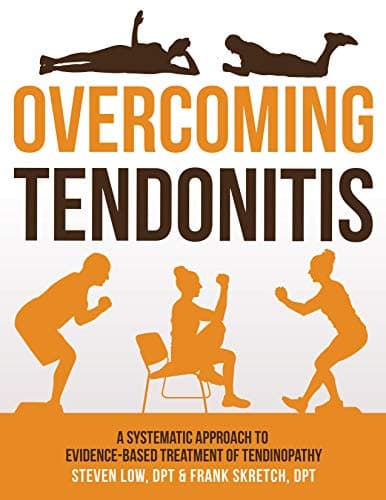
Core Idea
- Tendinopathy is not one condition: treatment and prognosis vary by tendon, body region, irritability stage, and whether the tendon is reactive, dysrepair/failed-healing, or degenerative.
- The book’s central argument is that pain, pathology, and function do not match neatly; imaging abnormalities are common even in painless tendons, and rehab should target load tolerance and function rather than “fixing” a picture on ultrasound or MRI.
- The authors favor an evidence-based, staged loading approach over rest-only, inflammation-focused, or one-size-fits-all tendon treatment.
How the Book Explains Tendinopathy
- The preferred term is tendinopathy, because “tendonitis/tendinosis” can falsely imply either inflammation or a single tissue state.
- The book uses a continuum model: reactive tendinopathy is an acute overload response, dysrepair/failed healing adds matrix disorganization and attempted repair, and degenerative tendinopathy is more hypocellular, disorganized, and often only partly reversible.
- Tendon pathology can include hypercellularity, neovascularization, neuronal ingrowth, collagen disorganization, proteoglycan pooling, and weakened type III collagen replacement, but these findings do not reliably predict symptoms.
- A major clinical point is that a tendon can be structurally abnormal and still painless, and even rupture can occur without prior pain or stiffness.
- Risk is usually a mix of intrinsic factors such as age, sex, obesity, weakness, flexibility, and body structure, plus extrinsic factors such as repetitive work, sport volume, impact, technique, and sudden load spikes.
- The authors repeatedly distinguish painful from aggravating exercise: pain alone does not mean harm, but an exercise that worsens symptoms and performance over time is a problem.
What Helps, What Does Not, and Why
- The preferred rehab logic is medical screening → classify the tendon → judge irritability → choose outcomes → select interventions → re-evaluate and adjust.
- Rest may help in reactive or early dysrepair stages, but is much less useful once the tendon is more degenerative; if rest fails, loading rehab becomes the main tool.
- Ice is generally dismissed as a tendinopathy strategy because the condition is usually not primarily inflammatory; it may only mask pain or affect surrounding tissues.
- RICE is rejected in favor of MEAT: Movement, Exercise, Analgesia, Treatment, with early movement and rehab preferred over immobilization.
- NSAIDs/paracetamol may reduce pain short term, but they are not tendon-healing treatments and may have negative effects on muscle or collagen synthesis.
- The authors do not treat increased blood flow as a main goal; modalities like heat, contrast baths, or “voodoo flossing” are not aimed at the core pathology.
- Eccentric loading is important, but the book argues it is not magically superior to combined eccentric-concentric loading; contraction type matters less than appropriate load, intensity, volume, and progression.
- Evidence is limited by small studies and mixed protocols, but the authors still rank eccentric/exercise therapy as the strongest general intervention, with isometrics especially useful for short-term pain relief.
- Isometrics are positioned as a bridge when pain limits training, often at roughly 70–85% MVIC for repeated holds, with the goal of reducing pain and lowering inhibition.
- A practical loading rule is to keep exercise pain roughly in the 0–3/10 range; higher pain often produces compensation and poor technique.
- Rehab should progress from pain reduction/irritability control → strength → functional strength → power → stretch-shortening cycle/return to sport.
- The book emphasizes graded exposure and symptom-guided continuation of sport when possible, usually with a meaningful volume reduction rather than total shutdown.
- Monitoring concepts such as ACWR and HRV are used to frame reinjury risk as a “too much, too soon” problem and to guide load adjustment.
Interventions the Authors Discuss
- For pain relief, isometrics are the most emphasized tool; GTN, TENS, needling/acupuncture, and sometimes manual therapy are adjuncts with more limited or site-specific evidence.
- Corticosteroid injections can help short-term pain but are viewed cautiously because of tendon weakening and rupture risk.
- ESWT is described as potentially favorable but not a first-line replacement for loading rehab.
- PRP, autologous blood injection, prolotherapy, ultrasound, and many supplements are not presented as strong primary answers; evidence is weak, mixed, or unconvincing.
- Botox may reduce pain in some upper-extremity cases, but evidence is not compelling for Achilles and it can create undesirable weakness, so it is a last-resort adjunct if function can tolerate it.
- Ergonomics is treated cautiously: it may improve general comfort, but the evidence is too weak to make firm tendon-specific promises.
- Manual therapy, massage, and deep friction work may help pain or mobility as adjuncts, but not as stand-alone tendon solutions.
- Stretching can be useful when range of motion is limited, especially as an adjunct, but stretching alone is not enough; ballistic stretching is not recommended.
Site-Specific Rehab Logic
- The book repeatedly insists that tendon location matters, so exercises should be matched to the involved region and sometimes to the tendon sub-region.
- Insertional Achilles is more irritable because compression near the bursa is a problem; it starts with flat-ground calf raises and avoids heel drop below neutral.
- Mid-portion Achilles more often tolerates incline or step-based calf raises and progresses more readily.
- Patellar tendinopathy commonly uses decline-board squats, knee-extension eccentrics, and step-downs before moving to single-leg and sport-specific work.
- Tennis elbow and golfer’s elbow are not treated as identical; wrist flexion, pronation/supination, and finger-flexor patterns may need different emphases.
- Rotator cuff rehab often needs work for supraspinatus plus infraspinatus/teres minor and scapular control, not just isolated shoulder pain relief.
- Hamstring rehab differs for proximal versus distal involvement, with different loading choices for each.
What To Take Away
- Tendinopathy is a load-management problem first, not simply an inflammation problem, and symptoms do not map cleanly onto tissue appearance.
- The most durable strategy in the book is progressive, individualized loading, often using isometrics for pain control and eccentric-concentric work for rebuilding capacity.
- Passive modalities can be used as adjuncts, but the authors consistently return to exercise, progression, and symptom-guided adaptation as the core of treatment.
- The big caution throughout is to avoid oversimplified tendon rules: the right plan depends on tendon type, stage, irritability, sport demands, and the person’s broader movement and stress context.
Generated with GPT-5.4 Mini · prompt 2026-05-11-v6