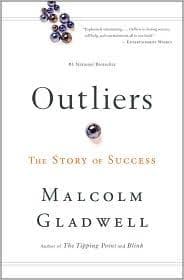
Core Idea
- Outliers argues that extraordinary achievement is rarely just the product of innate talent; it is usually built from timing, culture, family background, institutional support, and unusual opportunities.
- Gladwell’s recurring claim is that success comes from accumulated advantage: small early edges, repeated practice, and social conditions compound until they look like personal genius.
- The book also shows that failure is often misread as individual deficiency when the real issue is a mismatch between a person and the systems, norms, or opportunities around them.
How Success Gets Built
- The Matthew Effect is Gladwell’s name for the way early advantages snowball, as in Canadian hockey players born just after the age-cutoff who get selected earlier, receive better coaching, and keep pulling ahead.
- The same mechanism appears in education and elite fields: the relatively oldest students in a grade tend to score higher, and institutions often mistake maturity-related advantage for superior ability.
- Gladwell’s 10,000-Hour Rule says world-class expertise usually requires about 10,000 hours of deliberate practice, not just “natural” ability.
- The Beatles, Bill Joy, and Bill Gates all benefited from unusually rich practice environments that gave them far more hours of meaningful work than their peers.
- Gates and Joy were not simply lucky in a vague sense; their access to time-sharing computers, permissive environments, and repeated opportunities let them accumulate expertise very early.
- Gladwell’s point is that elite performance depends on opportunity structures that make intense practice possible, not just on effort in the abstract.
- He extends this idea to wealth, noting that many great fortunes were made by people born into unusually favorable historical windows, especially around the railroad and industrial boom or the rise of personal computing.
Intelligence, Class, and Practical Intelligence
- Gladwell challenges the idea that high IQ alone predicts major success; intelligence matters up to a point, but beyond a threshold it adds little compared with other advantages.
- Christopher Langan, the “smartest man in America,” is used to show that very high intelligence can still fail to translate into achievement without the practical skills needed to navigate institutions.
- The Terman Termites did not become uniformly extraordinary adults, which Gladwell uses to argue that genius-selection based on IQ overpromises what intelligence tests can predict.
- He distinguishes convergence tests from divergence or creative thinking, suggesting that raw IQ misses forms of imagination and associative thinking that matter in real life.
- Practical intelligence in the book means knowing what to say, to whom, and when; it is tied to upbringing, socialization, and confidence in dealing with institutions.
- Annette Lareau’s contrast between concerted cultivation and accomplishment of natural growth explains why middle-class children often learn to advocate for themselves and to expect adult responsiveness.
- Langan lacked that institutional ease, while Robert Oppenheimer had it, and Gladwell uses the contrast to show how social polish can matter as much as intellect.
- Gladwell treats many “squandered” gifted children as products of social class, not missed genetic potential; being smart is not enough if you cannot deploy that smartness effectively.
Culture, Work, and Learning
- Gladwell argues that culture can create advantages as well as obstacles, and he repeatedly links achievement to inherited habits of work, deference, persistence, and communication.
- Joe Flom rose in law partly because anti-Semitic exclusion pushed Jewish lawyers into litigation and hostile takeovers, where the white-shoe firms were unwilling to compete.
- Flom’s success was not a simple underdog story; discrimination created a niche that matched his skills just as corporate law was shifting toward takeover battles.
- A similar generational story appears with the Janklows, where being born in the right demographic trough gave the younger generation better schooling and opportunities than the older one.
- Gladwell uses the garment trade to show how immigrant Jewish families developed practical, entrepreneurial habits that later translated into professional success.
- In Harlan, Kentucky, and related Southern contexts, Gladwell presents violence as part of a culture of honor rooted in herding societies where reputation and retaliation mattered intensely.
- The Michigan insult experiment and later evidence on Southern aggression are used to argue that these norms persist long after the original economic conditions disappear.
- The Korean Air case shows a different cultural pattern: high power distance and deferential speech made it hard for junior crew members to warn captains directly in emergencies.
- Korean Air’s turnaround came from restructuring communication, retraining crews, and reducing hierarchy in the cockpit, not from replacing Korean identity itself.
- Gladwell also uses wet-rice agriculture to argue that demanding, labor-intensive farming traditions can foster persistence, attention, and comfort with hard work.
- The Asian math advantage in the book is linked partly to number-word systems that are more regular and easier to manipulate, and partly to cultural habits of persistence.
- Schoenfeld’s “glorious misconception” example shows that mathematical success depends on sticking with a problem long enough to make sense of it, not merely on quick answers.
Education, Time, and Opportunity
- KIPP Academy is Gladwell’s most concrete example of institutional design: it takes poor students and gives them a culture of discipline, longer hours, and explicit behavioral norms like SSLANT.
- KIPP’s results suggest that the gap is not only about talent; it is also about time spent learning and the habits students are taught to bring to school.
- Gladwell argues that the American school year is unusually short, and that long summer breaks disproportionately help affluent children because they have camps, books, tutors, and structured activities.
- Karl Alexander’s Baltimore research supports this by showing that much of the achievement gap opens during summer rather than during the school year itself.
- KIPP mirrors the “rice paddy” model more than the traditional American calendar: long days, Saturday classes, summer school, repetition, and steady reinforcement.
- Marita’s story captures the tradeoff: KIPP demands a near-adult work schedule from children, but it gives them a real shot at college and upward mobility.
- Gladwell’s broader educational claim is that schools can change outcomes when they build the right culture and time structure, not just when they identify “the best” students.
- The epilogue turns this into family history through Joyce Gladwell: her opportunities were shaped by colonial color hierarchy, scholarship policy, and a family line that already had some access to education.
- Even this personal success story is shown to rest on inherited structural advantages, not pure individual merit.
What To Take Away
- Outliers argues that exceptional achievement is best understood as the product of systems, not isolated individuals.
- Small early advantages can become decisive when institutions reward readiness, polish, or access more than raw potential.
- Cultural norms about honor, hierarchy, effort, and communication can either block success or make it easier.
- The book’s lasting message is that society overstates self-made excellence and underestimates the hidden scaffolding that makes excellence possible.
Generated with GPT-5.4 Mini · prompt 2026-05-11-v6