Core Idea
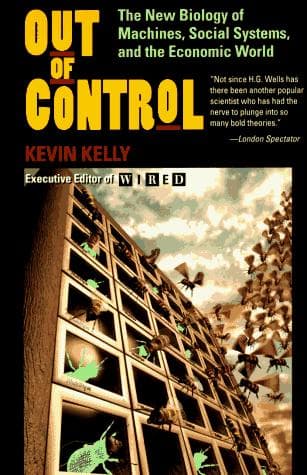
- Kelly’s central claim is that the most important systems of the future will be vivisystems: self-organizing, self-repairing, self-improving networks in which the born and the made increasingly merge.
- He argues that as systems become more life-like, they gain adaptability, resilience, and novelty, but they also become harder to centrally control.
- The book’s big inversion is that life, not machine-like clockwork, is the better model for complex future technology, organizations, and even planetary systems.
How Complex Systems Work
- Distributed intelligence is a recurring theme: bee hives, flocks, markets, brains, and networks coordinate through local rules, sparse communication, and feedback rather than top-down command.
- Kelly treats the hive as a superorganism and audience-controlled demos, flocking algorithms, and swarm robotics as proof that collective order can emerge from many simple agents.
- His key concept is emergence: higher-level properties appear that cannot be inferred from the parts alone, so the system must be run to be understood.
- He links memory and perception to distributed reconstruction rather than stored files, using clinical amnesia cases and sparse distributed memory research as evidence.
- The book repeatedly contrasts clockware with swarmware: use the former when supreme control matters, the latter when adaptation, robustness, and evolution matter more.
- Network logic is central: the Net replaces the Atom as the era’s icon because it captures interdependence, hubs, flows, and no single center.
- But networks are not pure anti-hierarchy; Kelly emphasizes nested hierarchies and layered control, with fast local actions feeding slower higher-level structures.
Life, Technology, and Coevolution
- Kelly’s most ambitious move is to say that nature and technology are coevolving into one another: organisms are engineered by humans, while machines borrow biological traits like replication, learning, self-governance, and repair.
- He calls gardens, economies, corporations, robots, circuits, and ecologies alike vivisystems because they all exhibit some degree of life-like organization.
- Coevolution is a major explanatory engine: monarchs and milkweed, chameleon and mirror, ants and acacia, and even markets and strategies all adapt in response to each other.
- He treats Earth itself as a vivisystem/Gaia: the atmosphere, rocks, and living matter form a coevolving, self-regulating whole in persistent disequilibrium.
- The Gaian point is not that the planet is conscious, but that life and geology jointly regulate conditions in ways that look like a distributed thermostat.
- Kelly’s evolutionary stance is that life is a form of learning: not magical foresight, but iterative adaptation, feedback, and selection across interacting systems.
- He extends this to culture and game theory, where repeated interaction makes openness, reputation, and Tit-for-Tat-like cooperation more effective than secrecy in many nonzero-sum settings.
Building and Growing Systems
- Chapter by chapter, Kelly argues that complex systems generally cannot be fully designed in one shot; they must be assembled incrementally, often with temporary scaffolds and indirect control.
- The ecological restoration examples show that successful ecosystems depend on the right sequence, chaperone species, disturbance regimes, and hidden stowaways, not just the right inventory of species.
- The reef, prairie, Bermuda island, and Biosphere 2 examples all show that assembly order matters and that some species or supports are only needed during startup.
- His closed-world experiments suggest that a system can be materially sealed yet remain viable if it can close the bio-elemental loops and preserve enough turbulence to prevent stagnation.
- Biosphere 2 becomes the emblem of this idea: a large, closed, energetically open ark whose fate depends on whether human engineering can eventually hand control over to biology.
- In robotics, this logic appears as Rodney Brooks’s subsumption architecture and his vision of fast, cheap, and out of control mobots that act embodied in the real world rather than relying on a central model.
- Kelly insists that embodiment matters: intelligence without a body is misleading, because sensory deprivation and disembodied computation drift into hallucination and fantasy.
Evolution as Search, Creativity, and Direction
- Kelly repeatedly recasts evolution as search through a vast space: Borges’s library, Karl Sims’s evolving images, Dawkins’s biomorphs, Latham’s forms, and Koza’s genetic programming all model discovery as guided variation.
- A central lesson of artificial evolution is that search can become creativity when the space is large enough and the selection process is good enough.
- He favors variable-length, open-ended systems over fixed-gene systems because open genomes and recursive primitives allow richer evolutionary possibilities.
- The artificial life movement, from Game of Life to Tierra, argues that life is a process, not a substance, and that new life-like systems can be built to study life itself.
- Kelly is especially interested in hyperlife: a broad category of strong, cohesive vivisystems that includes rain forests, networks, simulations, and machines.
- In his view, evolution is not just changing but becoming more evolvable: more complex, diverse, codependent, specialized, and capable of generating novelty.
- He also argues that organisms and organizations can learn before genes catch up, so flexibility, culture, and adaptation can steer long-term evolutionary outcomes.
- The endpoint is not a final perfected form but perpetual novelty: systems that keep generating new possibilities, including machines that evolve their own architectures.
What To Take Away
- The book’s deepest argument is that the future belongs to systems that are self-organizing, embodied, and coevolutionary, not centrally optimized machines.
- Kelly treats control as a limited and often counterproductive ideal in complex domains; survival comes from designing conditions under which systems can grow, adapt, and surprise us.
- His broadest synthesis is that biology is the prototype for postindustrial design, and the ultimate technology may be less like a machine and more like a living ecology.
- The book ends by making evolution itself the model: not a ladder of progress, but an open-ended process whose real achievement is the creation of possibility.
Generated with GPT-5.4 Mini · prompt 2026-05-11-v6