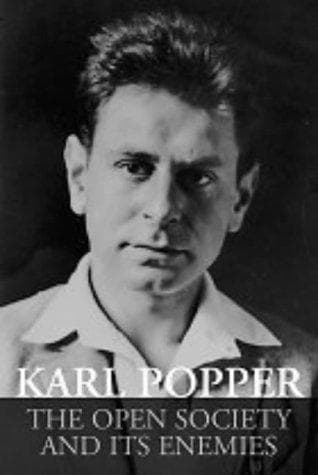
Core Idea
- Popper argues that the great threat to freedom is historicism: the belief that history follows discoverable laws that let thinkers predict the future and justify political destiny.
- Against this, he defends the open society as a moral and political order built on criticism, individual responsibility, and piecemeal social engineering rather than utopian blueprints.
- The book’s central enemies are Plato, Hegel, and Marx insofar as they supply intellectual cover for closed, tribal, or totalitarian politics.
Popper’s Main Argument Against Historicism
- Historicism treats individuals as pawns of larger forces—tribe, class, race, nation, or “history”—and confuses scientific laws with long-range historical prophecy.
- Popper insists that the future depends partly on our own decisions, so no social science can legitimately forecast the course of history in the prophetic sense historicists want.
- He distinguishes scientific prediction from historical prophecy: science can test laws and make limited forecasts, but it cannot foretell the shape of civilization as a whole.
- Historicism is politically harmful because it encourages passivity, excuses responsibility, and makes people act like “fate’s prophets” instead of makers of their fate.
- Popper repeatedly shows how historicism flatters intellectuals, offers apparent certainty, and can become self-fulfilling when people surrender democratic reform to supposed necessity.
- He ties the rise of the open society to a long moral and spiritual revolution: rejection of authority-for-its-own-sake, acceptance of criticism, and concern for reducing avoidable suffering.
Plato, Closed Society, and the Spell of the “Best State”
- Popper treats Plato as the most powerful anti-open-society thinker because Plato wants to arrest all political change and restore an idealized tribal order.
- Plato’s political ideal is not really a future utopia but a reconstruction of a lost Golden Age: a rigid caste state modeled on Sparta and Crete.
- The Platonic state is built on class privilege, not equality: rulers/guardians monopolize arms, education, and power, while the ruled remain unarmed and uneducated.
- Plato’s definition of justice is “each class minding its own business,” which Popper reads as stability of caste rather than justice among individuals.
- The state is treated as a super-organism or herd, and ruling becomes a kind of herdsmanship over human cattle.
- Plato uses breeding, eugenics, censorship, communal property, and the community of women and children to preserve ruling-class unity and prevent social change.
- Popper reads the Platonic Number and related breeding doctrines as pseudo-scientific attempts to manage degeneration by exact reproductive control.
- Plato’s hostility to democracy is central: he depicts democratic freedom as lawlessness, then traces democracy’s collapse into tyranny through class conflict and demagoguery.
- Popper admires Plato’s sociological insight but rejects his conclusion: Plato diagnoses decay brilliantly, yet uses the diagnosis to justify repression and caste rule.
Reason, Science, and Social Reform
- Popper’s alternative to utopian politics is piecemeal social engineering: solve specific harms first, test reforms, and revise them through criticism.
- He contrasts this with Utopian engineering, which starts from an ideal blueprint for the whole society and therefore tends toward centralization and dictatorship.
- In Popper’s view, good institutions are judged by what they do, not by some hidden essence or historical destiny.
- This connects to his broader critical dualism of facts and decisions: norms, proposals, and standards cannot be derived from facts, even though decisions themselves are factual events.
- Popper rejects both moral positivism (“what is, is right”) and the idea that future success determines moral truth; standards must be judged critically, not inherited from power.
- He also attacks essentialism in philosophy and social science, arguing that the search for hidden essences too easily becomes verbalism, scholasticism, or authoritarian “oracular” philosophy.
- By contrast, scientific inquiry is fallibilist: we learn by conjecture, criticism, and correction, not by claiming certainty or final definitions.
Marx, Hegel, and the Modern Closed Society
- Popper treats Marx as a humane but mistaken historicist: Marx offered a powerful critique of exploitation, yet wrongly turned it into prophecy about the inevitable collapse of capitalism.
- He rejects Marx’s claim that history must lead to a classless society; even if the bourgeoisie disappears, a new ruling class may arise among the victorious workers.
- Still, Popper accepts parts of Marx’s analysis, especially attention to economic structure, class conflict, and the need to control unchecked economic power.
- He argues that democracy, not prophecy, is the practical way to restrain both political and economic domination.
- Hegel is presented as a major channel for modern irrationalism and nationalism: he turns the state into the embodiment of Spirit, glorifies war, and legitimizes national destiny and great men.
- Popper sees Hegelian and later nationalist thought as reintroducing tribal collectivism in modern form, with war, power, and historical mission replacing equal citizenship.
- Throughout, Popper contrasts these systems with the liberal-democratic ideal exemplified by Pericles, Socrates, and the humanitarian universalism of Democritus.
What To Take Away
- The open society depends on criticism, accountability, and limited reforms, not on prophetic certainty or grand historical laws.
- Plato’s political philosophy is, for Popper, a sophisticated defense of closed, tribal, anti-individualist order disguised as wisdom.
- Marx and Hegel matter because they modernize the same temptation: to treat history, class, or nation as a substitute for responsible human decision.
- Popper’s lasting claim is that we should stop pretending to be history’s prophets and instead become its critics and makers.
Generated with GPT-5.4 Mini · prompt 2026-05-11-v6