Core Idea
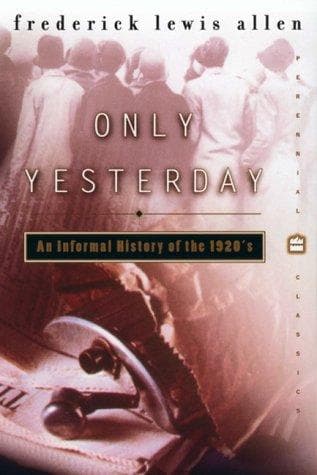
- Only Yesterday treats the 1920s as a still-fresh “contemporary history” of American public mind and daily life, from Armistice Day 1918 to the stock-market crash of late 1929.
- Allen’s central claim is that the decade was defined less by formal policy than by changing moods: postwar disillusion, moral revolt, business triumph, mass spectacle, and finally collapse.
- The book’s stakes are national: the 1920s remade manners, sex, religion, business, media, crime, and politics, then ended in the crash and Depression that exposed how fragile the era’s confidence had been.
The Postwar Break: Disillusion, Red Scare, and “Normalcy”
- The war ended with Wilsonian idealism, but the “bubble” was quickly punctured by disillusion, labor conflict, inflation, and a turn toward anti-radicalism.
- Allen stresses that the Red Scare was real but wildly exaggerated: the actual radical movements were small, yet bombs, strikes, and fear of Bolshevism produced a climate of hysteria.
- The Palmer raids, deportation fever, and attacks on socialist meetings show how wartime habits of summary action carried into peace.
- Prohibition was pushed through by wartime moral militancy and anti-German feeling, but enforcement was doomed from the start by geography, loopholes, and tiny federal manpower.
- Wilson’s tragedy, in Allen’s account, lies in his inability to compromise: he went to Paris to build the League of Nations, but returned home insisting on the Treaty as a moral whole, just as the country was turning against crusading idealism.
- Henry Cabot Lodge personifies the anti-Wilson reaction: nationalist, Senate-centered, and determined to keep the U.S. free of entangling alliances.
- Harding’s rise marks the national turn to “normalcy”: he was chosen because he was genial, unthreatening, and restorative rather than visionary.
- Allen’s portrait of Harding is bluntly double-edged: personally reassuring, but politically weak, ill-informed, and surrounded by the Ohio gang and administrative corruption.
The New Mass Culture: Manners, Sex, Media, and Spectacle
- Allen’s most famous theme is the “Problem of the Younger Generation”: a revolt among respectable sons and daughters over sex, smoking, drinking, dancing, dress, and parental authority.
- The flapper becomes the visual emblem of change: shorter skirts, bobbed hair, cosmetics, looser dresses, and a new body ideal aimed at youth and allure rather than domestic respectability.
- The new dance culture, especially the fox-trot and saxophone-driven music, makes courtship physically closer and more openly sensual.
- Allen links this moral shift to multiple forces: war disillusionment, women’s emancipation, Freud, prohibition, automobiles, confessional magazines, and movies.
- Women’s suffrage mattered symbolically, but the larger change was practical emancipation from housework through appliances, ready-made goods, laundries, canned foods, and paid employment.
- The automobile and prohibition together reshaped social life: cars created private spaces beyond supervision, while speakeasies and cocktail parties replaced the old masculine saloon with mixed drinking.
- New vocabularies of sex psychology and modern science spread through popularization, making terms like libido, inferiority complex, and Oedipus complex part of ordinary speech.
- Allen treats this as a real cultural revolution, but also as a confusing one: old restraints fell faster than a stable new code could form.
Business, Prosperity, and the Age of Ballyhoo
- After the 1921 slump, prosperity returned and became the era’s dominant fact; Allen calls the businessman the period’s dictator of destinies.
- The boom rested on mass production, Europe’s weakness, careful management, and Republican confidence, but also on installment buying and stock-market speculation, which pulled future income into the present.
- The automobile, radio, appliances, chain stores, movies, and advertising created a new consumer civilization; business and culture increasingly used the same language of salesmanship and appeal.
- Advertising shifts from describing products to selling emotions, status, youth, and fear; Allen treats campaigns like Listerine’s halitosis pitch as archetypal.
- The market of the 1920s becomes a public obsession before 1929, but the crash reveals how far speculation had outrun reality.
- In Allen’s phrase, the decade is an age of “ballyhoo”: people are mobilized by spectacles, from crosswords and murder trials to Scopes, Lindbergh, and prizefights.
- The press and radio do not invent every craze, but they amplify whatever can be turned into a national one-tune-at-a-time event.
Highbrows, Fundamentalists, Crime, and the Crash
- Allen sees a Revolt of the Highbrows against mass standardization, business culture, censorship, and majority morality, voiced by Mencken, Sinclair Lewis, and a new urban intellectual class.
- That revolt is sharpened by scientific skepticism and by the split between Fundamentalists and Modernists in Protestantism; the Scopes trial dramatizes the clash between literalism and modern thought.
- Yet the revolt is ambivalent: it debunks old certainties but often leaves behind emptiness, irony, and the question of what replaces lost faith.
- Prohibition proves to be the great failure of moral legislation, producing bootlegging, speakeasies, mixed drinking, and eventually a national underworld.
- Al Capone and Chicago gangsterism embody the consequences: organized vice, political corruption, theatrical violence, and a racketeering economy built on intimidation and bribery.
- Allen extends the same pattern to land booms, especially Florida: boosterism, speculation, and fantasy wealth create a bubble that collapses under default and hurricane.
- The culminating disaster is the stock-market crash of 1929, which Allen presents as both an economic break and a psychological reversal after years of inflated confidence.
- The crash destroys paper wealth, exposes structural weakness, and ends the era’s mood of effortless prosperity.
- The opening of the 1930s brings partial stabilization in some cultural habits, but also the Depression, which makes clear that the 1920s were not just a carefree decade but a fragile order now broken.
What To Take Away
- The 1920s in Allen’s telling are best understood as a struggle between postwar disillusion and new mass confidence, with neither side fully stable.
- The decade’s signature changes were cultural as much as economic: sex, dress, leisure, media, religion, and status were all reorganized around modernity.
- Many “victories” of the age were unstable or self-undermining: prohibition bred illegality, prosperity bred speculation, publicity bred ballyhoo, and reform bred backlash.
- Allen’s final judgment is not nostalgic or celebratory; the 1920s matter because they created the modern America that entered the Depression.
Generated with GPT-5.4 Mini · prompt 2026-05-11-v6