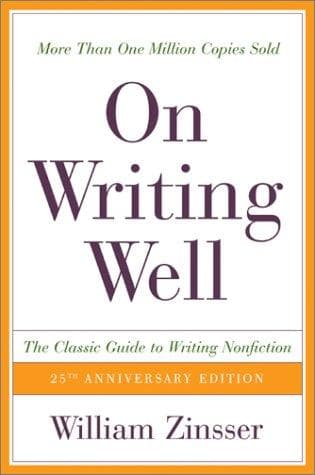
Core Idea
- Writing well is an act of clarity, selection, and revision, not a matter of ornate style or special inspiration.
- Zinsser treats nonfiction as a broad craft that includes memoir, travel, science, business, sports, criticism, and interviews, but insists the same fundamentals govern all of them: simplicity, unity, voice, and trust in real facts.
- His central distinction is not fiction vs. nonfiction but good writing vs. bad writing; good nonfiction is human, specific, and shaped by a writer who has actually thought through what matters.
The Craft of Clear Prose
- The book’s recurring enemy is clutter: pompous language, abstractions, jargon, weak verbs, unnecessary adjectives/adverbs, and fake formality.
- Zinsser repeatedly argues that clear writing comes from clear thinking, and that readers will not work hard to untangle prose that the writer has not made clean.
- He favors active verbs, lean sentence construction, and firm punctuation choices that serve rhythm and meaning rather than display.
- He warns against creeping nounism, passive voice, inflated official language, and “breezy” faux-casual writing, all of which hide the writer’s real voice.
- Revision is the heart of the process: the first draft is usually too long and too fuzzy, and the writer should cut, bracket, reorder, and rewrite until the prose is precise.
- The computer is valuable because it makes rewriting easier, but it also tempts writers to stop too soon and leave in bloated sentences.
Voice, Tone, and the Human Presence
- Zinsser wants nonfiction to retain a real person behind the words, so he urges writers to trust “I” when appropriate and, when not, still preserve “I-ness” instead of hiding behind institutions or passives.
- Every piece should sound like the same writer across subjects; he rejects the idea that a writer should adopt a special persona for baseball, jazz, or any other topic.
- He prizes taste as a writing instinct that knows what to leave out, and he links taste to freshness, restraint, and avoiding clichés.
- Reading aloud is one of his most useful tests because prose has sound, cadence, and musicality; readers “hear” writing in the inner ear.
- He values humor, but only when it feels organic and earned; wit should not become a substitute for content or seriousness.
What Good Nonfiction Looks Like in Practice
- Selection is everything in travel writing and memoir: the writer must decide what matters to the reader and resist dumping the whole experience onto the page.
- For place-writing, he stresses the twin pillars of places and people; vivid settings come alive through exact details and through the human beings who inhabit them.
- He distrusts travelese—syrupy adjectives, personifying clichés, and generic praise like “charming” or “quaint”—because it replaces observation with sentiment.
- Memoir is not autobiography in the grand sense but a shaped corner of life, often built from a few episodes, sensory triggers, and moments of emotional truth.
- He calls memoir “the art of inventing the truth”: the writer rearranges remembered life into a meaningful narrative without betraying its essential reality.
- Interviews succeed when the writer gets people speaking in their own language, then edits fairly; Zinsser praises careful quotation, but rejects fabrication, distortion, and clever quote-tagging.
- In science writing, the major task is sequence: explain one thing at a time, begin with what the reader must know, and use concrete images or analogies to make the unfamiliar visible.
- In business and institutional writing, the writer’s job is to find the missing person behind the jargon, restore the human speaker, and translate abstraction into plain English.
- Sports writing, like the other forms, works when it treats athletes as people rather than as vehicles for jargon, cliché, statistics, or the reporter’s self-display.
- Arts criticism should be specific, informed, and willing to take a stand; it must know the medium well enough to place a work in context and say something exact about it.
Limits, Habits, and Enduring Standards
- Zinsser insists that usage changes, so writers should stay alert to new words and shifting conventions without surrendering to fashionable junk.
- He is flexible about some innovations, but conservative where grammar and precision matter; distinctions such as fortuitous/fortunate, disinterested/uninterested, and infer/imply still matter.
- He treats sexist language as a real prose problem and prefers solutions that remove the gendered pronoun cleanly rather than cluttering the sentence.
- The strongest writing often comes from trusting the material: facts, odd details, and real human color usually beat decorative “feature” writing.
- He repeatedly shows that the best stories are found by following genuine curiosity, asking “What else?” and staying open to the unexpected shape of a subject.
- Across the book, the writer’s real competition is with himself: improve the sentence, sharpen the lead, strengthen the ending, and make each piece truer to its purpose.
What To Take Away
- Write for yourself first, because sincerity is the only reliable route to a voice readers trust.
- Cut until the prose earns its place; most first drafts need far less material and far more revision than the writer wants to admit.
- Use facts, people, and specifics, not abstractions or prepackaged style, to create authority and warmth.
- Aim for precision with life in it: the best nonfiction is plain, disciplined, and unmistakably human.
Generated with GPT-5.4 Mini · prompt 2026-05-11-v6