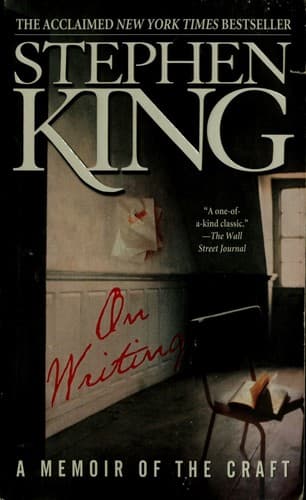
Core Idea
- King treats writing as a craft built from reading, practice, revision, and honesty, not as a mystical gift or prestige performance.
- The book is both memoir and workshop: he uses his own life, successes, failures, and addictions to show how a working writer is formed.
- His central claim is that serious writing is practical work—serious enough to matter, but not sacred, and always grounded in language, clarity, and persistence.
The Writer’s Tools and Materials
- King’s tool metaphor begins with his grandfather’s nested toolbox: a writer needs a portable toolbox of vocabulary, grammar, style, and judgment.
- Vocabulary belongs on the top shelf, but he prefers the right plain word over inflated diction; “tip” is better than “emolument.”
- Grammar matters, but mostly as a working habit absorbed through reading and use; he values nouns and verbs most and allows fragments when they serve the sentence.
- He repeatedly warns against passive voice, overexplaining, and adverbs in dialogue attribution, especially flashy “Swifties” like “said contemptuously.”
- His cleanest attribution rule is simple “said”; he treats ornate tags and verb substitutions as signs of fear or self-consciousness.
- Paragraphs are the basic unit of written life for him: they organize thought, control pace, and can “wake up” prose the way Frankenstein’s monster comes to life.
- He wants prose to transmit a clear image across time and distance, which he calls telepathy: the writer sends, the reader receives and completes the picture.
- That means giving enough detail to orient the reader, but not burying them in inventory; a few strong sensory details usually beat exhaustive description.
How Good Writing Happens
- King insists there are bad writers, competent writers, good writers, and geniuses, and that talent is not purely fixed.
- A competent writer can become good through work and the right tools, but bad writers do not become good simply by wishing harder.
- His non-negotiables are reading and writing a lot; he treats lack of time to read as a sign that there is no real time to write.
- He recommends reading broadly and constantly, including bad books for negative instruction and great books for feel, style, plot, and truth.
- Early imitation is normal: he says he wrote in the voices of Bradbury, Cain, and Lovecraft before developing his own.
- He rejects the idea that writing should wait for the muse; instead, you keep the appointment and work until the “basement guy” shows up.
- His daily practice is disciplined but not romantic: mornings for new pages, a goal of roughly 2,000 words a day, and a draft finished in about three months.
- He calls his best productivity secrets staying healthy and staying married, because stability and a closed door matter more than inspiration.
- His rule “write with the door closed, rewrite with the door open” captures his belief that first drafts should be private and fast, while revision can accept outside judgment.
- He sees stories as found things rather than plotted inventions; plot is useful only as a jackhammer when necessary.
- The real starting point is usually a What-if situation: vampires in a Maine town, a trapped mother and child, a rabid dog, a cop gone berserk.
- He believes fiction works best when characters are treated as people inside their own minds, even villains like Annie Wilkes or Greg Stillson.
- Good dialogue reveals character; bad dialogue sounds written, and profanity is acceptable only when it matches the truth of the voice.
Memoir as Proof: Work, Risk, and Recovery
- King’s childhood stories, early rejections, and amateur publishing show how early obsession, family support, and repeated failure shaped his voice.
- His mother’s encouragement, his brother Dave’s homemade publications, and John Gould’s newspaper lessons all become formative proofs that writing is learned by doing.
- Carrie is his key example of revision and persistence: he nearly abandoned the first draft, Tabby rescued it, and the book taught him not to trust his first judgment about a character.
- The success of Carrie changed his life financially, but the memoir treats that moment as part of craft history, not glamour.
- He is equally blunt about addiction: alcohol, then cocaine and other drugs, nearly destroyed his work and family, and he rejects the myth that substances are necessary to creativity.
- The Shining, The Tommyknockers, and Misery are tied to his addiction experience, which he presents as loss rather than bohemian wisdom.
- Tabby’s intervention forced a choice between self-destruction and family; he frames recovery as choosing marriage and his children over the fantasy of being a writer who needs to be wrecked.
- The 1999 van accident becomes a second rebirth story: near death clarified that writing was something he wanted to return to, not just a profession to resume.
- Recovery after the accident reinforces his thesis that writing can help you “get up, get well, and get over” suffering.
What To Take Away
- Writing is craft before it is mystique: learn the tools, use them plainly, and keep improving them.
- Reading is not optional: it is the training ground where style, judgment, and ambition are formed.
- Revision is where the real work happens: the first draft gets the story down; the second draft removes what does not belong.
- The point is not fame or self-dramatization: for King, writing matters because it is a way back to life, and “the water is free.”
Generated with GPT-5.4 Mini · prompt 2026-05-11-v6