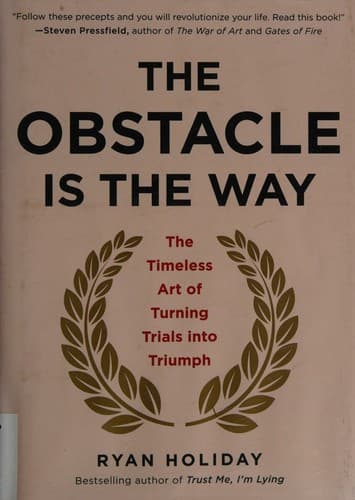
Core Idea
- The book’s central claim is Marcus Aurelius’s maxim: “The impediment to action advances action. What stands in the way becomes the way.”
- Holiday argues that obstacles are not just things to survive; with the right stance, they can become the raw material for progress, leverage, and even advantage.
- His method is a Stoic one, but explicitly pragmatic: not optimism, denial, or abstract philosophy, but a way to turn setbacks into action.
The Three Disciplines
- The book is organized around three interdependent disciplines: Perception, Action, and Will.
- Perception means seeing events clearly, without panic, prejudice, or the stories we immediately attach to them.
- Action means doing the work, deliberately and creatively, instead of waiting for circumstances to improve.
- Will means enduring what cannot be changed, preserving inner freedom, and finding meaning when control is limited or gone.
Perception: See Things Clearly
- The first task is to separate the objective event from the subjective judgment: “This happened” is not the same as “this is bad.”
- Holiday repeatedly stresses that what hurts us most is often not the obstacle itself but our interpretation of it.
- Rockefeller in the Panic of 1857 is the model of calm perception: while others panicked, he stayed objective and saw opportunity in chaos.
- Rubin “Hurricane” Carter shows the Stoic split between power and powerlessness: even in prison, he retained control over attitude, choices, and self-command.
- Laura Ingalls Wilder’s response to hardship shows the same point: the same conditions can be framed as catastrophe or as adventure.
- The book emphasizes emotional discipline, including apatheia as calm equanimity rather than numbness.
- “Steady your nerves” means remaining cool under stress, not merely feeling brave in theory.
- The goal is to alter your perspective by changing context and framing, as when Pericles calmed his men by changing how they understood the eclipse.
- Holiday’s recurring Stoic question is: Is it up to you? Focus energy on what is in your power—judgment, attitude, desire, decision, and response.
- Steve Jobs’s “reality distortion field” is used as a more aggressive version of this: refuse the narrow frame of “it can’t be done.”
- The discipline of perception culminates in seeing the obstacle as a possible opening, not merely a threat.
Action: Move, Persist, Adapt
- Once reality is seen clearly, the response is not hesitation but action, and the book treats motion as the antidote to fear and self-pity.
- Demosthenes is the model of disciplined effort: through relentless training and repetition, he overcame poverty and a speech impediment.
- Holiday’s action principle is simple: obstacles do not remove themselves, and they do not care about our intentions.
- Get moving means starting anywhere and using momentum; Amelia Earhart’s career is presented as an example of saying yes to a risky opening and then going.
- Persistence is more than stubbornness: Grant at Vicksburg kept trying until he found an unconventional route, and Edison’s many filament tests become a story about persistence as genius.
- Iterate means failing cheaply, learning quickly, and not being embarrassed by small losses; startups illustrate this through the Minimum Viable Product.
- Follow the process means reducing huge goals to the next drill, the next task, the next rep; Nick Saban’s program embodies this approach.
- Do your job, do it right insists that humble work matters because every task is part of the answer life demands from us.
- What’s right is what works captures the book’s pragmatism: the point is not purity, but effectiveness.
- The book praises the flank attack over the head-on clash; the best campaign is often indirect, leverage-based, and aimed at the enemy’s blind spot.
- Washington, Gandhi, and Martin Luther King Jr. are used to show that sometimes resistance is best answered by withdrawal, noncooperation, or redirecting the opponent’s energy against itself.
- Holiday also argues for channeling energy rather than expressing it emotionally; Arthur Ashe and Joe Louis turned restraint and external pressure into controlled force.
- Crises can be used offensively: Obama’s response to the Jeremiah Wright controversy and Rahm Emanuel’s “never let a serious crisis go to waste” exemplify seizing the moment.
- The deepest action lesson is that restraint can be action too: standing still, moving sideways, or going around may be smarter than forcing straight ahead.
Will: Endure, Accept, Love Fate
- The third discipline begins where action ends: when outcomes remain outside our control, we need will.
- Lincoln is the key example of suffering transmuted into strength; his losses, depression, and hardship helped form patience, humor, and endurance.
- The checklist of will includes accept what cannot change, manage expectations, persevere, love fate, protect the inner self, submit to a larger cause, and remember mortality.
- Roosevelt’s “Inner Citadel” is built through preparation before crisis, not discovered after it arrives.
- Holiday uses the idea of premeditatio malorum and modern premortem thinking to show that mentally rehearsing setbacks reduces surprise and strengthens readiness.
- Acquiescence is not passivity in general; it is consent to necessity when an external fact cannot be changed.
- The book repeatedly returns to people who converted constraint into capability: Jefferson’s speech impediment, Edison’s deafness, Helen Keller’s disabilities, and Phil Jackson’s injured hip.
- Amor fati is stronger than acceptance: not just enduring fate, but loving it because whatever happened is now the material to work with.
- Edison’s factory fire is the emblematic example; he treated the loss as something to rebuild from, not something to sentimentalize.
- Jack Johnson’s smiling defiance under abuse shows that cheerfulness itself can be a weapon against humiliation and intimidation.
- Perseverance is framed as bigger than persistence: Odysseus, Churchill’s KBO (“Keep Buggering On”), and the line about “behind mountains are more mountains” all stress long-term staying power.
- The highest form of will is to act for something bigger than yourself; Stockdale, McCain, and Rollins show how unity, duty, and service shrink fear.
- Memento mori is not morbidity but focus: remembering death clarifies priorities and makes urgency rational.
- The closing Marcus Aurelius example shows the ideal Stoic pattern: respond calmly, act decisively, forgive when possible, and do not let events dictate your inner state.
What To Take Away
- The book’s recurring formula is see clearly, act boldly, endure deeply.
- Obstacles are not presented as inherently good; they become useful when perception, action, or will transforms them into something workable.
- The method is Stoic, but Holiday’s emphasis is practical: philosophy matters only if it helps under pressure.
- The final message is that what blocks the path can become the path, and the right response to hardship is not collapse but conversion.
Generated with GPT-5.4 Mini · prompt 2026-05-11-v6