Core Idea
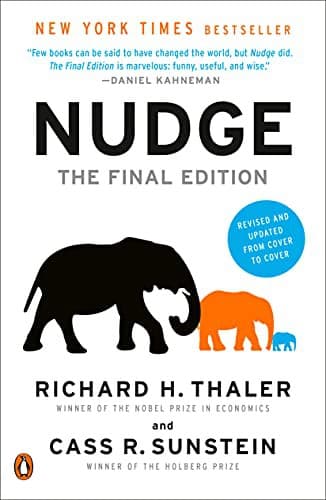
- Nudge argues for libertarian paternalism: preserve freedom of choice while deliberately shaping choice architecture so people are more likely to choose what they themselves would prefer under full information, attention, and self-control.
- A nudge changes behavior predictably without banning options or materially changing incentives; because choice architecture is inevitable, the real question is not whether to nudge but how to design defaults, displays, and frictions well.
- The final edition updates the original with new material on smart disclosure, sludge, personalized defaults, climate, finance, and COVID, while reaffirming the authors’ commitment to freedom of choice and their rejection of presumed consent for organ donation.
How Humans Actually Choose
- The book’s central behavioral distinction is Econs vs. Humans: Econs are frictionless optimizers, while Humans are distracted, biased, inconsistent, and often poor at rare, delayed, or hard-to-learn decisions.
- Thaler and Sunstein emphasize that people do best in familiar, high-feedback settings and worst in choices like retirement saving, mortgages, medical care, and insurance, where errors are easy and learning is slow.
- Their recurring heuristics are anchoring, availability, representativeness, optimism/overconfidence, loss aversion, status quo bias, framing, and the split between Automatic and Reflective systems.
- They illustrate these with classic examples: the Linda problem, mug experiments, planning fallacy, tip-screen anchors, gun-risk availability, and the power of loss-framed vs. gain-framed messages.
- The core policy implication is not that people are irrational in every domain, but that predictable mistakes are common enough to justify smart design, especially where attention is scarce and feedback is weak.
Better Design: Make It Easy, Make It Fun, Avoid Sludge
- Good design follows stimulus-response compatibility: the cue should point to the correct action, as in door handles, the Stroop effect, road markings, or a circled map to a health clinic.
- The authors repeatedly stress “make it easy”: small frictions can derail desired behavior, while simple prompts, reminders, checklists, and forcing functions can produce large gains.
- Defaults are one of the strongest nudges because people often stick with the status quo; the book notes that opt-out designs can raise participation sharply, but defaults are not universal fixes and can be rejected when obviously bad.
- The authors distinguish required choice, active choosing, and default-based systems, using them selectively when inertia or manipulation is a concern.
- They also develop smart disclosure: standardized, machine-readable, timely information that lets consumers and software compare complex products more effectively.
- A related design principle is curation: sometimes the answer is not more options but better filtering, sorting, and presentation.
- Another is make it fun: play, lotteries, and gamified incentives can outperform tiny cash payments because people overweight salient chances and enjoy the process.
- The book’s dark mirror is sludge: hidden forms, cancellation hurdles, long waits, confusing websites, and other frictions that make it hard to do what people want to do.
- The sludge examples are central: rebate redemption, subscription traps, paperwork-heavy benefits systems, cookie consent screens, and college aid forms all show how institutions can profit from friction.
- The authors argue that competition often fails to eliminate sludge because firms can make money from inattention, inertia, and hard-to-cancel services.
Self-Control, Social Influence, and Major Policy Domains
- Self-control is modeled as a conflict between a farsighted Planner and a myopic Doer; tools like commitment devices, automatic saving, self-exclusion lists, and even daylight saving time can help the Planner win.
- Mental accounting is treated as a useful internal commitment device: people put money in separate jars or accounts, which can support budgeting even though it violates strict fungibility.
- Social influence operates through information and peer pressure; people are highly responsive to what others do, what others approve of, and what they think others think.
- The book uses social cascades to explain trends in music, politics, norms, and panics, including conformity experiments, pluralistic ignorance, and the spread of false beliefs.
- Because visible behavior shapes behavior, norm messages can be powerful and cheap; examples include tax letters saying “nine out of ten people pay on time,” towel-reuse messages based on provincial norms, and identity-based campaigns like “Don’t Mess with Texas!”
- On retirement and insurance, the authors warn against default drift and low-value complexity while favoring standardized options, reminders, and high deductibles when losses are small and rare.
- Credit cards, mortgages, health plans, and insurance are recurring examples of markets that are useful but psychologically dangerous because features are shrouded, choices are hard to compare, and firms often profit from bad decisions rather than good ones.
- Their preferred remedies combine disclosure, standardization, defaults, and automated helpers such as user engines, since advice alone is often too weak against confusion and procrastination.
- On organ donation, the authors prefer prompted choice and easier registration over presumed consent or routine removal, partly because family decisions and true wishes are more complex than default theory suggests.
- On climate change, nudges are helpful but insufficient: the problem is a collective-action failure that also requires taxes, cap-and-trade, standards, disclosure, defaults, and coordinated international pressure.
- They favor combining behavioral tools with incentives, including carbon taxes, Green More Tomorrow price paths, energy-efficiency standards, green defaults, and norm feedback.
What To Take Away
- The book’s deepest claim is that design is policy: once you accept that no choice environment is neutral, the question becomes whether you will shape it carelessly, manipulatively, or intelligently.
- Defaults, friction, framing, and social proof are not minor details; they often determine whether people save, enroll, comply, donate, or quit.
- Nudges work best where decisions are hard, infrequent, delayed, or poorly learned, but they should be paired with an explicit check for sludge and with respect for real autonomy.
- The final edition’s larger message is pragmatic: good institutions do not assume ideal choosers; they build systems that are easier, clearer, and more humane for actual Humans.
Generated with GPT-5.4 Mini · prompt 2026-05-11-v6