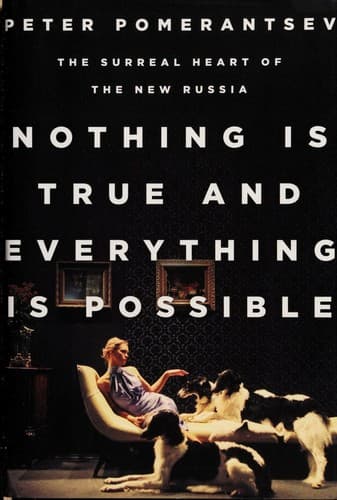
Core Idea
- Russia in the 2000s is depicted as a postmodern dictatorship: reality is turned into performance, truth into perspective, and politics into managed entertainment.
- The Kremlin does not simply censor; it creates a whole simulated public sphere through television, staged opposition, selective enemies, and theatrical legality.
- Pomerantsev’s central claim is that in this system, money, media, crime, ideology, and identity all become interchangeable costumes, and people learn to survive by acting within the script.
How the System Works
- Television is the key instrument of rule across Russia’s vast geography, and after Putin’s rise it becomes a tool for manufacturing consent, rewriting history, and selecting the enemy of the week.
- The state blends Soviet control with Western-style entertainment, so channels like TNT can offer glossy “freedom” while maintaining complete freedom for complete silence on politics.
- Putin himself is a media product: soldier, lover, hunter, businessman, spy, tsar, superman; the news functions like incense blessing his actions.
- Vladislav Surkov is the architect of this order, managing parties, NGOs, opposition, and TV so that every ideology is occupied and no autonomous political space survives.
- Surkovian language—“stability,” “managed democracy,” “conservative modernisation,” “effective manager”—is presented as empty but powerful, shaping what feels possible more than what is literally true.
- The regime also learns to imitate pluralism: independent-looking companies, tax raids, bribes, and paperwork all become part of a ritualized legality that masks control.
Money, Performance, and the New Elite
- Moscow’s boom economy produces a city of Maybachs, neon, skyscrapers, and sudden wealth, where gangsters become artists and identities are fluid.
- The book treats this world as a culture of performance rather than authenticity, a condition Pomerantsev first mistook for freedom and later sees as delirium.
- Gold-digger academies, mistress economies, and “sponsors” turn relationships into explicit markets; women are taught tactics for extracting gifts and status from rich men.
- Characters like Oliona show both the glamour and brutality of this world: staged apartments, transactional survival, and hidden histories of kidnapping and rape.
- The rise of fatherlessness becomes a recurring motif, with the president imagined as a kind of sugar daddy/protector figure standing in for absent men.
- Gangster culture and state culture mirror each other: former criminals become filmmakers or local authorities, while Kremlin imagery makes Putin look like a mob boss.
- The new elite is self-consciously theatrical, from hyper-designed parties to style-driven reinvention, yet many of them remain anxious, rootless, and drawn to London as a place where words and rules still mean something.
Reality, Abuse, and the Collapse of Meaning
- The book repeatedly shows how Russian power works through short circuits in meaning: words detach from objects, and official reality can simply reverse what happened.
- Yana Yakovleva’s arrest over diethyl ether shows this mechanism clearly: a normal industrial chemical is reclassified as a narcotic, and bureaucracy turns into outright absurdity.
- Arrest, court, and prison are staged as routine theater; the accused are processed like parcels, judges repeat prosecutors, and cruelty is rendered ordinary.
- Yet publicity can sometimes break the script: Yana’s case becomes visible through media and protest, exposing how elite clan warfare can drive “anti-corruption” enforcement.
- The struggle between Cherkesov and Patrushev shows that state institutions are also weapons in internal Chekist conflict, and rivals can destroy each other before the president discards both.
- Moscow itself becomes a record of regime change: old buildings are demolished, fake-historic replacements rise, and architecture turns into a multiple-personality city where memory is constantly erased.
- Activists staging funerals for demolished buildings treat Old Moscow as a time machine, because the city’s courtyards and alleys preserve traces of a more real past than the glossy new constructions.
Bodies, Identity, and Manufactured Belief
- Ruslana Korshunova’s story shows how beauty, modeling, and aspiration can erase identity: girls become images, live under comparison, and learn to perform themselves.
- Her death is surrounded by rumor, but the book emphasizes the emotional and social machinery around her life: loneliness, heartbreak, and the pressure to become a perfect image.
- A major thread is the Rose of the World self-help organization, which uses coercive group techniques, sleep disruption, confession, repetition, and emotional flooding to produce dependence.
- The Rose’s language of “transformation,” “effectiveness,” and “taking responsibility” mirrors Kremlin-style emotional management, turning suffering into self-blame.
- Participants often leave euphoric and bonded, then crash into depression, obsession, and confusion; the text treats this as a manipulative technology rather than genuine self-improvement.
- The author links this to a wider culture in which TV, mysticism, psychoanalysis, and politics all blur together, making belief itself a managed commodity.
- Even “real” reality TV fails because audiences have been trained by scripted reality to distrust authenticity; Russians no longer automatically believe what is presented as spontaneous.
- The same logic appears in foreign-facing propaganda such as RT, which sells a “Russian point of view” as if truth were merely perspective.
What To Take Away
- The book’s core vision is that post-Soviet Russia is not simply authoritarian; it is simulated, with power operating through performance, media, and managed contradictions.
- Pomerantsev argues that truth loses force when institutions, television, and money all reward the same flexibility of self-presentation.
- Many apparently separate worlds—oligarch wealth, gangster culture, self-help cults, development aid, journalism, and state television—are shown to belong to one system of PR over reality.
- The final mood is not just Russian despair but an export warning: the logic of offshore money, image-management, and elite self-censorship has begun to travel west, especially into London.
Generated with GPT-5.4 Mini · prompt 2026-05-11-v6