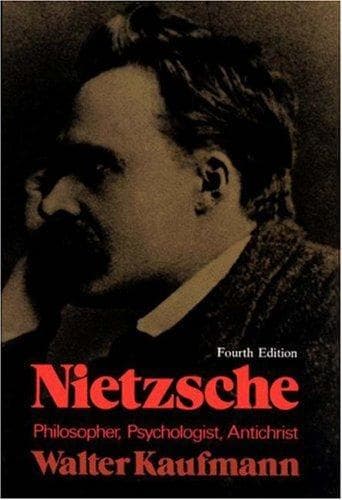
Core Idea
- Kaufmann’s central aim is to destroy the posthumous “Nietzsche legend”: the caricature of Nietzsche as incoherent, anti-Semitic, proto-Nazi, or a thinker of brute domination.
- He argues that Nietzsche is best read as a serious philosopher of self-overcoming, sublimation, and value-creation, not as a writer of random aphorisms or a theorist of race and power politics.
- The book’s recurring method is to privilege published works, historical development, and context over isolated notebook fragments and tendentious anthologies like The Will to Power.
Nietzsche’s Method, Style, and Development
- Nietzsche’s aphoristic style is not sloppiness but a philosophical method: each aphorism is a thought experiment or Versuch that tests possibilities from multiple angles.
- Kaufmann insists Nietzsche is a problem-thinker, not a system-builder; he rejects grand systems while still pursuing determinate problems and answers.
- Nietzsche’s “anti-system” stance does not mean incoherence: the apparent discontinuity of the books is “more apparent than real” because the experiments cohere existentially.
- The mature Nietzsche begins from nihilism—the collapse of inherited values after “God is dead”—and asks whether values can survive without supernatural sanction.
- His critique of Christianity is aimed less at the historical Jesus than at Pauline Christianity, the moralized God-concept, and the cultural consequences of that worldview.
- Kaufmann repeatedly stresses that Nietzsche does not reject truth as such; he opposes dogmatic systems that stop inquiry and calls truth itself “divine.”
Will to Power, Sublimation, and Revaluation
- Nietzsche’s will to power is not mainly a political doctrine but a psychological and cultural hypothesis about life as self-expansion, self-mastery, and creative force.
- Kaufmann distinguishes power from the will to power: the latter can be crude or ruthless, while genuine power is disciplined, rational, and self-transforming.
- The highest form of power is reason or Geist, because it organizes inner chaos, forecasts consequences, and masters the self rather than merely others.
- Sublimation is central: impulses are not destroyed or castrated but redirected into higher forms such as art, thought, style, discipline, and love.
- This is why Nietzsche can criticize Christianity for extirpating passion while still valuing a transformed, spiritualized sensuality.
- Nietzsche’s revaluation of all values is not a neat new moral code; it is an internal critique that exposes the hypocrisy, self-contradiction, and exhaustion of current valuations.
- The hammer in Twilight of the Idols is a tuning fork: it tests whether idols are hollow, not a symbol of simple destruction.
- Nietzsche’s late project was planned in four books—Antichrist, Free Spirit, Immoralist, Dionysus—but Kaufmann treats these mainly as critical and transitional, not as a finished system.
Self-Realization, Culture, and Politics
- Across the early and middle works, Nietzsche’s deepest ethic is become who you are: realize the “true self” rather than the merely empirical ego.
- Culture means overcoming the split between inner and outer life, and the main enemies are fear, laziness, conformity, and the pressure of the State.
- Kaufmann reads Schopenhauer as Educator as a symbolic self-portrait: Nietzsche uses Schopenhauer, Goethe, and others as supra-historical models for self-formation.
- Nietzsche is strongly anti-statist and suspicious of mass politics, but not in a simple anarchist or liberal sense; he attacks both liberal and totalitarian forms of political idolatry.
- The target of his critique is the mass, the mediocre, and the herd, not “humanity” as such.
- His hostility to nationalism, the German Reich, and party life is inseparable from his ideal of the single one who works out a self-perfected life.
- Kaufmann emphasizes that Nietzsche’s critique of “breeding,” rank, and nobility is about spiritual and cultural inheritance, not biological racism.
Overman, Eternal Recurrence, and Nietzsche’s Real Legacy
- The Übermensch is not a super-race or biological ideal but a type of higher self-overcoming, tied to discipline, wholeness, and creative strength.
- Kaufmann traces the term’s history and insists Nietzsche’s overman is closer to Goethe than to Napoleon or Hitler.
- The overman and eternal recurrence belong together: the overman makes the recurrence bearable because he can affirm existence so completely that he wills its endless repetition.
- Eternal recurrence is treated as both an existential test and a speculative cosmological hypothesis; its deepest function is to sharpen amor fati, the willingness to want nothing otherwise.
- Nietzsche’s late anti-Darwinian remarks are meant to deny progress as a law of life: higher types are rare, fragile, and not the endpoint of species evolution.
- Kaufmann’s final verdict is that Nietzsche should be judged by the philosophical coherence and seriousness of these ideas, not by the insanity of his last years or by the editorial manipulations that followed.
What To Take Away
- Nietzsche, as Kaufmann reads him, is a thinker of self-overcoming, not domination.
- The book’s main enemy is the distorted Nietzsche created by bad editing, bad translations, and ideological appropriation.
- Nietzsche’s key concepts—will to power, sublimation, revaluation, overman, eternal recurrence—form an interconnected attempt to answer nihilism after the death of God.
- Kaufmann’s larger lesson is methodological: read Nietzsche historically, comparatively, and in context, or his aphorisms will be turned into whatever the interpreter already wants to find.
Generated with GPT-5.4 Mini · prompt 2026-05-11-v6