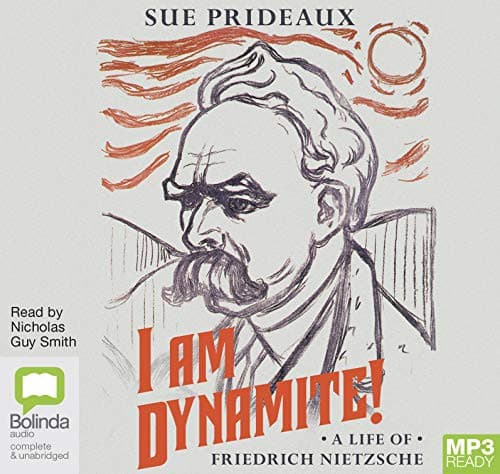
Core Idea
- The book presents Nietzsche as a thinker whose life, illness, friendships, loves, and breakdowns are inseparable from his philosophy.
- Its central claim is that Nietzsche’s major ideas — Apollonian/Dionysian, death of God, will to power, eternal recurrence, amor fati, and the Übermensch — emerge from concrete crises of body, culture, and relationship.
- It also shows how Nietzsche was repeatedly misunderstood, first by Wagner and his circle, then by family, publishers, and finally by later political appropriators who turned him into something close to an anti-Nietzsche.
Nietzsche’s Formation: Music, Suffering, and Wagner
- Nietzsche’s childhood is framed as musical, solitary, pious, and physically fragile, with early grief over his father’s death shaping his sense of himself as a continuation of the dead father.
- His schooling at Schulpforta combined classical rigor with illness, but also produced his early independence, literary ambition, and fascination with Hölderlin, Empedocles, and tragic madness.
- The first great adult turning point is his encounter with Richard Wagner and Schopenhauer: Wagner’s music seemed to reveal being itself, while Schopenhauer gave Nietzsche a metaphysics of suffering, fragmentation, and world-as-will.
- Tribschen becomes the symbolic center of this period: an artistic, quasi-sacral space where Nietzsche is absorbed into Wagner’s world of operatic totality, royal myth, and nationalist fantasy.
- The relationship later breaks as Nietzsche recoils from Wagner’s anti-Semitism, Francophobia, Christianity in Parsifal, and the self-serving politics around Bayreuth.
How the Early Philosophy Works
- The Birth of Tragedy is not just Wagnerian enthusiasm but a theory of culture built on the tension between Apollo and Dionysus.
- The Apollonian stands for form, dream, individuality, image, measure, and representation; the Dionysian stands for intoxication, music, ecstasy, self-loss, and the collapse of individuality.
- Greek tragedy is presented as the historic fusion of these forces, especially through the chorus, while modern culture is criticized for dissolving myth into cold explanation.
- Nietzsche attacks Socratic rationalism as the force that destroys tragedy by making knowledge, science, and “naturalness” into idols.
- He repeatedly treats modern scholarship as book-dust, utility, and lifeless pedantry, and opposes to it the possibility of art, myth, and a fuller culture.
- Schopenhauer and Wagner initially serve as the modern figures who might reopen the gate to tragedy, though Nietzsche later abandons both.
Break with Wagner, Free Spirits, and New Methods
- Illness becomes philosophically productive: Nietzsche’s headaches, eye strain, and exhaustion force him into dictation, aphorism, and shorter forms.
- In Human, All Too Human, Daybreak, and The Gay Science, he turns toward psychology, naturalism, and genealogy, breaking with metaphysics and with Wagnerian-Schopenhauerian certainty.
- Paul Rée strongly influences this shift toward an anti-metaphysical, evolutionary, and aphoristic style.
- The “free spirits” are people who can live without final truths, tolerate uncertainty, and keep thinking after the collapse of inherited religion and morality.
- God is dead is the key diagnostic claim: not a slogan of liberation, but the recognition that Christian morality and its “shadow” continue to structure modern life long after belief has gone.
- Nietzsche’s conversations with Lou Salomé are crucial here; she becomes an intellectual partner, a possible co-thinker, and a mirror for his attempt to move beyond solitude.
- Their triangle with Rée ends in emotional disaster, but it helps crystallize Nietzsche’s thinking about masks, friendship, self-becoming, and the need to say yes to necessity.
Mature Philosophy and the Final Years
- In Zarathustra, Nietzsche creates a prophetic figure who descends from solitude to teach eternal recurrence, the Übermensch, and amor fati.
- Eternal recurrence is both a metaphysical thought experiment and an existential test: can one affirm every moment as if it had to return forever?
- Amor fati becomes Nietzsche’s formula for greatness: not resignation, but loving what is necessary and transforming pain into affirmation.
- Beyond Good and Evil and On the Genealogy of Morality attack philosophy as disguised prejudice, argue that truth is perspectival, and trace morality to ressentiment, punishment, and the inward turn of repressed instincts.
- He presents Christianity as a slave morality that glorifies weakness while denying life, and contrasts it with a harsher, more affirmative vision of self-overcoming.
- Late works like The Case of Wagner, Twilight of the Idols, and The Anti-Christ sharpen the attack on Wagner, Christianity, pity, and systems, while preserving Nietzsche’s admiration for strength, style, and selective greatness.
- Ecce Homo turns autobiography into self-mythology, with chapters like “Why I am so Wise” and “Why I am a Destiny,” and culminates in “I am not a man, I am dynamite,” meaning destructive critique of inherited values.
Breakdown, Archive, and Afterlife
- Nietzsche’s mental collapse in Turin is narrated carefully as a medical and interpretive problem, not a simple morality tale: the book emphasizes the uncertainty around diagnosis and the mixed evidence of contemporaries.
- After the breakdown, Elisabeth Förster-Nietzsche takes control of his papers, image, and reputation, turning the archive into a shrine and reshaping him into a nationalist monument.
- The posthumous Nietzsche is repeatedly distorted: The Will to Power is assembled from notes as if it were a masterwork, and later readers, especially Nazis, selectively used him for their own purposes.
- The book stresses that Nietzsche was not a fascist theorist; his anti-state, anti-nationalist, anti-anti-Semitic, anti-system stance is repeatedly at odds with the uses made of him.
- Figures like Georg Brandes, Harry Kessler, Meta von Salis, Dostoevsky, and Strindberg show how Nietzsche first spread through cosmopolitan, avant-garde, and radical circles before being nationalized and misused.
What To Take Away
- Nietzsche’s thought is presented as inseparable from his body, friendships, loves, and recurring breakdowns.
- His big ideas are not abstract slogans but responses to the collapse of religion, Wagnerian art, modern science, and bourgeois culture.
- The book’s strongest warning is historical: Nietzsche’s language is easy to monumentalize, but his actual project is anti-systematic, anti-nationalist, and aimed at the difficult work of self-overcoming.
- His challenge remains open because he refuses to supply a final answer; the reader must decide whether to negate life, endure it, or affirm it.
Generated with GPT-5.4 Mini · prompt 2026-05-11-v6